Author: JobsReach Team

  • B1/B2 Aircraft Engineer Jobs in the Netherlands (2026): Why Demand Is Surging

    In 2026, licensed B1 and B2 aircraft engineers are among the most sought-after professionals in the Dutch aviation sector. With fleet modernization, busy operations at Amsterdam Airport Schiphol and expanding MRO facilities, demand for certified engineers continues to grow.

    If you are exploring B1/B2 aircraft engineer opportunities in the Netherlands, this guide explains why the market is booming, which aircraft types are most in demand, and what professionals need to know to stay competitive.

    EASA B1 B2 Engineer

    Why B1 B2 Aircraft Engineer Jobs in the Netherlands Are Increasing in 2026

    The Netherlands is one of Europe’s most strategically important aviation markets.

    At the center of activity is Schiphol Airport, supporting:

    • Short-haul and long-haul passenger operations
    • Cargo and logistics operations
    • Line and base maintenance operations
    • Technical services and ground handling

    All aircraft maintenance and certification require EASA Part-66 licensed engineers, making B1 and B2 professionals essential to keeping fleets operational.

    Major Employers Driving Demand

    Several organizations create strong demand for licensed engineers:

    B1/B2 Aircraft Engineer Jobs at KLM

    Operating a mixed fleet of narrow-body and wide-body aircraft across Europe and intercontinental routes.

    KLM Engineering & Maintenance

    A leading MRO provider supporting both KLM and third-party operators.

    B2 Avionics Engineer Roles at Transavia

    A growing short-haul fleet requiring continuous line and base maintenance.

    These organizations create ongoing opportunities for engineers with active type ratings and recent CRS experience.


    Most In-Demand Aircraft Types for EASA B1 B2 Engineers

    In 2026, engineers with experience or type ratings on the following aircraft are highly competitive:

    • Boeing 737
    • Boeing 787
    • Airbus A320

    B2 avionics engineers are increasingly important due to digital systems, predictive maintenance, and advanced flight management tools.


    Latest Aviation Trends in the Netherlands (2026)

    Understanding market trends is crucial for career planning. Key trends include:

    • Fleet Modernization – Newer Airbus and Boeing models increase demand for certified engineers.
    • Digitalization – Advanced avionics and predictive maintenance technologies are reshaping maintenance operations.
    • MRO Expansion – Line and base maintenance facilities are growing to support larger fleets.
    • Cross-Border Mobility – EU recognition of EASA licenses allows engineers to work in multiple countries.
    • Sustainability Initiatives – Green aviation programs and alternative fuel projects are creating new technical roles.

    Salary and Career Outlook

    B1/B2 engineers in the Netherlands enjoy:

    • Competitive EU-level salaries
    • Shift allowances and pension benefits
    • Contractor flexibility and rotation opportunities
    • Premium rates for multi-type rated engineers

    Ongoing fleet growth and regulatory requirements ensure sustained demand for certified professionals in 2026.


    How JobsReach Aviation Supports Aviation Professionals

    While JobsReach Aviation is building its platform, it is designed for all aviation professionals, including engineers, technical staff and operations specialists.

    Key features include:

    • Connect with Other Aviation Professionals – Network with peers, share insights, and stay updated on career opportunities.
    • Stay Informed on Latest Trends – Access analysis of fleet modernization, digitalization, MRO expansion, and emerging roles in aviation.
    • Career Guidance – Learn how to position yourself for competitive roles, maintain certifications, and track market demand.

    Even if you’re focused on B1/B2 engineering roles, JobsReach Aviation provides valuable information and networking opportunities across the aviation industry.


    Final Thoughts

    The Netherlands remains one of Europe’s strongest markets for licensed B1 and B2 aircraft engineers in 2026.

    Fleet modernization, operational growth and MRO expansion ensure ongoing opportunities for certified engineers.

    By leveraging JobsReach Aviation, aviation professionals can stay informed about market trends, connect with peers, and prepare for upcoming opportunities across the Dutch and European aviation sectors.

    To learn more about the Europe Aviation Career Roadmap 2026, check out this article.

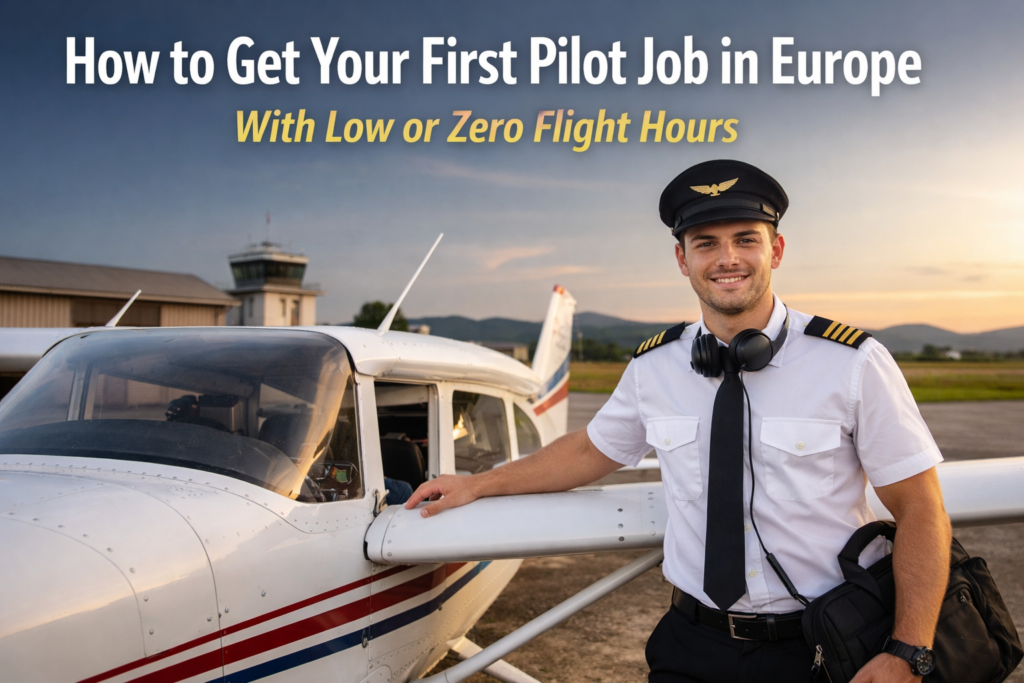
  • How to Get Your First Pilot Job in Europe with Low or Zero Flight Hours

    Getting your first pilot job in Europe is often the hardest step in an aviation career especially if you’re a newly graduated pilot with low or zero flight hours. Most job listings demand experience you don’t yet have, creating a frustrating cycle.

    The good news is that many pilots before you faced the same problem and still succeeded. This guide focuses on practical, realistic ways to break into the European aviation market with minimal experience.

    Why Getting Your First Pilot Job in Europe Is So Difficult

    Europe has one of the most regulated aviation environments in the world. Operators prefer pilots who:

    • Are familiar with EASA regulations
    • Require minimal additional training
    • Already have real operational experience

    As a low-hour graduate, your main objective is simple:
    build credible flight experience as efficiently as possible.

    Flight Instructor: The Fastest Way to Build Flight Hours

    Becoming a flight instructor is the most common first job for low-hour pilots in Europe.

    Why flight instruction works:

    • You accumulate flight hours quickly
    • You improve decision-making and procedural discipline
    • Instructor experience is highly respected by airlines
    • You earn income while flying

    Even if instruction isn’t your long-term goal, it is often the most reliable stepping stone toward commercial or airline flying.

    Entry-Level Pilot Jobs That Accept Low Hours

    Not all pilot jobs require thousands of hours. Some entry-level flying jobs in Europe are accessible to new graduates:

    • Tourist and sightseeing flights
    • Aerial photography and survey flying
    • Agricultural or utility flying
    • Pipeline or powerline patrols

    These jobs may be seasonal or location-specific, but they provide valuable operational experience and help you move beyond zero hours.

    Small Airlines and Regional Operators in Europe

    Major airlines rarely hire low-hour pilots directly.
    However, small and regional operators are often more flexible.

    How to improve your chances:

    • Be willing to relocate anywhere in Europe
    • Apply directly to operators, not only job portals
    • Look for airlines offering mentorship or type-rating support

    Many airline captains today started their careers with small regional companies.

    Cadet Programs and Graduate Pilot Schemes

    Several European airlines and flight schools offer cadet programs designed specifically for newly licensed pilots.

    These programs often include:

    • Structured training and mentoring
    • A defined path to employment
    • Lower initial flight-hour requirements

    Cadet programs are competitive, but they remain one of the best entry points for low-hour pilots in Europe.

    Trained Outside Europe? Start License Conversion Early

    If you completed your training outside Europe, you must convert your license to EASA standards before working commercially.

    Typical requirements:

    • EASA theoretical knowledge exams
    • Skill test or simulator assessment
    • Possible additional flight training
    • Costs of approximately €10,000–€20,000
    • Timeline of 3–12 months

    Starting the conversion early significantly increases your job options.

    Networking: The Hidden Pilot Job Market

    Many first pilot jobs are never publicly advertised.

    Effective networking includes:

    • Staying in contact with instructors and examiners
    • Attending aviation expos and job fairs
    • Connecting with pilots and recruiters on LinkedIn
    • Joining European aviation forums and clubs

    In many cases, a strong recommendation matters more than total flight hours.

    Alternative Ways to Gain Aviation Experience

    If flying jobs are limited at first, consider staying active within aviation:

    • Simulator or ground school instruction
    • UAV / drone operations
    • Dispatch or operational roles with flying companies

    These positions keep you close to flying opportunities and strengthen your professional profile.

    Key Takeaways for Low-Hour Pilot Graduates

    • Flight instruction is the fastest way to build hours
    • Entry-level and niche jobs provide valuable experience
    • Small airlines are more open to low-hour pilots
    • Cadet programs offer structured entry into aviation
    • Networking is essential in the European job market
    • Every flight hour matters, especially early on

    Final Thoughts

    Getting your first pilot job in Europe with low or zero flight hours is challenging but absolutely achievable. Success depends on flexibility, persistence, and smart career planning. Your first job doesn’t define your entire career, but it does open the door. Once you start flying, opportunities expand quickly.

    If you’d like to explore more pilot career opportunities, take a look at the article below.

    https://blogs.jobsreach.net/opportunities-for-pilots/

  • The Ultimate Guide to the COMPASS Test: Everything Aspiring Pilots Need to Know (EPST Phase 1 & Beyond)

    COMPASS pilot aptitude test overview for flight school applicants

    If you’re aiming to join a flight school or an airline cadet program, you will almost certainly encounter the COMPASS test one of the aviation industry’s leading pilot aptitude assessments.
    Despite its importance, many applicants feel unsure about what the test actually includes, how to prepare, and what the different modules truly measure.

    This guide gives you one complete overview of the COMPASS test, including:

    • All modules explained clearly
    • What each section measures
    • Examples
    • Preparation tips
    • EPST-specific insights

    Whether you’re applying to EPST Phase 1, CAE, FTE Jerez, or any school using COMPASS, this article will help you prepare with confidence.

     What Is the COMPASS Test?

    COMPASS stands for Computerized Pilot Aptitude Screening System.
    It is a computer-based assessment designed to measure a candidate’s pilot potential not aviation knowledge or flying experience.

    It evaluates whether you have the native cognitive and coordination abilities required for flight training.

    The COMPASS Test Measures: Hand eye foot coordination, Multitasking ability, Mental arithmetic, Short-term memory, Spatial orientation, English skills & Reaction time.

    These abilities are essential for flying and help schools predict how well you will perform in aircraft or simulators.

    COMPASS Test Modules

    The exact modules vary slightly by flight school, but the main components remain the same. Below, you’ll find a complete explanation of each module.

     1. Control Test (Tracking & Coordination)

    The Control Test is one of the most important and challenging parts of COMPASS. It measures your ability to coordinate your hands, feet, and eyes simultaneously.

    Your Task

    You control two instruments at once:

    1. A ball drifting left/right (controlled with rudder pedals)
    2. A needle moving on a gauge (controlled with a joystick or yoke)

    How Controls Work

    • If the ball drifts right, press the left pedal
    • If the ball drifts left, press the right pedal

    This is based on real aircraft yaw control.

    What Makes It Hard

    • You must constantly switch your focus
    • You can’t “fixate” on one instrument
    • Small, smooth corrections are required
    • It becomes harder as the speed increases

    What It Measures

    • Coordination, Reaction time, Divided attention, Precision

    Pro Tips

    • Don’t overcorrect
    • Keep movements smooth
    • Scan both instruments continuously
    • Stay relaxed — tension leads to jerky inputs

     2. Math Test (Mental Arithmetic)

    The Math module contains simple but fast-paced arithmetic.
    The difficulty is not the math itself, but the time pressure.

    Included in This Section

    • Addition, Subtraction, Multiplication, Division, Long division & Multiplication tables.

    What’s NOT Included

    • No algebra, No geometry, No word problems, No aviation questions.

    Why It Matters

    Pilots constantly perform mental calculations:

    • Fuel, Altitude/vertical speed, Descent planning, Speed &Time.

    Preparation Tips

    • Practice without a calculator
    • Memorize multiplication tables
    • Use mental shortcuts
    • Practice long division in your head
    • Train under time pressure

     3. Memory Test

    This test evaluates your short-term memory and your ability to recall information under pressure.

    Typical Formats

    • Number sequences, Symbols, Positions on a grid, Flash sequences that disappear after 1–2 seconds

    What It Measures

    • Working memory, Accuracy, Attention & Your ability to retain ATC instructions or checklists.

    How to Prepare

    • Use memory apps
    • Practice chunking numbers
    • Repetition drills
    • Visualization techniques

    4. Spatial Orientation Test

    This module tests your ability to visualize orientation and position, an essential pilot skill.

    Common Tasks

    • Determining aircraft attitude
    • Rotating objects in 3D
    • Matching views to instruments

    Why It Matters

    Pilots constantly interpret pitch, roll, direction & orientation in space.

    How to Prepare

    3D puzzle apps, Mental rotation exercises, Flight simulator practice.

     5. English Test

    The aviation world uses English as its standard language, so COMPASS includes a basic English module.

    Areas Covered

    Grammar, Vocabulary, Reading comprehension, Synonyms, antonyms & Basic aviation Terminology.

    Difficulty

    Moderate level similar to secondary school English.

    How to Prepare

    • Read aviation news, Practice grammar basics, Learn ICAO phraseology.

    6. Multitasking Test

    This test simulates cockpit workload.
    You will perform two or more tasks at once, such as: Simple calculations, Keeping a target centered and Responding to audio cues.

    How to Improve

    • Multitasking games, Dual-task exercises, Practice math while doing a second task (e.g., tracking a cursor)

     7. Physics/Science Module (Not Always Included)

    Some flight schools include a simple science module.

    Typical Questions

    • Speed = distance ÷ time
    • Basic forces
    • Pressure & temperature
    • Mechanics basics

    Difficulty

    Very basic high-school level.

     What Passing COMPASS Really Means

    The COMPASS test is designed to evaluate whether you have the natural abilities required to become a pilot. It doesn’t expect perfection. It doesn’t require experience.
    It simply checks whether you can learn to fly effectively.

    If you understand the modules and practice the basics especially coordination, math, and multitasking. You’ll walk into the test with confidence.