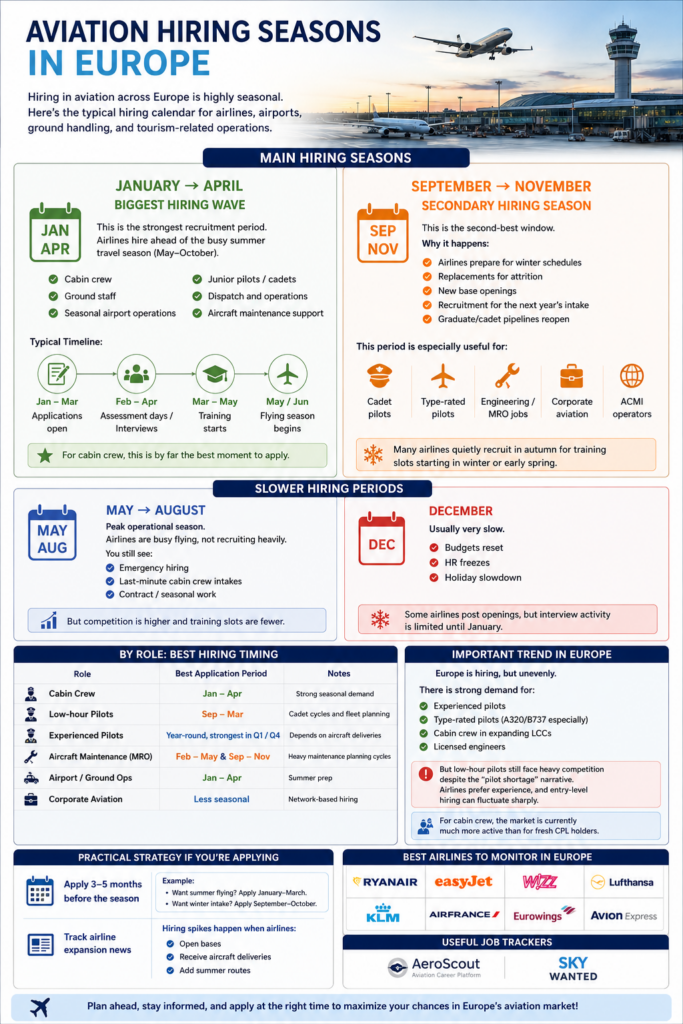
In Europe, aviation hiring is highly seasonal, especially for airlines, airports, ground handling, and tourism-related operations.
Here’s the typical hiring calendar:
Main hiring seasons
January → April (biggest hiring wave)
This is the strongest recruitment period.
Airlines hire ahead of the busy summer travel season (May–October), especially for:
Cabin crew
Ground staff
Seasonal airport operations
Junior pilots / cadets
Dispatch and operations
Aircraft maintenance support
Low-cost carriers like Ryanair, easyJet, and Wizz Air often launch recruitment drives during Q1 for summer operations.
Typical timeline:
Applications open: Jan–March
Assessment days/interviews: Feb–April
Training starts: March–May
Flying season begins: May/June
For cabin crew, this is by far the best moment to apply.
September → November (secondary hiring season)
This is the second-best window.
Why it happens:
Airlines prepare for winter schedules
Replacements for attrition
New base openings
Recruitment for the next year’s intake
Graduate/cadet pipelines reopen
This period is especially useful for:
Cadet pilots
Type-rated pilots
Engineering/MRO jobs
Corporate aviation
ACMI operators
Many airlines quietly recruit in autumn for training slots starting in winter or early spring.
Slower hiring periods
May → August
Peak operational season.
Airlines are busy flying, not recruiting heavily. You still see:
Emergency hiring
Last-minute cabin crew intakes
Contract/seasonal work
But competition is higher and training slots are fewer.
December
Usually very slow.
Budgets reset
HR freezes
Holiday slowdown
Some airlines post openings, but interview activity is limited until January.
By role: best hiring timing
Role
Best application period
Notes
Cabin Crew
Jan–Apr
Strong seasonal demand
Low-hour Pilots
Sep–Mar
Cadet cycles and fleet planning
Experienced Pilots
Year-round, strongest in Q1/Q4
Depends on aircraft deliveries
Aircraft Maintenance (MRO)
Feb–May & Sep–Nov
Heavy maintenance planning cycles
Airport/Ground Ops
Jan–Apr
Summer prep
Corporate Aviation
Less seasonal
Network-based hiring
Important trend in Europe right now
Europe is hiring, but unevenly.
There is strong demand for:
Experienced pilots
Type-rated pilots (A320/B737 especially)
Cabin crew in expanding LCCs
Licensed engineers
But low-hour pilots still face heavy competition despite the “pilot shortage” narrative. Reddit discussions from European pilots repeatedly mention that airlines prefer experience, and entry-level hiring can fluctuate sharply.
For cabin crew, the market is currently much more active than for fresh CPL holders.
Platforms like JobsReach Aviation are helping reshape how professionals connect within the aviation industry. By focusing on industry-specific networking, JobsReach Aviation enables pilots, cabin crew, engineers, and other aviation professionals to build meaningful connections, share insights, and discover opportunities directly within their field. This creates a more targeted and relevant ecosystem where employers and candidates can engage beyond traditional job boards and strengthen long-term professional relationships. 👉 https://jobsreach.net/aviation.html
Finding the right Maintenance, Repair, and Overhaul (MRO) opportunity as a B1 engineer is not always as straightforward as it should be.
Despite the growth of digital platforms and job boards, many licensed aircraft engineers still rely heavily on word of mouth to discover new roles. While this approach has worked for years, it also brings limitations, especially in today’s fast-evolving aviation industry.
How Networking Drives Hiring in the Aviation MRO Industry
Aviation maintenance is often described as a small, tightly connected community.
In many cases:
Engineers hear about vacancies through colleagues or former teammates
Opportunities circulate within known circles
Hiring decisions are influenced by trusted recommendations
This system has its advantages. It builds trust and ensures that experienced professionals are referred for critical roles. However, it also creates challenges.
Limitations of Word of Mouth Hiring for B1 Engineers
While personal networks are valuable, relying on them alone can restrict opportunities.
1. Limited Visibility
Not all job openings reach everyone. If you’re not part of a specific network, you may never hear about certain roles.
2. Geographic Barriers
For engineers looking to relocate, especially across countries, local networks may not be enough.
3. Uneven Access
New entrants or those switching sectors within aviation may find it harder to break into established circles.
4. Missed Matches
Highly skilled engineers may miss roles that perfectly match their license and experience simply because the information didn’t reach them.
Professionals building connections for aviation career growth
Modern Aviation Job Search Strategies for B1 Engineers
The aviation industry is evolving and so are the ways professionals connect and find opportunities.
B1 engineers today are beginning to look beyond traditional methods by:
Expanding their professional networks online
Engaging in aviation-specific communities
Staying informed about industry trends and movements
However, a major gap still exists: There is no single focused space dedicated to connecting aviation professionals in a meaningful way.
Why Aviation Networking Is Essential for Aircraft Maintenance Careers
Networking remains essential, but it doesn’t have to be limited to personal contacts.
A more effective approach combines:
Strong personal connections
Wider industry visibility
Access to shared insights and opportunities
When engineers can connect beyond their immediate circles, they gain:
Better awareness of global opportunities
Insights into different MRO environments
Support from peers facing similar challenges
Improving Access to MRO Opportunities for Licensed Aircraft Engineers
To improve how opportunities are discovered in aviation maintenance, the industry needs to move toward:
More transparent job visibility
Stronger peer-to-peer connections
Accessible platforms tailored to aviation professionals
This doesn’t replace word of mouth, it enhances it.
A New Direction for Aviation Professionals
As conversations with engineers continue to highlight these challenges, it’s clear that there is a growing need for a more focused and connected approach.
Creating a space where aviation professionals can:
Connect with peers globally
Share insights and experiences
Stay informed about industry trends
Discover opportunities relevant to their qualifications
This is something We’ve been actively exploring through JobsReach Aviation with the goal of supporting aviation professionals in building stronger connections and accessing better opportunities over time.
✍️ Final Thoughts
Word of mouth will always be a part of aviation hiring and for good reason.
But as the industry grows more complex and global, relying on it alone may no longer be enough.
For engineers, combining traditional networks with broader, more accessible connections could open the door to better, more relevant MRO opportunities.
For those exploring broader aviation career paths, especially internationally, understanding different regions can also make a significant difference. For example, Europe offers diverse opportunities for aviation professionals at various stages of their careers.
The aviation industry is one of the most safety-critical and highly regulated sectors in the world. Hiring pilots, cabin crew, and technical staff is not just about filling vacancies, it directly impacts passenger safety, operational efficiency, and service quality.
Despite advances in digital recruitment, airlines continue to rely heavily on in-person recruitment drives. These events allow recruiters to assess candidates’ technical skills, behavior, and professionalism in ways that online applications alone cannot. However, traditional methods are expensive, resource-intensive, and time-consuming.
Platforms like JobsReach Aviation are now helping airlines optimize recruitment by reducing costs, improving efficiency, and streamlining the hiring process without compromising quality.
Why Airlines Prefer In-Person Recruitment Drives
Airlines like Emirates, Qatar Airways, and Singapore Airlines still conduct large-scale, in-person hiring events for several key reasons:
1. Safety-Critical Evaluation
Aviation roles demand more than certifications:
Pilots must demonstrate decision-making under pressure and situational awareness.
Cabin crew need strong communication, customer service skills, and emergency response capability.
These competencies are difficult to measure effectively through online applications alone.
2. Real-Time Behavioral Assessment
In-person drives allow recruiters to evaluate:
Professional appearance and grooming
Body language and confidence
Interpersonal and teamwork skills
For cabin crew, these factors directly impact passenger experience and brand image.
3. Group Exercises and Simulations
Recruitment events often include:
Group discussions
Emergency response simulations
Role-playing service scenarios
These exercises replicate real inflight situations, revealing skills that resumes cannot capture.
4. High-Volume Screening Efficiency
A single recruitment day can process hundreds of candidates through multiple assessment stages, reducing hiring timelines while maintaining rigorous evaluation standards.
Staffing in Recruitment Drives
In-person recruitment is resource-intensive. Typical staffing requirements include:
Cabin Crew Drives
3–8 HR recruiters
2–5 assessors/trainers
1–3 coordinators/admin staff
Total: 6–15 staff per event
Pilot Drives
Senior captains (technical assessors)
HR recruiters
Simulator instructors and psychologists
Total: 5–12 specialized staff
These professionals often travel internationally, adding significant logistical costs.
Total Realistic Campaign Cost
Recruitment costs extend far beyond the event itself, including preparation, staffing, travel, marketing, and assessment tools.
For cabin crew hiring, costs typically include recruitment agency support, digital and social media promotion, venue and logistics management, and internal screening processes. These activities are often conducted at scale, requiring coordinated effort across multiple teams and locations.
For pilot recruitment, the cost structure is more complex due to technical and regulatory requirements. In addition to sourcing and marketing, airlines must invest in simulator assessments, technical evaluations by experienced captains, and travel and logistics for both candidates and assessors.
Overall, airline hiring campaigns represent a significant operational and financial commitment, driven by the need for safety, compliance, and high-quality talent selection. This highlights the importance of optimizing recruitment strategies to improve efficiency and reduce unnecessary costs.
Hidden Cost Drivers:
Agency commissions (15–20% per pilot hire)
Global social media campaigns targeting aviation professionals
Travel and accommodation for recruiters
Manual screening and verification processes
Why Airlines Would Partner with JobsReach Aviation
JobsReach Aviation helps airlines streamline recruitment, reduce costs, and improve candidate quality, while maintaining industry standards.
1. Reduce Dependency on Recruitment Agencies
By enabling direct candidate applications, JobsReach reduces:
High agency commissions
Multiple layers of resume screening
Marketing duplication
This lowers hiring costs significantly. For example, replacing a €20,000 agency commission per pilot with a flat platform fee can save airlines hundreds of thousands per campaign.
2. Industry-Specific Talent Pool
Unlike general platforms, JobsReach focuses solely on specialized industry such as aviation professionals:
Currently, candidates upload licenses and medical certificates, which are manually validated. While accurate, this process highlights an opportunity for future automation to improve speed and scalability.
5. Global Employer Branding
JobsReach helps airlines:
Promote hiring campaigns worldwide
Target specific aviation segments
Highlight company culture, fleet growth, and career opportunities
This strengthens brand visibility and engagement among qualified professionals.
Building the Future of Airline Recruitment
While in-person drives remain important for safety-critical evaluations, airlines can now combine them with digital platforms and AI tools to:
Reduce costs
Improve candidate quality
Accelerate hiring timelines
Support global talent sourcing
By partnering with JobsReach Aviation, airlines can maintain rigorous in-person assessments while reducing operational burden and creating a seamless, modern recruitment ecosystem.
Join the JobsReach Aviation Ecosystem
Airline recruitment is resource-intensive and costly, but it is essential for ensuring safety, service quality, and operational excellence. Partnering with JobsReach Aviation provides a smarter, cost-effective solution, combining direct applications, AI-assisted screening, and access to a global aviation talent ecosystem—while preserving the value of in-person assessments.
By partnering with JobsReach Aviation, airlines can reduce hiring costs, streamline recruitment, and maintain compliance, while actively supporting a larger mission: promoting specialized industries and enabling aviation professionals to access the right opportunities with ease.
Partner with JobsReach Aviation today to connect with qualified candidates, showcase your brand globally, and grow the aviation industry together.
If you want a complete roadmap to aviation careers in Europe for 2026 — covering pilots, ATC, and airport jobs, check out this article Europe Aviation Career
Industry Context & Cost Justification
While airlines do not publicly disclose detailed recruitment budget breakdowns, several industry data points show that recruitment and training in aviation involve significant expense.
Specialist job boards charge employers substantial fees for job listings and talent access, reflecting part of the recruitment cost structure (AirlineJobs Pricing). Platforms like JobAvion illustrate that success fees for aviation hires can be a meaningful percentage of salary, showing how agency-type costs are part of airline hiring expenses (JobAvion).
Research on pilot turnover confirms that turnover and recruiting costs represent major airline cost categories, reinforcing that high-quality hiring is resource-intensive (ERAU Study on Pilot Turnover). Additionally, pilot training and certification — a key part of onboarding new talent — often requires substantial financial investment (Aviation HR Statistics).
Aviation recruitment authorities also highlight the hidden costs associated with poor hiring decisions, including financial losses, compliance risk, and operational disruption (Goose Recruitment Insights).
The aviation industry is regaining altitude after years of turbulence, but one critical challenge continues to weigh it down, a growing shortage of qualified pilots. Airlines, charter operators, and flight academies around the world are facing unprecedented recruitment and retention hurdles. Let’s explore the core challenges and how leading regions are responding.
Pilot Shortage and Demand Surge
The most pressing issue is a widening gap between supply and demand. As air travel rebounds, fleets expand, and new routes open, the demand for licensed pilots far outpaces the current training pipeline. Many senior pilots who retired early during COVID-19 have not returned, leaving airlines scrambling to fill cockpits.
The Global Pilot Shortage: A Widespread Challenge
The aviation industry is facing one of its most significant challenges in decades, a worldwide shortage of qualified pilots. As global air travel rebounds and fleet expansions continue, the demand for experienced flight crew has far outpaced the current supply.
From North America and Europe to the Middle East and Asia-Pacific, airlines are competing for a limited pool of licensed professionals. Retirement of senior pilots, limited training capacity, and high entry costs for new candidates have deepened the crisis.
This imbalance is forcing airlines to increase incentives, raise salaries, and expand training programs to secure and retain talent, all while battling the growing operational costs tied to recruitment, onboarding, and compliance.
What was once a regional issue has now become a global aviation workforce challenge, reshaping how airlines approach recruitment and talent development in every part of the world.
Pilots onboard
High Cost and Lengthy Training Pipeline
One of the biggest barriers to entry remains the cost and duration of training. Becoming a commercial pilot often requires US$80,000–150,000 and years of training before reaching airline-ready status. This discourages younger candidates and limits diversity in the profession.
To counter this, airlines are stepping in with sponsored cadet programs and training partnerships:
🇪🇺 In Europe, carriers like Lufthansa, British Airways, and easyJet offer structured ab-initio and modular cadet programs to fast-track aspiring pilots into airline operations.
🇸🇦 In the Middle East, airlines such as Emirates, Etihad, and Qatar Airways invest heavily in aviation academies, offering scholarships and in-house training tailored to their fleets.
🇺🇸 In the United States, regional airlines including United Aviate, Delta Propel, and American Airlines Cadet Academy provide clear, funded pathways from flight school to cockpit, reducing financial pressure for new entrants.
Experience, Regulations, and Retention
Despite new technologies and modern hiring tools, the pilot recruitment process remains bound by strict regulatory standards. The FAA’s 1,500-hour rule in the U.S., for example, creates an extended training timeline before candidates qualify for airline roles. Europe’s EASA and the Middle East’s GCAA maintain similar high standards for safety and certification.
At the same time, many experienced pilots are reaching retirement age, intensifying competition for talent. Airlines are responding with improved benefits, leadership opportunities, and lifestyle incentives to retain skilled professionals.
Diversity, Inclusion, and Future Skills
Women and minorities remain underrepresented, with women comprising less than 6% of pilots globally. Airlines and academies are beginning to promote outreach programs, mentorship networks, and sponsorships to diversify the talent pool.
Additionally, as cockpits become more automated, pilots must combine technical expertise with leadership, communication, and decision-making skills, a blend that’s reshaping pilot assessment and training.
To make recruitment more efficient and cost-effective, JobsReach Aviation is transforming how airlines connect with aviation talent. JobsReach Aviation provides a direct digital bridge between airlines and aviation professionals worldwide. The platform allows airlines to connect directly with qualified pilots, engineers, cabin crew, and ground staff, eliminating the need for costly intermediaries and recruitment events.
By centralizing aviation hiring, JobsReach Aviation significantly reduces recruitment costs, speeds up hiring processes, and enables employers to access a verified pool of aviation talent, all in one platform built specifically for the industry.
JobsReach Aviation is a industry specific platform for aviation
A Platform Built for Aviation — Not Just Another Job Site
Unlike general career platforms such as LinkedIn, JobsReach Aviation is dedicated exclusively to the aviation industry. It lists top aviation institutes and partnered airlines actively hiring, helping candidates identify training programs, job openings, and professional development opportunities all in one place.
For young aviation enthusiasts, it offers a clear path to pursue their dream careers. For experienced professionals, it delivers the latest aviation insights, opportunities, and career mobility to help them progress and switch roles with confidence.
By focusing solely on aviation, JobsReach Aviation promotes growth, connectivity, and opportunity across the global aviation community.
Competition and Retention Pressure
As airlines compete for a limited pool of qualified pilots, salary packages, signing bonuses, and relocation incentives have skyrocketed. Smaller regional airlines and private charter operators struggle to match the compensation and lifestyle benefits offered by major carriers, leading to high turnover and recruitment churn.
The Path Ahead
The path to solving the pilot shortage requires collaboration, innovation, and smarter technology. Airlines, regulators, and training institutions must continue to expand access to funding, modernize training pathways, and promote aviation careers to the next generation.
With the rise of digital platforms like JobsReach Aviation, the industry is finally equipped to reduce recruitment costs, reach a global talent pool, and ensure the next generation of aviators is ready to take flight.
The aviation industry is constantly evolving, and professionals need a platform that understands their unique needs. JobsReach Aviation is emerging as the go-to platform for aviation professionals and recruiters, offering an industry-specific approach that outshines competitors like LinkedIn and Aviation Job Search.
Aviation professional at the airport
Here’s why JobsReach Aviation is revolutionizing the aviation job market:
✈️ Industry-Specific Focus: Aviation First
Unlike LinkedIn, which serves all industries, JobsReach Aviation is built exclusively for aviation professionals. This means job seekers and recruiters can connect faster without filtering through irrelevant profiles. Airlines, MROs, and aviation companies can find the right talent without sifting through countless unrelated applications.
✅ Targeted aviation job search – No distractions from other industries. ✅ Relevant connections – Engage with professionals, pilots, engineers, and recruiters directly.
🚀 Effortless & Fast Job Applications
Traditional job platforms require users to constantly upload and update their CVs. JobsReach Aviation simplifies this process by allowing professionals to create a profile and share a unique link with recruiters, no need for repetitive resume submissions.
✅ No CV required – Just share your JobsReach profile. ✅ One-click applications – Save time and apply instantly. ✅ Direct employer connections – Avoid third-party barriers and job board limitations.
young blonde businesswoman with a plane model
💰 Cost-Effective for Recruiters & Employers
Recruiters on LinkedIn and Aviation Job Search face high costs for job postings. For example, Aviation Job Search charges £699 per listing, while LinkedIn’s premium hiring tools come at a significant cost. JobsReach Aviation offers a more affordable subscription model, making it an attractive option for aviation companies looking for talent.
✅ Lower hiring costs – More budget-friendly than pay-per-post platforms. ✅ Unlimited job postings – Unlike platforms that charge per job listing. ✅ Better ROI – Companies can reach a targeted audience without excessive costs.
🌍 Global Reach & Industry Networking
Aviation professionals often get lost in the noise of general job platforms. JobsReach Aviation ensures better visibility, helping professionals stand out in their industry. Additionally, the platform fosters an aviation-specific community, where professionals can share knowledge, network, and collaborate beyond just job hunting.
✅ Aviation-focused community – Connect with industry experts and peers. ✅ Job opportunities worldwide – Expand career options beyond local markets. ✅ Stay updated – Engage in forums, discussions, and industry trends.
🎁 Exclusive Perks for Aviation Professionals
JobsReach Aviation isn’t just about job searching—it’s about career growth. The platform offers additional benefits to help aviation professionals advance in their careers.
✅ Personalized public profiles – Get a unique URL to share with employers. ✅ Career growth webinars – Free sessions with aviation hiring experts. ✅ Referral programs – Earn rewards by inviting peers to join.
🏆 Why JobsReach Aviation is the Future of Aviation Hiring
How JobsReach Compares to Other Platforms
Feature
JobsReach Aviation
LinkedIn
Aviation Job Search
Industry-Specific Focus
✅ Aviation Only
❌ General
✅ Aviation Only
No CV Required for Applications
✅ Yes
❌ No
❌ No
One-Click Profile Sharing
✅ Yes
❌ No
❌ No
Affordable for Recruiters
✅ Lower Cost
❌ High
❌ Pay-Per-Post (£699)
Aviation Networking & Community
✅ Aviation-Focused
❌ Mixed Industries
❌ No Dedicated Community
AI-Powered Job Matching
✅ Yes
❌ No
❌ No
With its aviation-first approach, simplified job applications, lower costs, and strong networking features, JobsReach Aviation is leading the way in the aviation industry. Whether you’re a pilot, mechanic, ground staff, or recruiter, JobsReach Aviation is the ultimate platform to connect, grow, and succeed in the aviation job market.
🔗 Start your journey today – Create your JobsReach Aviation profile and take your career to new heights!
In the aviation industry, the importance of an aircraft mechanic is paramount. These experts ensure flight safety, resolve complex issues, and are essential for seamless operations. With the industry’s ongoing expansion, securing the right aircraft mechanic is more critical than ever.
Mordor Intelligence projects that the aviation market will expand by $54 billion by 2028, making it essential to have a skilled aircraft mechanic.
This blog will walk you through the key steps to ensure you hire not just any mechanic, but a dedicated professional who maintains the highest standards of safety, competence, and teamwork.
From identifying your hiring requirements and creating compelling job descriptions to verifying certifications and evaluating soft skills, this comprehensive guide explores the intricate process of choosing the ideal candidate. Whether you’re an airline, a maintenance facility, or a private aircraft owner, the principles outlined here will assist you in assembling a team of skilled mechanics who are not only technically proficient but also fit well with your organization’s culture. Additionally, you can also checkout the Essential Information to Know Before Becoming an Aircraft Mechanic.
Significance of aircraft mechanics
Aircraft mechanics are the unsung heroes of aviation, playing a crucial role in ensuring the safety and functionality of aircraft. These skilled professionals are the guardians of the skies, tasked with meticulously inspecting, repairing, and maintaining aircraft to the highest standards.
Flight safety is the top priority in aviation, and aircraft mechanics are pivotal to this commitment. With their expertise, they thoroughly examine every aircraft component, from engines to avionics, ensuring each system functions perfectly. Their work is crucial in preventing mechanical failures during flight, ultimately protecting the lives of passengers and crew.
Additionally, regulatory compliance is fundamental in aviation, and aircraft mechanics are essential in maintaining these standards. Through meticulous inspections and strict adherence to maintenance protocols, they ensure that aircraft meet stringent regulations. This commitment not only guarantees flight safety but also ensures that the aircraft remain certified and airworthy.
In essence, aircraft mechanics are the foundation of aviation, combining technical expertise with a steadfast dedication to safety. Their proficiency not only maintains the operational integrity of aircraft but also inspires confidence in the millions of passengers who fly daily. Without the commitment and precision of aircraft mechanics, the aviation industry would not achieve its heights. You can also explore tips for securing quality employment as an aircraft mechanic.
Clarifying your staffing requirements
Selecting the right aircraft mechanic starts with a precise understanding of your unique needs and criteria. Accurately defining these requirements is essential to identifying a candidate who integrates smoothly into your aviation team and fulfills the role’s expectations.
Defining Skills and Expertise: Begin by detailing the specific skills and expertise you need from an aircraft mechanic. Factor in the types of aircraft your organization handles, the maintenance protocols required, and potential technical complexities. Whether you seek proficiency in avionics, engines, airframes, or a blend of these specialties, precision in this aspect is crucial.
Levels of Experience: Decide on the level of experience you seek in a candidate. Are you interested in entry-level mechanics who are motivated to develop their skills, or do you need senior mechanics with substantial industry experience to provide leadership and mentorship?
Certifications and Qualifications: Various aircraft necessitate specific certifications and qualifications. Specify the FAA certifications, licenses, and educational backgrounds required for the position. This ensures that your candidates are legally authorized to conduct maintenance duties.
Soft Skills and Team Compatibility: While technical abilities are essential, evaluating soft skills is equally critical. Evaluate the candidate’s capacity to collaborate effectively within a team, communicate clearly, and adapt to the dynamic environment of aviation operations.
Future Growth Potential: Consider the future requirements of your organization. Are you seeking a mechanic capable of advancing into a leadership role? Clearly defining these goals from the outset will aid in selecting a candidate aligned for long-term growth.
In conclusion, a thorough grasp of your hiring requirements forms the bedrock of a successful recruitment endeavor. This clarity enables you to attract candidates with the appropriate skills, experience, and attributes to thrive as aircraft mechanics in your aviation team.
Creating a compelling job description
A well-crafted job description is essential for a successful aircraft mechanic hiring process. It serves as the initial point of contact between your organization and prospective candidates, offering a clear outline of the role and its expectations.
Clear Position Title and Overview: Begin with a precise and accurate job title that reflects the role, such as “Aircraft Mechanic” or “Aviation Maintenance Technician.” Follow this with a brief overview that outlines the main responsibilities and the importance of the role within your organization.
Responsibilities and Duties: Detail the primary responsibilities and duties the candidate will perform. Include tasks such as aircraft inspections, repairs, and maintenance. Specify the types of aircraft involved and any specialized tasks required.
Qualifications and Prerequisites: Clearly outline the necessary qualifications, certifications, and licenses candidates must have. This should include FAA certifications, A&P licenses, educational background, and any specific training requirements.
Skills and Abilities: Specify the technical skills and abilities required for the position, such as expertise in diagnosing aircraft issues, using specialized tools, and adhering to maintenance protocols.
Work Environment and Hours: Provide a brief description of the work environment, whether it is in a hangar, workshop, or field. Indicate if the role involves shift work or specific working hours.
Company Overview: Offer a concise overview of your organization, including its values and mission. This helps candidates grasp the broader context of the position.
Application Instructions: Specify how candidates should apply, whether through an online application portal, email, or other methods. Include the application deadline if applicable.
Equal Opportunity Statement: Highlight your commitment to diversity and equal opportunity employment.
A well-crafted job description not only attracts qualified candidates but also establishes a transparent and efficient hiring process. It ensures that potential candidates clearly understand the role’s responsibilities and expectations, leading to more informed applications and a better fit for your organization.
Finding candidates
Identifying the right aircraft mechanic for your team necessitates a strategic approach to sourcing candidates. By utilizing diverse channels and methods, you can broaden your reach and attract a pool of qualified candidates.
Aviation Job Boards: Specialized online job boards focusing on aviation and aircraft maintenance are invaluable resources. Platforms like JobsReach Aviation, AEROjobs and Aviation Job Search are popular among industry professionals.
Aircraft Maintenance Associations: Organizations such as the Aircraft Maintenance Technicians Association (AMTA) typically offer job boards and networking opportunities that facilitate connections with potential candidates.
Social Media: Utilize platforms like LinkedIn to post job openings and engage with individuals who have relevant experience. LinkedIn groups focused on aviation can also facilitate networking opportunities.
Aviation Schools and Training Centers: Reach out to local aviation schools and training centers. Graduates seeking employment often value opportunities to begin their careers with established organizations.
Career Fairs and Workshops: Participate in aviation-themed career fairs and workshops. These events enable direct engagement with potential candidates and allow you to showcase your organization.
Employee Referrals: Encourage current employees to recommend qualified candidates. They can help identify individuals who may be a good fit for your team.
Networking Events: Attend industry conferences, seminars, and workshops. Networking in person can help establish connections with both active job seekers and those not actively looking.
Recruitment Agencies: Consider collaborating with recruitment agencies specializing in aviation. They can streamline candidate identification and screening processes.
By diversifying your candidate sourcing strategies, you enhance your chances of finding the ideal aircraft mechanic who not only possesses the necessary technical skills but also aligns well with your organization’s values and culture.
Assessing technical proficiency
Evaluating the technical proficiency of potential aircraft mechanic candidates is crucial to ensuring they can effectively maintain and repair aircraft. Here’s how to assess their technical skills effectively:
Skills Assessment Tests: Implement or develop tests that simulate real-world scenarios aircraft mechanics face, covering diagnostics, repairs, and tool usage.
Portfolio Review: Request candidates to share a portfolio showcasing past projects to evaluate the quality of their maintenance and repairs.
Hands-On Tasks: Include practical tasks during interviews, such as component assembly or troubleshooting, to observe their skills firsthand.
Technical Interview: Prepare technical questions about aircraft systems, maintenance procedures, and safety protocols to gauge their knowledge.
Scenario-based Questions: Present hypothetical maintenance scenarios and assess their problem-solving approach.
Reference Checks: Contact previous employers to verify their technical skills and work performance.
Certification Verification: Confirm the validity and relevance of their certifications and licenses.
Using these methods ensures you select aircraft mechanics capable of maintaining the safety and reliability of your aircraft fleet.
Confirming certifications and licenses
When hiring an aircraft mechanic, verifying their certifications and licenses is more than a procedural step; it’s essential for ensuring the safety and reliability of your aviation operations. Valid certifications and licenses indicate a mechanic’s qualifications, expertise, and adherence to industry standards.
FAA Certifications: Begin by confirming that the candidate holds the necessary Federal Aviation Administration (FAA) certifications, such as the Airframe and Powerplant (A&P) license. This certification demonstrates their competency in aircraft maintenance and repair.
License Verification: Validate certifications and licenses by cross-referencing them with official FAA databases to ensure their authenticity and prevent potential misrepresentation.
Specialized Endorsements: Ensure the mechanic possesses any specialized endorsements or type ratings required for the specific aircraft your organization operates.
Current Compliance: Check the expiration dates of certifications and licenses to ensure they are current. Staying updated with renewals is crucial for meeting industry standards.
Background Checks: Consider conducting background checks to further verify the candidate’s credentials and uncover any discrepancies.
Verifying certifications and licenses is critical for upholding the performance and safety standards of your aircraft. By following these steps, you demonstrate your commitment to maintaining excellence and compliance in aviation operations.
Evaluating interpersonal skills and compatibility within the team
While technical competence is crucial for an aircraft mechanic, evaluating soft skills and alignment with your team’s culture is equally essential. Mechanics operate within a collaborative and dynamic environment that requires effective communication, adaptability, and teamwork.
Communication: Assess how well candidates convey technical information clearly and succinctly. Effective communication is vital for interacting with colleagues, supervisors, and possibly passengers regarding maintenance procedures and concerns.
Adaptability: Aviation evolves rapidly, requiring mechanics to adjust to new technologies and procedures. During interviews, discuss instances where candidates demonstrated flexibility and adept problem-solving in challenging situations.
Teamwork: Since mechanics often work in teams, their ability to collaborate harmoniously is critical. Inquire about their experience working with diverse teams and their willingness to share knowledge and support their colleagues.
Attention to Detail: Soft skills also encompass attention to detail, essential for meticulous maintenance and safety. Ask candidates about their methods for double-checking work and their adherence to protocols.
Conflict Resolution: Aircraft maintenance teams may encounter disagreements. Evaluate how candidates handle conflicts constructively, prioritizing safety and teamwork in their solutions.
Cultural Alignment: Assess candidates’ alignment with your organization’s values and culture, particularly regarding safety, professionalism, and continuous improvement.
By evaluating a candidate’s soft skills and team fit, you ensure they bring not only technical expertise but also the interpersonal qualities necessary to excel in a collaborative aviation environment. This holistic approach enhances overall team performance and fosters a culture of trust and unity.
Executing impactful interviews
Interviews form the cornerstone of your aircraft mechanic selection process, offering a crucial opportunity to assess a candidate’s qualifications, skills, and fit for your team. A well-structured interview can uncover valuable insights beyond what’s stated on their resume.
Structured Questioning: Prepare a blend of technical and behavioral questions to evaluate both the candidate’s expertise and soft skills. Inquire about specific maintenance challenges they’ve faced and their approach to resolving them.
Work Experience: Discuss their previous roles, focusing on the types of aircraft they’ve worked on and the complexity of their tasks.
Problem-Solving Ability: Present hypothetical maintenance scenarios to gauge their problem-solving skills, showcasing their critical thinking and decision-making capabilities.
Safety Focus: Evaluate their adherence to safety protocols by asking how they identify and mitigate potential risks in their work.
Team Collaboration and Communication: Assess their ability to collaborate within a team and effectively communicate with colleagues, supervisors, and other stakeholders.
Passion and Knowledge: Explore their enthusiasm for aircraft maintenance and their commitment to staying updated with industry advancements.
Scenario-Based Queries: Pose real-world situations and inquire about their strategies for handling them, highlighting their practical application of knowledge.
Request Examples: Encourage candidates to provide specific examples from their experience to support their claims of skills and achievements.
An effective interview process extends beyond technical verification, allowing you to gauge a candidate’s attitude, adaptability, and alignment with your organization’s values. By employing a well-rounded set of questions, you can ensure a thorough assessment and confidently select aircraft mechanics who excel in their role and enhance your team.
Conclusion
In the aviation industry, precision and excellence are of utmost importance. Hiring an aircraft mechanic with the right technical skills, certifications, and licenses is fundamental to maintaining these standards. However, it doesn’t end there. The significance of soft skills, teamwork, and cultural alignment cannot be overlooked.
As you select the next member of your aviation maintenance team, remember that you’re not just hiring a mechanic; you’re bringing on board a professional who will play a crucial role in the safety and success of your aircraft operations. By following the steps outlined in this guide, you’re not only ensuring the effectiveness of your operations but also contributing to the ongoing advancement of aviation safety and excellence.
JobsReach Aviation is a dedicated platform designed for aviation where aviation professionals can directly access job opportunities from airlines around the world.
At JobsReach Aviation, we specialize in connecting talented professionals with exclusive opportunities in the aviation industry. By focusing on niche markets, we ensure that you find the perfect match for your skills and career aspirations.
JobsReach Aviation connects you with a community of aviation professionals, including pilots, aircraft engineers, mechanics, ground staff, and more.