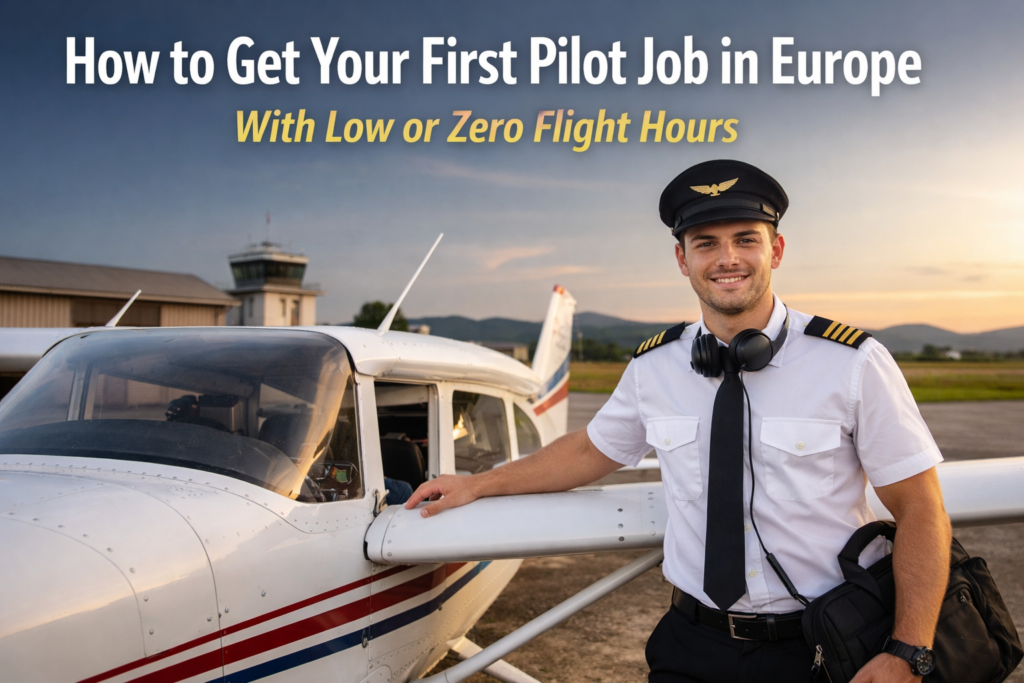
Getting your first pilot job in Europe is often the hardest step in an aviation career especially if you’re a newly graduated pilot with low or zero flight hours. Most job listings demand experience you don’t yet have, creating a frustrating cycle.
The good news is that many pilots before you faced the same problem and still succeeded. This guide focuses on practical, realistic ways to break into the European aviation market with minimal experience.
Why Getting Your First Pilot Job in Europe Is So Difficult
Europe has one of the most regulated aviation environments in the world. Operators prefer pilots who:
Are familiar with EASA regulations
Require minimal additional training
Already have real operational experience
As a low-hour graduate, your main objective is simple: build credible flight experience as efficiently as possible.
Flight Instructor: The Fastest Way to Build Flight Hours
Becoming a flight instructor is the most common first job for low-hour pilots in Europe.
Why flight instruction works:
You accumulate flight hours quickly
You improve decision-making and procedural discipline
Instructor experience is highly respected by airlines
You earn income while flying
Even if instruction isn’t your long-term goal, it is often the most reliable stepping stonetoward commercial or airline flying.
Entry-Level Pilot Jobs That Accept Low Hours
Not all pilot jobs require thousands of hours. Some entry-level flying jobs in Europe are accessible to new graduates:
Tourist and sightseeing flights
Aerial photography and survey flying
Agricultural or utility flying
Pipeline or powerline patrols
These jobs may be seasonal or location-specific, but they provide valuable operational experience and help you move beyond zero hours.
Small Airlines and Regional Operators in Europe
Major airlines rarely hire low-hour pilots directly. However, small and regional operators are often more flexible.
How to improve your chances:
Be willing to relocate anywhere in Europe
Apply directly to operators, not only job portals
Look for airlines offering mentorship or type-rating support
Many airline captains today started their careers with small regional companies.
Cadet Programs and Graduate Pilot Schemes
Several European airlines and flight schools offer cadet programsdesigned specifically for newly licensed pilots.
These programs often include:
Structured training and mentoring
A defined path to employment
Lower initial flight-hour requirements
Cadet programs are competitive, but they remain one of the best entry points for low-hour pilots in Europe.
Trained Outside Europe? Start License Conversion Early
If you completed your training outside Europe, you must convert your license to EASA standards before working commercially.
Typical requirements:
EASA theoretical knowledge exams
Skill test or simulator assessment
Possible additional flight training
Costs of approximately€10,000–€20,000
Timeline of 3–12 months
Starting the conversion early significantly increases your job options.
Networking: The Hidden Pilot Job Market
Many first pilot jobs are never publicly advertised.
Effective networking includes:
Staying in contact with instructors and examiners
Attending aviation expos and job fairs
Connecting with pilots and recruiters on LinkedIn
Joining European aviation forums and clubs
In many cases, a strong recommendation matters more than total flight hours.
Alternative Ways to Gain Aviation Experience
If flying jobs are limited at first, consider staying active within aviation:
Simulator or ground school instruction
UAV / drone operations
Dispatch or operational roles with flying companies
These positions keep you close to flying opportunities and strengthen your professional profile.
Key Takeaways for Low-Hour Pilot Graduates
Flight instruction is the fastest way to build hours
Entry-level and niche jobs provide valuable experience
Small airlines are more open to low-hour pilots
Cadet programs offer structured entry into aviation
Networking is essential in the European job market
Every flight hour matters, especially early on
Final Thoughts
Getting your first pilot job in Europe with low or zero flight hours is challenging but absolutely achievable. Success depends on flexibility, persistence, and smart career planning. Your first job doesn’t define your entire career, but it does open the door. Once you start flying, opportunities expand quickly.
If you’d like to explore more pilot career opportunities, take a look at the article below.
Becoming a pilot is a dream shared by many, but turning that dream into reality requires choosing the right flight school. Across Europe and the United States, several world-class academies offer rigorous training, modern fleets, and structured programs designed to meet international aviation standards.
In this article, we explore what makes these schools stand out and what it takes to be eligible for admission.
🎓 Basic Eligibility to Join a Flight School
While every school has specific requirements, most pilot training programs — whether EASA or FAA regulated — follow similar eligibility criteria:
🧠 Educational Requirements
Minimum education: High school diploma or equivalent (10+2 or A-Level).
Preferred: Background in Science, Mathematics, or Engineering — especially Aeronautical Engineering or related disciplines.
Some integrated ATPL (Airline Transport Pilot License) programs prefer candidates with a university degree.
🕒 Age Requirements
Minimum age: 17–18 years to start flight training.
Minimum 21 years for Airline Transport Pilot (ATPL) license issuance.
🩺 Medical Fitness
Class 1 Medical Certificate (EASA or FAA, depending on region).
Vision: 20/20 (corrected acceptable).
No serious health conditions affecting flight safety.
Passed by an authorized aviation medical examiner (AME).
🌍 Language Proficiency
Must demonstrate English language proficiency (ICAO Level 4 or higher).
Some European schools may require additional language assessment if English is not your first language.
✈️ Other Preferred Qualities
Strong aptitude for mathematics and physics.
Problem-solving skills and quick decision-making ability.
Passion for aviation and willingness to commit to rigorous schedules.
For some programs: clean background check and valid passport (for international students).
🌍 Top Flight Schools in Europe
School
Location
Key Features
Eligibility Highlights
CAE Oxford Aviation Academy
Oxford, UK
One of the world’s best-known academies; strong airline partnerships (e.g., British Airways, easyJet).
High school diploma (Math & Physics preferred), Class 1 Medical, strong English skills.
L3Harris Airline Academy
UK, Portugal, & EU
Offers EASA and FAA training; known for integrated ATPL programs and airline placement.
18+, good command of English, strong academics, Class 1 Medical.
Airline pipelines like Delta Propel, United Aviate, American Cadet Academy.
Visa Support
Available for EU/non-EU students via student visas.
M1/F1 student visas with optional work permissions.
💼 Why Training Matters: Pathway to a Pilot Career
Pilot training is a significant investment, both financially and in time. However, with the global pilot shortage forecasted to exceed 600,000 new pilots by 2040, graduates from reputed schools stand at an advantage. Airlines are actively partnering with academies to fast-track cadets, often sponsoring part of the training or offering employment guarantees after program completion.
📊 Reference: Boeing Pilot & Technician Outlook 2024–2043 According to Boeing, the aviation industry will require over 600,000 new pilots globally by 2043 to meet fleet growth and replacement demand.
JobsReach Aviation is transforming how pilots and aviation professionals connect with global employers.
✈️ Secure profile management: Upload and verify pilot licenses, training records, and medical certificates.
💬 Direct communication: Built-in messaging to engage directly with airline recruiters.
🌍 Industry insights: Learn about aviation developments, hiring trends, and training opportunities.
🎓 Education partnerships: Featuring top aviation institutes and academies across Europe, the Middle East, and the USA.
It’s a dedicated aviation ecosystem designed to bridge the gap between aspiring pilots, flight schools, and airlines, eliminating the noise of general job platforms.
🧮 Comparing Program Types: Integrated vs Modular vs MPL etc.
Integrated ATPL: Full-time, immersive. Typically ~18-24 months in Europe. It includes all theory, flight hours, simulator, etc. Faster, structured, but costlier.
Modular: Train in parts; more flexibility, can pace modules over time. Good if working/studying concurrently. Lower upfront cost but total cost over time may be similar.
MPL (Multi-Crew Pilot Licence): Focused on airline-style training emphasizing crew resource management early. Requires airline partners.
✈️ Flight Schools & Programs: Costs, Requirements, and Advantages
School / Program
Location
Approx Cost
Key Eligibility Requirements
Advantages & Highlights
Aerocadet – Full Professional Airline Pilot Program (FPAP-EU)
Europe (Romania)
~ US$67,250 (zero to ATPL without type-rating) (aerocadet.com)
• No experience required (“zero time” start) • Good English & aptitude • Class 1 Medical • Passoretical tests and screening • Internship commitment for instructor job option (aerocadet.com)
Integrated ATPL + instructors internship Guaranteed airline placement support Accommodation included Option for FAA ATPL / type-rating is possible (aerocadet.com)
Airbus Flight Academy (Europe Campus)
Angoulême, France
Varies; fees not always publicly listed; integrated ATPL cost in Europe often ~ €110,000 in many schools. (Flight Academy)
• Pass online assessment (math & English) • On-site assessment (aptitude, situational awareness) • Must meet visa / residence conditions if non-EU • Class 1 EASA Medical • Age likely 18+ (Airbus Aircraft)
High-quality assets: modern fleet, simulators, theoretical training in English Strong brand recognition Airline cadet pathways Good learning environment (weather, airspace) (Airbus Aircraft)
• Meets the EASA approval • Medical certificate class 1 • Strong proficiency in English • Financial readiness for tuition + living costs over 18 months (greenflightacademy.com)
New modern aircraft, strong sustainability focus Payment sample plan by instalments Good employment connection and support Campus accommodation and support services included (greenflightacademy.com)
ATP Flight School (USA)
USA (multiple locations)
$86,995 → $116,995 depending on starting level (zero time to advanced fast-track) (https://atpflightschool.com/)
• At least high school diploma • Class 1 FAA Medical • English proficiency • If starting from zero, must complete PPL, then instrument, multi-engine etc. • Living & exam costs extra (ThePricer)
Recognized FAA training path Fixed-cost pricing (good for budgeting) Multiple centres so location flexibility Fast-track programs for serious candidates Large fleet & experienced instructors (ATP Flight School)
Fly School Air Academy
Europe
≈ €80,000-€95,000 depending on program and simulator hours etc. (CPL/ATPL integrated) (https://www.flyschool.es/)
• No previous flight experience for “integrated” route • Must satisfy English and mathematics background • Class 1 Medical • Ability to commit to full-time training for 18-24 months (pilotnetwork.eu)
Includes significant simulator hours Multiple hours on B737/A320 sims Flight instructor course included in some cadet programs Good reputation and structured ADM (airline-style) prep (pilotnetwork.eu)
Minimum age ~18 High school diploma or equivalent with strong maths & physics English proficiency (often ICAO Level 4 or higher) Class 1 Medical (EASA standard) Pass aptitude / assessment tests (eg situational awareness, psychometric)
🏢 Other Private / Well-Known Schools in Europe & USA
School
Location(s)
Key Programs
Qualification Requirements
Advantages
Sabena Flight Academy (now part of CAE Global)
Belgium (Brussels), also overseas campuses via CAE ✈️ (Sabena Engineering)
Integrated ATPL, Flight crew training, type rating, advanced courses.
Same basics: Secondary school, medical, English, minimum age. Also require mental & skills assessment.
Other European Modular / Private Schools
EAS Barcelona (Spain), Aerofan FTO (Spain), various UK/Portugal/Italy based schools
PPL → CPL → ATPL modular or integrated, ME/IR, MCC etc.
Comparable entry requirements: Age, education, medical, English. Some modular routes are more flexible for working/part-time students.
USA Private Flight Schools
Many FAA-approved schools across States (Florida, Arizona, etc.)
PPL, Instrument Rating, CPL, Multi-Engine, Flight Instructor, fast-track ATP
FAA medical, English, academic competency (high school + sometimes college), sometimes university pathway programs.
Advantage is good weather (especially in southern states), large availability, often lower cost per flight hour, strong post-training job market.
Flight Schools in Europe and USA
What to Look for When Choosing a Private Flight School
License standard (EASA, FAA, etc.) and recognition by airlines.
Medical & age eligibility at the start.
Fleet & training equipment, including simulators.
Location/weather (to minimize delays due to weather).
Cost vs funding options (scholarships, cadet partnerships).
Graduate success and airline placement, or job-pathway promises.
Flexibility (modular vs integrated) depending on your schedule and resources.
Things to Watch Out / Hidden Costs
Living expenses: housing, food, transport; often not included in training fees. Schools in Eastern Europe are cheaper in this regard.
Equipment & Uniforms: headset, flight bag, uniforms, iPad/tablet often extra.
Exam & licence fees: theory exams, checkrides, license issuance may cost extra.
Visa / Travel Costs for international students.
Simulator or extra hours if weather or scheduling causes delays.
⚠️ Disclaimer
Program fees, entry requirements, and listed advantages may vary by location, exchange rate, and training type (MPL, ATPL, modular, or cadet). It’s strongly recommended to contact each flight school directly for the most accurate, up-to-date information on costs, eligibility, course structure, and available financing options.
🚀 Final Thoughts
Whether you aspire to fly for a global airline or charter operator, choosing the right flight school is the most important first step. With the aviation industry expanding rapidly across continents, now is the time to invest in quality training and platforms like JobsReach Aviation make it easier than ever to turn passion into a lifelong career in the skies.
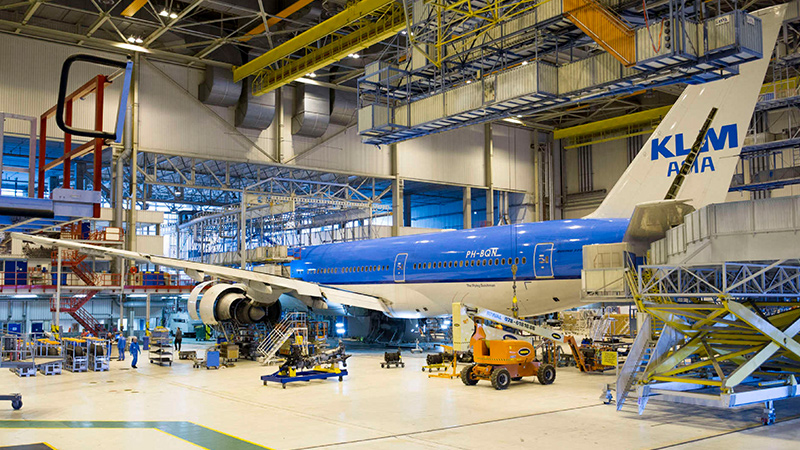
The aviation Maintenance, Repair, and Overhaul (MRO) industry plays a critical role in ensuring the safety, performance, and longevity of aircraft worldwide. From engine overhauls to airframe maintenance, MRO companies provide essential services that support the global airline industry. Below, we highlight the top MRO companies globally, in Europe, and in the Netherlands.
Top 10 MRO Companies in the World
ST Engineering Aerospace
Headquarters: Singapore
ST Engineering Aerospace is one of the world’s largest MRO providers, offering airframe, component, and engine MRO services. It operates across Asia-Pacific, Europe, and the Americas.
Lufthansa Technik
Headquarters: Germany
Lufthansa Technik is renowned for its comprehensive range of services, including airframe, engine, and cabin maintenance. It serves a global customer base, including airlines, leasing companies, and military clients.
HAECO Group
Headquarters: Hong Kong
HAECO provides a broad spectrum of MRO services across its global network, specializing in airframe maintenance, structural modifications, and engine services.
Air France Industries KLM Engineering & Maintenance
Headquarters: France/Netherlands
A joint venture between Air France and KLM, this company is a major player in the global MRO industry, offering maintenance solutions for airframes, engines, and components.
Delta TechOps
Headquarters: United States
As the maintenance division of Delta Air Lines, Delta TechOps provides world-class MRO services to both Delta’s fleet and other airlines globally.
AAR Corp
Headquarters: United States
AAR Corp is a major independent provider of MRO services, offering airframe, engine, and component repair, as well as supply chain management, to commercial airlines and government sectors.
SIA Engineering Company
Headquarters: Singapore
Associated with Singapore Airlines, SIA Engineering offers comprehensive MRO services with a network spanning across Asia-Pacific.
Turkish Technic
Headquarters: Turkey
Turkish Technic is a leading MRO provider in the Middle East, specializing in aircraft, engine, and component maintenance. It supports a wide range of international customers.
Boeing Global Services
Headquarters: United States
Boeing Global Services, through its extensive network, offers a wide range of MRO solutions, from basic aircraft maintenance to advanced technology services for commercial and defence clients.
GE Aviation
Headquarters: United States
GE Aviation, a subsidiary of General Electric, offers extensive MRO services for aircraft engines, supporting a wide range of commercial and military aircraft.
Top 10 MRO Companies in Europe
Illustration of European Union flag
Lufthansa Technik
Headquarters: Germany
As Europe’s leading MRO provider, Lufthansa Technik offers a wide array of services, including engine overhaul, cabin maintenance, and aircraft modification.
Air France Industries KLM Engineering & Maintenance
Headquarters: France/Netherlands
This joint venture is one of Europe’s largest MRO companies, offering comprehensive services for airframe, engine, and component support to airlines across the globe.
ST Engineering Aerospace
Headquarters: Singapore (with European facilities)
Known for its comprehensive MRO solutions, ST Engineering Aerospace operates a significant presence in Europe, serving customers across the continent.
Aero Maintenance Group (AMG)
Headquarters: France
Aero Maintenance Group specializes in aircraft maintenance services, including airframe repair and engine testing, primarily focused on the European market.
MTU Aero Engines
Headquarters: Germany
MTU Aero Engines is a major player in the European MRO industry, providing engine repair and maintenance services for a variety of commercial and military aircraft.
TAP Maintenance & Engineering
Headquarters: Portugal
TAP provides a range of maintenance services, including airframe and engine MRO for aircrafts operated by TAP Air Portugal and various international carriers.
LHT (Lufthansa Technik) Italy
Headquarters: Italy
An extension of Lufthansa Technik, LHT Italy offers airframe and engine MRO services, focusing on the Southern European market.
SR Technics
Headquarters: Switzerland
SR Technics is a leading European MRO provider, offering comprehensive services for aircraft and engine maintenance, component repair, and modifications.
Ryanair Engineering
Headquarters: Ireland
Ryanair Engineering provides MRO services, primarily for Ryanair’s fleet of aircraft, but also offers third-party services, particularly in aircraft base maintenance.
GKN Aerospace
Headquarters: United Kingdom
GKN Aerospace offers a wide range of services, including engine and aerostructure MRO, and has a strong presence in the European MRO market.
Top 10 MRO Companies in the Netherlands
KLM Engineering & Maintenance
Headquarters: Amsterdam, Netherlands
KLM’s MRO division offers comprehensive services, including airframe, engine, and component maintenance. It serves both KLM’s fleet and third-party clients globally.
Fokker Services
Headquarters: Hoofddorp, Netherlands
Fokker Services specializes in the maintenance of regional aircraft, providing services such as airframe overhaul, cabin modification, and engine maintenance.
Transavia Engineering
Headquarters: Netherlands
Part of Air France-KLM, Transavia’s MRO division handles the maintenance of its low-cost airline fleet and offers services to other carriers in the region.
NLR (Netherlands Aerospace Centre)
Headquarters: Amsterdam, Netherlands
NLR offers a wide range of aerospace services, including aircraft performance optimization, and MRO solutions for the aviation industry, focusing on research and development.
Satair
Headquarters: Amsterdam, Netherlands
A subsidiary of Airbus, Satair provides parts and supply chain management, along with MRO services for aerospace components and avionics.
Fokker Techniek
Headquarters: Hoofddorp, Netherlands
Fokker Techniek, a subsidiary of GKN Aerospace, provides MRO services to the general aviation, commercial, and military sectors, including complex maintenance and upgrades.
JetSupport
Headquarters: Netherlands
Jet Support provides a range of aviation services, including MRO support for private jets and smaller aircraft, specializing in avionics and systems.
SAMCO
Headquarters: Netherlands
SAMCO Aircraft Maintenance is a leading independent provider of MRO services, specializing in maintenance, repair, and overhaul solutions for regional jets and turboprop aircraft, catering to airlines and operators worldwide.
Regional Jet Center
Headquarters: Netherlands
RJC is known for its specialized aircraft and component MRO services, providing tailored solutions for aviation operators throughout Europe.
Nayak Aircraft Services
Headquarters: Amsterdam, Netherlands
Nayak offers comprehensive maintenance services, specializing in aircraft inspection, repairs, and modifications, serving both regional and international airlines.
How JobsReach Aviation Can Help MRO Companies Hire Global Talent
As the MRO industry continues to evolve, the need for skilled professionals and talented resources is growing. JobsReach Aviationoffers a powerful solution for MRO companies to access a global talent pool and streamline their recruitment process.
Global Talent Pool: JobsReach Aviation enables MRO companies to access a diverse, global talent pool, ensuring they can find the right professionals from anywhere in the world.
Streamlined Recruitment: The platform offers an efficient recruitment process, allowing MROs to quickly post jobs, review resumes, and conduct interviews.
Targeted Talent: JobsReach Aviation connects MROs with both experienced professionals and aspiring aviation students, ensuring the right fit for each role.
Faster Hiring: By simplifying recruitment, JobsReach Aviation helps MRO companies fill positions quickly, preventing delays and maintaining smooth operations.
Recent Advancements in MRO (Maintenance, Repair, and Overhaul)
Robots assembling the forward and aft sections of the 777 fuselage
Globally, MRO companies are integrating new technologies to stay competitive and meet industry demands.
AI and Predictive Maintenance
Companies like Lufthansa Technik, GE Aviation, and Rolls-Royce are utilizing AI and data analytics to predict when components will fail, enabling proactive maintenance and reducing unscheduled downtimes.
Sustainability Initiatives
Many MRO providers, such as ST Engineering Aerospace and Air France KLM Engineering & Maintenance, are focusing on green technologies, including eco-friendly jet engine cleaning and the use of sustainable materials, to minimize their environmental footprint.
3D Printing and Additive Manufacturing
MRO companies, including GE Aviation and AAR Corp, are adopting 3D printing to manufacture parts on-demand, improving turnaround times, reducing part shortages, and cutting costs.
Digital Twin Technology
Boeing and Rolls-Royce are implementing digital twin technology, creating virtual replicas of aircraft for real-time monitoring, which helps optimize maintenance schedules and extend the lifespan of components.
Digital Twins in Aircraft Maintenance
Robotics and Automation
The use of robotics in MRO services, particularly for tasks like inspection and cleaning, is increasing. GE Aviation and AAR Corp are using automated systems to enhance efficiency, speed, and precision in maintenance processes.
Blockchain for Parts Tracking
Companies like Honeywell Aerospace and Rolls-Royce are using blockchain technology to ensure the authenticity and traceability of parts, enhancing safety and compliance.
Electric and Hybrid Aircraft MRO
With the rise of electric and hybrid aircraft, MRO companies such as ST Engineering Aerospace are preparing for the maintenance needs of these new technologies, focusing on electrical systems and hybrid powertrains.
The aviation MRO industry is undergoing significant transformation driven by technological advancements. From AI and robotics to sustainable practices and blockchain, the future of MRO is leaning heavily toward innovation. These advancements not only improve efficiency and cost-effectiveness but also help the industry meet the growing demands of safety, sustainability, and regulatory compliance. Both Europe and the rest of the world are embracing these changes, ensuring that MRO remains a crucial pillar in the aviation sector’s continued growth.
In a fast-moving industry like aviation, JobsReach Aviation plays a critical role in helping MRO companies attract, hire, and retain the skilled professionals needed to meet the demands of modern aviation. Through its global network and innovative recruitment methods, JobsReach Aviation supports MROs in maintaining smooth operations and staying ahead of industry advancements.
Are you thinking about becoming an aircraft mechanic? If so, it’s important to recognize the significant responsibilities that come with the role. As a certified aircraft mechanic, you will be tasked with maintaining and repairing airplanes to ensure the safety of passengers and crew. Before you embark on this career path, it’s crucial to understand what it entails. In this blog, we’ll discuss 10 essential things you need to know before becoming an aircraft mechanic. Continue reading to get an inside look at this rewarding career. You can also explore tips for securing quality employment as an aircraft mechanic.
1.Aircraft Mechanics Are Responsible for the Maintenance and Repair of Aircrafts
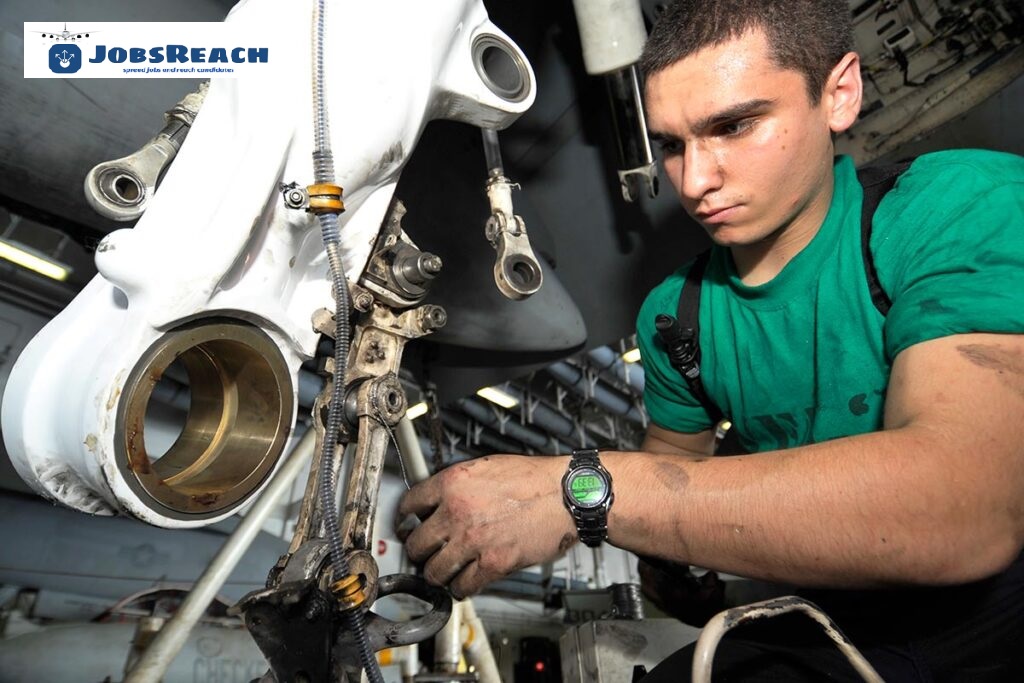
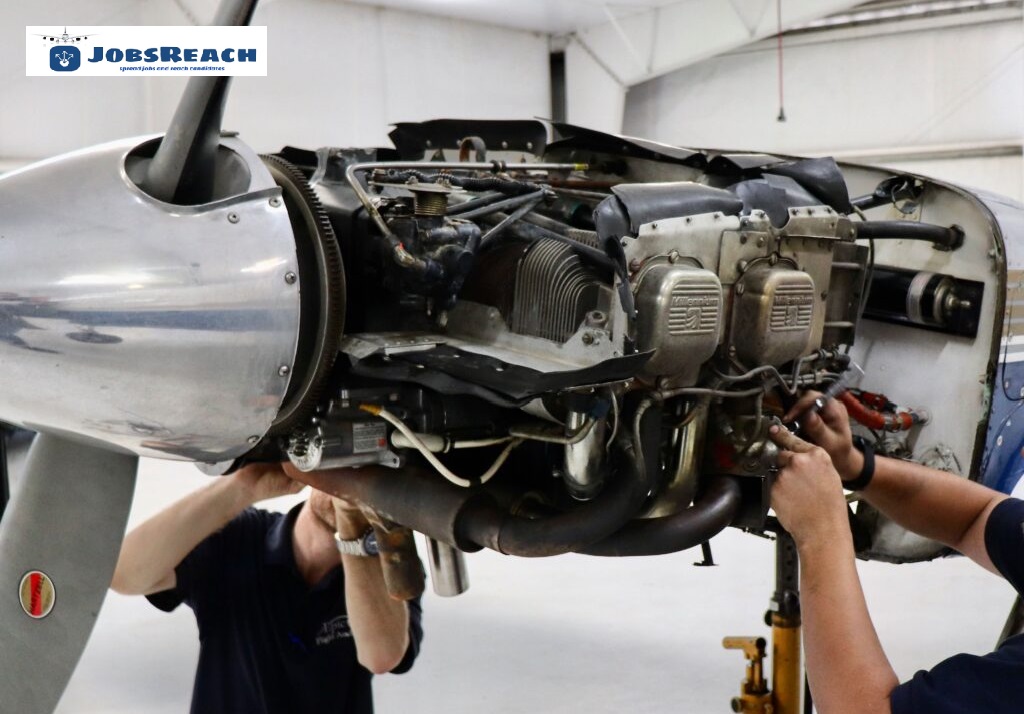
Becoming an aircraft mechanic demands extensive knowledge of aviation and aviation safety. This role involves maintaining and repairing various aircraft systems and components, including the fuselage, wings, engine, hydraulics, and fuel system.
To become a certified aircraft mechanic, you must complete rigorous training and education. This includes mastering aviation terminology, maintenance practices, safety measures, basic electrical functions and principles, aerospace materials and hardware, and all engine systems and propellers.
Additionally, working as an aircraft mechanic requires exceptional attention to detail to meet both customer expectations and the safety regulations set by the Federal Aviation Administration (FAA).
For those passionate about aviation, being an aircraft mechanic is a rewarding career. With dedication and hard work, you can contribute to the advancements in the aeronautical field!
2.They must possess a thorough understanding of aviation systems
Aircraft mechanics require a deep understanding of aviation systems, specifically hydraulics, pneumatics, and electrical systems. This knowledge is crucial for passenger safety, as mechanics must accurately interpret service manuals to diagnose mechanical issues and perform repairs correctly.
They must have an intimate understanding of aviation systems, focusing on components such as powered lift systems, propellers, and navigation and communication equipment. A typical day might involve troubleshooting component malfunctions with aviation test equipment like multimeters, replacing engine parts, running aviation computer diagnostics, and responding to emergency calls as needed.
Therefore, exceptional technical knowledge of aviation systems is essential for the job and must be acquired before becoming an aircraft mechanic.
3.Aircraft mechanics must be proficient in reading blueprints and schematics
As an aircraft mechanic, interpreting blueprints and schematics is crucial for effectively diagnosing and repairing malfunctions. Schematics are detailed diagrams that outline the design of an aircraft’s systems and components, while blueprints offer additional visual guidance related to each part of the system.
To accurately address any mechanical issue, it’s essential to understand these blueprints and schematics to pinpoint the exact source of the malfunction. Therefore, aircraft mechanics must have a comprehensive understanding of how each component works and interacts with others to ensure that repairs are both precise and safe.
4.They must be capable of using hand tools and power tools safely
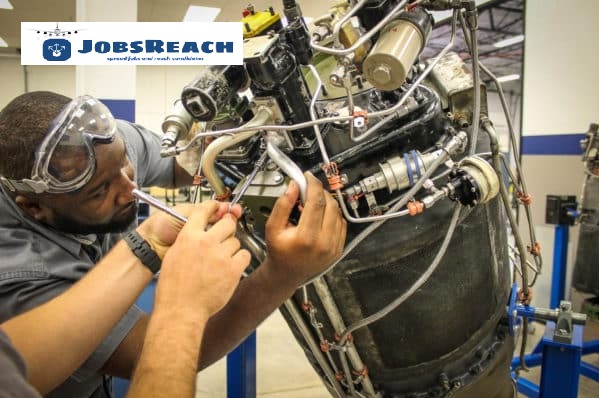
Being an aircraft mechanic involves using a variety of hand and power tools for disassembling, assembling, inspecting, and repairing aircraft systems. Proper tool use is crucial for making precise adjustments and repairs safely. Familiarity with a broad range of tools is necessary for effective diagnosis and repair.
Mechanics must also understand the correct use of each tool to avoid damaging the aircraft or its systems during repairs. This includes keeping tools in good condition and storing them safely.
Additionally, understanding safety measures when working with hand and power tools is important. This includes wearing protective eyewear and gloves, and being aware of potential hazards in the work environment.
By adhering to these practices, aircraft mechanics can ensure that all repairs are performed accurately and safely.
5.They may need to work overtime or on weekends, as aircraft often require maintenance outside of regular business hours.
Those considering a career as an aircraft mechanic should be prepared for extended hours to meet the maintenance needs of aircraft. The aviation industry operates around the clock, requiring mechanics to often work outside of regular business hours, including evenings and weekends.
This role may also involve travel if maintenance is needed away from home, and flexibility in scheduling is essential to accommodate the demands of airlines.
Therefore, before pursuing this profession, it’s important to be comfortable with the possibility of working beyond standard working hours.
6.Aircraft mechanics must have a high school diploma or equivalent. Additionally, they may need an associate’s degree or certification from an accredited aviation school.
To become an aircraft mechanic, a high school diploma or equivalent is required. Additional qualifications, such as an associate’s degree from an accredited aviation school or certification from the Federal Aviation Administration (FAA) or the National Center for Aircraft Technician Training (NCATT), are also advantageous.
These qualifications demonstrate a commitment to the field and can enhance employment prospects as an aircraft mechanic. Additionally, a valid driver’s license may be necessary in certain situations.
Therefore, having the appropriate qualifications, certifications, and licenses is essential for those pursuing a career as an aircraft mechanic.
7.They must pass a Federal Aviation Administration (FAA) physical exam every two years.
To work in the aviation industry, aircraft mechanics must pass a physical examination conducted by the Federal Aviation Administration (FAA) every two years. This exam includes tests for hearing, vision, respiratory function, cardiovascular health, and neurological status. The purpose is to ensure that all personnel working on aircraft are physically capable of performing their duties.
Additionally, since the role may involve handling hazardous materials and working in challenging conditions, maintaining a valid physical examination is crucial.
Therefore, individuals considering this profession should ensure they are in good physical condition to pass all FAA requirements.
8.Aircraft mechanics typically earn between $34,000 and $67,000 annually
Aircraft mechanics typically earn between $34,000 and $67,000 per year. The salary range varies based on experience, qualifications, and the region of employment.
Additionally, benefits such as health insurance, pension plans, and paid vacation days may be offered, depending on the employer.
Therefore, individuals considering a career in aviation should be aware of the potential earnings and ensure their qualifications and experience are of a high standard to maximize their earning potential.
For insights into the broader employment landscape, explore the 2024 Job Market in the Netherlands, including key trends, opportunities, and salary ranges.
9.They can find employment with airlines, aircraft manufacturers, or government agencies
The aviation industry is highly competitive, and job opportunities are not guaranteed. However, aircraft mechanics can find employment with airlines, aircraft manufacturers, or government agencies.
Each of these employers may have different qualifications and experience requirements, so it is important to research the specific criteria before applying for positions. Additionally, many employers prefer candidates with up-to-date FAA certification.
Therefore, those considering a career as an aircraft mechanic should ensure they have the appropriate qualifications and certifications to enhance their chances of securing employment.
10.Aircraft mechanics must pursue continuing education and training to stay current with the latest advancements in aviation technology
The aviation industry is continuously evolving, so aircraft mechanics must keep up with the latest technology to remain employed.
Fortunately, there are numerous continuing education opportunities available to help them stay ahead. Many employers also offer additional training, such as seminars, workshops, and online courses.
Therefore, aircraft mechanics should take advantage of these development opportunities to stay informed about industry advancements. This will help them stay competitive and enhance their chances when applying for positions in the aviation industry.
Conclusion
Aircraft mechanics are crucial to the aviation industry, as they ensure that all aircraft are in safe working condition. Those interested in this profession should obtain the necessary qualifications, certifications, and licenses to enhance their chances of securing employment.
Moreover, staying current with the latest technology and industry advancements is essential to remain competitive and successful. With the right qualifications and ongoing training, aircraft mechanics can enjoy a rewarding career in the aviation industry.
Here JobsReach reaches candidates across the globe with relevant opportunities, attracting ideal applicants for the job vacancies posted by employers on our platform, and makes hiring possible without boundaries. JobsReach has no limits, connecting with potential applicants from anywhere in the world directly, without intermediaries.