Tag: Aviation Careers

  • Beyond Job Boards: How JobsReach Is Building Industry-Specific Career Ecosystems

    In today’s fast-moving professional world, finding the right opportunity or the right talent shouldn’t feel like searching for a needle in a haystack.

    Yet for many professionals in aviation, healthcare, and technology, that’s exactly what job searching has become.

    For years, professionals across industries have relied on large job platforms to find opportunities, grow their careers, and connect with employers.

    But here’s the reality:
    scale has come at the cost of relevance.

    And that’s where JobsReach is redefining the experience.

    Enter JobsReach, an industry-specialized career and hiring ecosystem designed to serve niche professional sectors with precision, intelligence, and community at its core.

    JobsReach - Industry Ecosystem

    🔍 An Industry-Centric Alternative to Generic Job Platforms

    Traditional job platforms cast a wide net. They aim to serve everyone across every profession. While that scale brings visibility, it often sacrifices relevance.

    JobsReach takes a different approach.

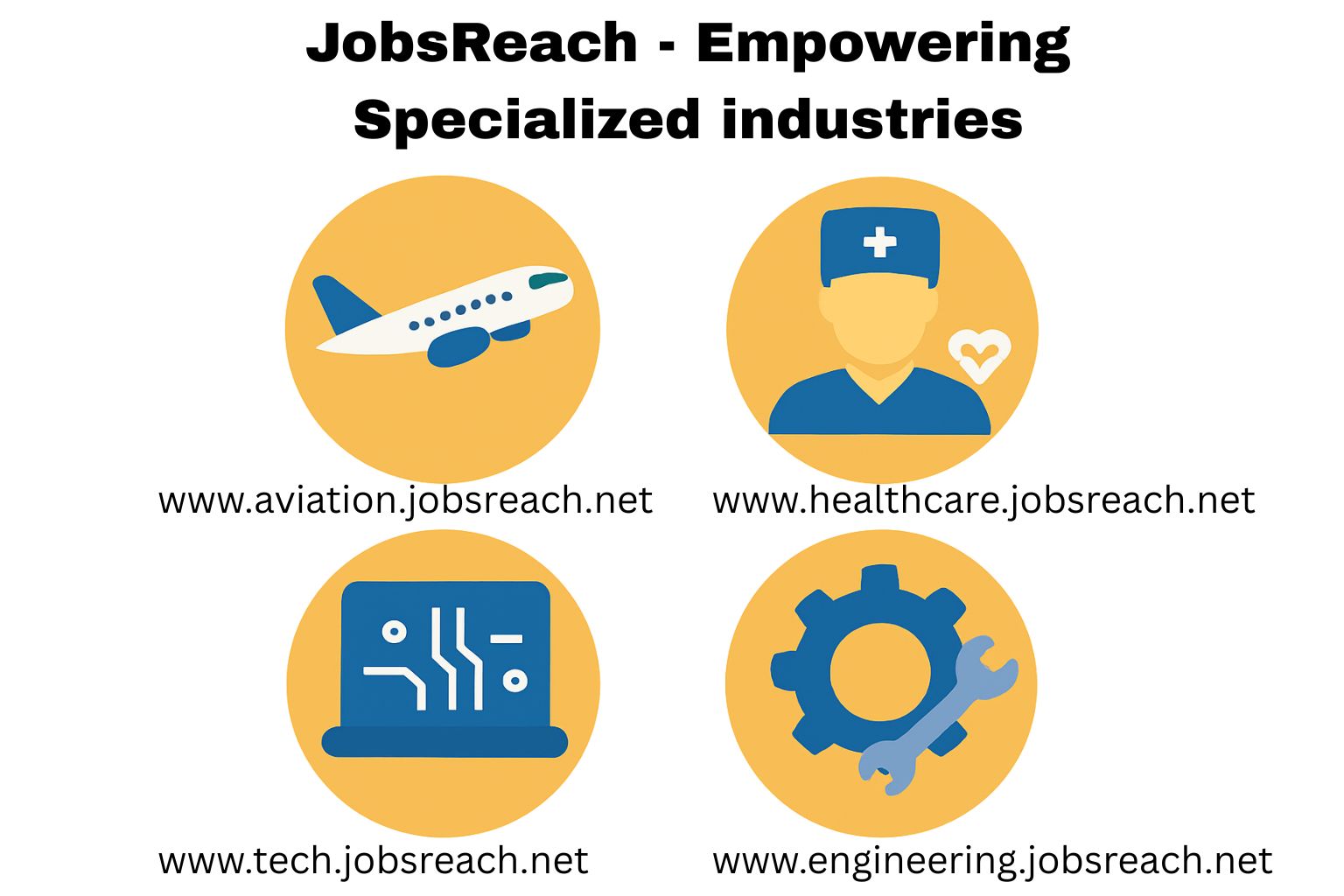
    Instead of broad listings and generalized networking, it offers dedicated ecosystems for:

    • ✈️ Aviation
    • 🏥 Healthcare
    • 💻 Technology

    Each ecosystem is tailored to the unique hiring demands, skill structures, and certification requirements of its industry.

    The result?
    More relevance. Less noise. Better matches.

    Why This Concept Matters Today

    Across aviation, healthcare, and technology, structural challenges are reshaping hiring.

    📍 High Demand & Skill Shortages

    • Aviation faces projected shortages of pilots, technicians, and air traffic professionals.
    • Healthcare continues to struggle with workforce gaps, especially in specialized and critical care roles.
    • Technology evolves faster than traditional hiring pipelines can keep up.

    Employers urgently need qualified, certified, and experienced professionals efficiently.

    At the same time, professionals need visibility, clarity, and direct access to opportunity.

    JobsReach was designed to bridge that gap.

    The Bigger Vision

    JobsReach represents a shift in how specialized industries approach hiring.

    It blends:

    • Industry specialization
    • AI recruitment technology
    • Professional networking tools
    • Knowledge-sharing resources

    For professionals who feel underserved by broad platforms, this industry-centric model offers a more relevant and empowering alternative.

    It’s not just about finding a job.
    It’s about building a career within a community that understands your profession.

    And that’s what makes JobsReach different.

    If you’re ready for a smarter, more focused way to connect talent with opportunity, the future of industry hiring may already be here.

    🧠 More Than a Job Platform — A Career Ecosystem

    Beyond hiring tools, JobsReach strengthens its ecosystem through a dedicated knowledge base that:

    • Shares industry insights and career advice
    • Highlights emerging skills and market demand
    • Positions employers as thought leaders

    This continuous learning environment supports long-term career growth not just job placement.

    What JobsReach Does Differently

    JobsReach is more than a listing site, it’s a connected career ecosystem built on these pillars:

    🧠 1. AI‑Driven Precision Matching

    JobsReach uses intelligent AI algorithms to:

    • Analyze job requirements and candidate profiles
    • Automate tailored candidate screening
    • Recommend jobs based on real skill match (not just keywords)

    This reduces irrelevant applications and speeds up hiring cycles.

    🤝 2. Deep Industry Engagement

    Professionals gain specialized networking tools and communities where they can:

    • Exchange insights and trends
    • Showcase expertise through personalized profiles and video introductions
    • Participate in mentorship and workshops with industry peers

    📚 3. Career Growth & Knowledge Tools

    Beyond jobs, JobsReach strengthens professional development by:

    • Publishing industry insights and trend data
    • Sharing curated career advice tailored to each sector
    • Helping candidates understand emerging career paths and skill demands

    What JobsReach Looks Like in Action

    JobsReach is not a concept, it’s a growing ecosystem already in motion.

    Through platforms like Aviation JobsReach and Healthcare JobsReach, professionals gain access to highly targeted opportunities aligned with their certifications, experience, and career paths.

    At the same time, the JobsReach Blogs and knowledge base provide continuous insights into industry trends, emerging skills, and career strategies bridging the gap between learning and hiring.

    This integrated approach transforms job searching from a fragmented process into a connected career journey.

    💡 What Makes JobsReach Truly Different

    JobsReach is more than a job platform. it’s a dynamic industry ecosystem designed to foster peer-to-peer networking and meaningful professional connections. Within the platform, professionals and employers can:

    • Connect with peers and industry leaders to expand their global network
    • Gain insights and share opportunities specific to their field
    • Ask questions and engage in community discussions
    • Mentor and learn from others, sharing expertise and real-world experience
    • Actively contribute to the industry conversation, building visibility and credibility

    In short, JobsReach empowers professionals to not just find jobs, but to grow, collaborate, and thrive within a connected industry network.

    The Future of Industry Hiring

    For professionals who feel lost in crowded platforms…
    For employers struggling to find the right talent…

    JobsReach offers a smarter, more focused alternative.

    It’s not just about finding your next job.
    It’s about building your career in a space designed for your industry.

    👉 The future of hiring isn’t bigger platforms.
    👉 It’s better, smarter, industry-focused ecosystems.

    And that future is already taking shape with JobsReach.

    For a deeper look at how social media influences professional growth and where it falls short, see our related article: Social Media Platforms: The New Frontier of Entertainment and Its Limits for Professional Growth

  • Airline Hiring Costs: How JobsReach Aviation Reduces Them

    The aviation industry is one of the most safety-critical and highly regulated sectors in the world. Hiring pilots, cabin crew, and technical staff is not just about filling vacancies, it directly impacts passenger safety, operational efficiency, and service quality.

    Despite advances in digital recruitment, airlines continue to rely heavily on in-person recruitment drives. These events allow recruiters to assess candidates’ technical skills, behavior, and professionalism in ways that online applications alone cannot. However, traditional methods are expensive, resource-intensive, and time-consuming.

    Platforms like JobsReach Aviation are now helping airlines optimize recruitment by reducing costs, improving efficiency, and streamlining the hiring process without compromising quality.

    Why Airlines Prefer In-Person Recruitment Drives

    Airlines like Emirates, Qatar Airways, and Singapore Airlines still conduct large-scale, in-person hiring events for several key reasons:

    1. Safety-Critical Evaluation

    Aviation roles demand more than certifications:

    • Pilots must demonstrate decision-making under pressure and situational awareness.
    • Cabin crew need strong communication, customer service skills, and emergency response capability.

    These competencies are difficult to measure effectively through online applications alone.

    2. Real-Time Behavioral Assessment

    In-person drives allow recruiters to evaluate:

    • Professional appearance and grooming
    • Body language and confidence
    • Interpersonal and teamwork skills

    For cabin crew, these factors directly impact passenger experience and brand image.

    3. Group Exercises and Simulations

    Recruitment events often include:

    • Group discussions
    • Emergency response simulations
    • Role-playing service scenarios

    These exercises replicate real inflight situations, revealing skills that resumes cannot capture.

    4. High-Volume Screening Efficiency

    A single recruitment day can process hundreds of candidates through multiple assessment stages, reducing hiring timelines while maintaining rigorous evaluation standards.

    Staffing in Recruitment Drives

    In-person recruitment is resource-intensive. Typical staffing requirements include:

    Cabin Crew Drives

    • 3–8 HR recruiters
    • 2–5 assessors/trainers
    • 1–3 coordinators/admin staff

    Total: 6–15 staff per event

    Pilot Drives

    • Senior captains (technical assessors)
    • HR recruiters
    • Simulator instructors and psychologists

    Total: 5–12 specialized staff

    These professionals often travel internationally, adding significant logistical costs.

    Total Realistic Campaign Cost

    Recruitment costs extend far beyond the event itself, including preparation, staffing, travel, marketing, and assessment tools.

    For cabin crew hiring, costs typically include recruitment agency support, digital and social media promotion, venue and logistics management, and internal screening processes. These activities are often conducted at scale, requiring coordinated effort across multiple teams and locations.

    For pilot recruitment, the cost structure is more complex due to technical and regulatory requirements. In addition to sourcing and marketing, airlines must invest in simulator assessments, technical evaluations by experienced captains, and travel and logistics for both candidates and assessors.

    Overall, airline hiring campaigns represent a significant operational and financial commitment, driven by the need for safety, compliance, and high-quality talent selection. This highlights the importance of optimizing recruitment strategies to improve efficiency and reduce unnecessary costs.

    Hidden Cost Drivers:

    • Agency commissions (15–20% per pilot hire)
    • Global social media campaigns targeting aviation professionals
    • Travel and accommodation for recruiters
    • Manual screening and verification processes

    Why Airlines Would Partner with JobsReach Aviation

    JobsReach Aviation helps airlines streamline recruitment, reduce costs, and improve candidate quality, while maintaining industry standards.

    1. Reduce Dependency on Recruitment Agencies

    By enabling direct candidate applications, JobsReach reduces:

    • High agency commissions
    • Multiple layers of resume screening
    • Marketing duplication

    This lowers hiring costs significantly. For example, replacing a €20,000 agency commission per pilot with a flat platform fee can save airlines hundreds of thousands per campaign.

    2. Industry-Specific Talent Pool

    Unlike general platforms, JobsReach focuses solely on specialized industry such as aviation professionals:

    • Categorized by role: Pilot, Cabin Crew, Engineer
    • Experience-based filtering: flight hours, aircraft type, recency
    • Structured profiles for faster evaluation

    This improves candidate relevance and reduces HR workload.

    3. AI-Assisted Initial Screening

    JobsReach can support:

    • Parsing CVs to extract experience, licenses, and type ratings
    • Ranking candidates against airline standards
    • Shortlisting suitable candidates for final in-person assessment

    This reduces manual screening time by 50–70% and speeds up hiring cycles.

    4. Compliance Verification (Manual Today, Scalable Tomorrow)

    Currently, candidates upload licenses and medical certificates, which are manually validated. While accurate, this process highlights an opportunity for future automation to improve speed and scalability.

    5. Global Employer Branding

    JobsReach helps airlines:

    • Promote hiring campaigns worldwide
    • Target specific aviation segments
    • Highlight company culture, fleet growth, and career opportunities

    This strengthens brand visibility and engagement among qualified professionals.

    Building the Future of Airline Recruitment

    Airline Hiring

    While in-person drives remain important for safety-critical evaluations, airlines can now combine them with digital platforms and AI tools to:

    • Reduce costs
    • Improve candidate quality
    • Accelerate hiring timelines
    • Support global talent sourcing

    By partnering with JobsReach Aviation, airlines can maintain rigorous in-person assessments while reducing operational burden and creating a seamless, modern recruitment ecosystem.

    Join the JobsReach Aviation Ecosystem

    Airline recruitment is resource-intensive and costly, but it is essential for ensuring safety, service quality, and operational excellence. Partnering with JobsReach Aviation provides a smarter, cost-effective solution, combining direct applications, AI-assisted screening, and access to a global aviation talent ecosystem—while preserving the value of in-person assessments.

    By partnering with JobsReach Aviation, airlines can reduce hiring costs, streamline recruitment, and maintain compliance, while actively supporting a larger mission: promoting specialized industries and enabling aviation professionals to access the right opportunities with ease.

    Partner with JobsReach Aviation today to connect with qualified candidates, showcase your brand globally, and grow the aviation industry together.

    If you want a complete roadmap to aviation careers in Europe for 2026 — covering pilots, ATC, and airport jobs, check out this article Europe Aviation Career

    Industry Context & Cost Justification

    While airlines do not publicly disclose detailed recruitment budget breakdowns, several industry data points show that recruitment and training in aviation involve significant expense.

    Specialist job boards charge employers substantial fees for job listings and talent access, reflecting part of the recruitment cost structure (AirlineJobs Pricing). Platforms like JobAvion illustrate that success fees for aviation hires can be a meaningful percentage of salary, showing how agency-type costs are part of airline hiring expenses (JobAvion).

    Research on pilot turnover confirms that turnover and recruiting costs represent major airline cost categories, reinforcing that high-quality hiring is resource-intensive (ERAU Study on Pilot Turnover). Additionally, pilot training and certification — a key part of onboarding new talent — often requires substantial financial investment (Aviation HR Statistics).

    Aviation recruitment authorities also highlight the hidden costs associated with poor hiring decisions, including financial losses, compliance risk, and operational disruption (Goose Recruitment Insights).

  • Why Specialized Industries Are Struggling And How Purpose-Built Platforms Like JobsReach Can Drive Growth

    Why Specialized Industries Are Struggling And How Purpose-Built Platforms Like JobsReach Can Drive Growth

    In 2025, many specialized industries like aviation, healthcare, technology, engineering, and others faced systemic setbacks that go beyond cyclical business trends. These challenges were not just about economic headwinds, they revealed a deeper structural issue in how professionals connect, learn, and advance their careers.

    In crowded digital environments dominated by generic social media and broad professional networks, the voices and needs of specialized industries are often hidden, buried under content that has little relevance to the specific skills, insights, and opportunities these professionals require.

    Specialized professionals in aviation, healthcare, tech, and engineering are often buried under irrelevant content on generic platforms; JobsReach provides industry-focused networking and growth.

    To understand both the problem and the solution, it helps to look at the data.


    📉 The Hidden Crisis in Specialized Industries

    Healthcare: A Global Workforce Shortage

    The healthcare industry continues to grapple with a massive talent gap:

    • A projected shortage of at least 10 million healthcare workers globally by 2030 has been identified, with serious implications for public health outcomes and economic growth. Closing this gap could avert 189 million years of life lost and add $1.1 trillion to the global economy. McKinsey & Company
    • Many healthcare organizations report difficulty recruiting staff with specialized digital health skills, even as demand for AI and telemedicine roles grows. WifiTalents

    These shortages are not evenly distributed; they are most acute in roles that directly impact patient care, innovation adoption, and operational efficiency.


    Aviation: Growth Without Enough Workforce

    Although travel demand rebounded strongly post-pandemic, the aviation workforce has struggled to keep pace:

    • Estimates project a need for around 1.5 million new aviation professionals globally by 2034, spanning pilots, technicians, cabin crew, and air traffic controllers. VisaVerge
    • Aviation companies are investing heavily in upskilling, with 78% planning increased training, yet only about 35% of staff feel confident in their digital skills. WifiTalents

    This mismatch between workforce supply and industry growth threatens reliability, innovation adoption, and safe operations.


    Tech & Engineering: Skills Gap Continues to Hamper Growth

    The technology sector is facing some of the most intense competition for talent:

    • Nearly 50% of employers worldwide report difficulty finding candidates with the right skills, and 75% struggle to fill technology and digital roles. Market.biz
    • The World Economic Forum reports that 50% of employees will need reskilling by 2025 due to rapid technological change—a trend that spans across engineering and tech roles. Keevee

    In engineering and industrial sectors more broadly, 73% of employers say they are struggling to find the skilled talent they need, particularly in engineering, manufacturing, and tech domains. ManpowerGroup Nederland


    📣 Why Generic Platforms Fall Short

    So why is this happening, even as workforce shortages become more visible?

    JobsReach shifts the professional landscape by offering industry-focused platforms that connect talent with opportunities, insights, and peers in their field.

    Today’s major networking and job platforms are built for scale, not relevance. They prioritize broad engagement over focused industry insights, leading to several problems:

    • Noise over knowledge: Content unrelated to specific industries competes for attention, burying meaningful professional insights beneath marketing, lifestyle posts, and generic content.
    • Poor signal for specialized skills: Professionals in aviation, healthcare, technology, or engineering find it difficult to identify peer insights, emerging trends, and relevant opportunities.
    • Networking limitations: Generic platforms lack the context to facilitate deep mentorship, industry-specific collaboration, and targeted job matching.

    In short, professionals are present but their communities and career pathways are not being supported.


    🛠 The Case for Industry-Focused Platforms

    To unlock the full potential of specialized industries, professionals need focused ecosystems where:

    • Skills and insights are shared among true peers
    • Career pathways are visible and navigable
    • Employers and candidates can connect directly on relevant terms
    • Mentorship and growth opportunities are embedded in the network

    This is where specialized platforms make a difference.


    🌐 Introducing the JobsReach Ecosystem

    JobsReach is pioneering a new model of industry-focused professional networking and opportunity discovery:

    🔹 JobsReach — A hub for industry-specific career growth and deep professional engagement.
    👉 https://jobsreach.net/

    A professional network for industry talent, JobsReach helps professionals find jobs, mentorship, and insights within their specialized fields.

    🔹 JobsReach Aviation — A dedicated community for pilots, engineers, maintenance professionals, and aviation leaders.
    👉 https://aviation.jobsreach.net/

    🔹 JobsReach Healthcare — A space for nurses, clinicians, allied health professionals, administrators, and healthcare innovators.
    👉 https://healthcare.jobsreach.net/

    🔹 JobsReach Tech & Engineering — Designed for software developers, engineers, data scientists, cloud and cybersecurity experts, and technology leaders.
    👉 https://tech.jobsreach.net/

    These platforms are built not to replicate generic social feeds, but to elevate industry relevance ensuring professionals find insights, connections, mentorship, and opportunities tailored to their field.


    🌟 The Way Forward: Growth Through Community and Mentorship

    In 2026 and beyond, growth will no longer be about being everywhere online, it will be about being where it matters.

    For aviation professionals, that means connecting with peers who understand the nuances of safety, regulation, and innovation.
    For healthcare workers, it means sharing insights on digital transformation and patient care frameworks.
    For tech and engineering professionals, it means collaborating around emerging technologies, skill pathways, and career acceleration.

    Mentorship, community, and focused knowledge sharing will be the engines of future industry growth. Generic platforms cannot serve these needs effectively not when industries are evolving faster than ever.

    With data showing persistent shortages, unmet training needs, and growing demand for specialized skills, the case for industry-focused networks has never been stronger.

    Emerging industry specialized platforms for professional growth
    Industry-focused platforms like JobsReach are stepping in to fill the gap for sectors such as aviation, healthcare, and technology.

    JobsReach is leading this transformation bringing professionals together in the spaces where their careers and industries truly grow.

    For more insights on career growth and industry trends, check out our Specialized Industry Blogs.

    If you’re ready for meaningful connections and industry-specific opportunities, explore the JobsReach community today:

    🧑‍💼 / 👩‍💼 https://jobsreach.net/forcandidate.html

    👥/🏢 https://jobsreach.net/foremployer.html

  • Social Media Platforms: The New Frontier of Entertainment and Its Limits for Professional Growth

    Over the past decade, social media platforms have evolved far beyond networking tools. They have become central hubs of entertainment, increasingly replacing traditional formats like television and movie theatres. Rather than passive consumption of scheduled content, modern audiences now experience real-time, interactive entertainment shaped by users themselves a cultural shift with profound effects on media consumption and social behaviour.

    Rise of Social Media platforms and the need for industry specialized platforms
    Social media is overtaking traditional media, making specialized platforms indispensable in fields such as aviation, healthcare, and technology

    🌐 Social Media as the New Entertainment Powerhouse

    Today’s platforms like TikTok, YouTube, Instagram and others are not just places to connect with friends. They have become primary entertainment destinations, especially for Gen Z and younger viewers who prefer short-form, personalized, and algorithm-driven content over traditional broadcast shows and long-form movies.

    • Shift in viewing habits: Social video now accounts for significant portions of what used to be television viewing, with sources reporting social platforms contributing up to roughly 20% of all TV consumption.
    • Ad revenue transformation: Creator-driven content on platforms such as YouTube and TikTok is poised to surpass traditional media in advertising revenue marking a pivotal shift in where money and attention are flowing.
    • Interactive formats: Features like live-streaming, duet challenges, and short clips have turned users into both content creators and consumers, reshaping entertainment into a participatory ecosystem.

    This transformation is rooted in user-generated content, where creators entertain large audiences by sharing their daily lives, humour, talents, and opinions often exposing personal facets of their lives in public spaces to generate engagement and followers.

    🎭 The Social Media Entertainment Effect: Exposure for Attention

    Unlike traditional media, where professionals produce scripted shows or films, social platforms reward visibility and shareability. This often drives users to:

    • Exhibit parts of their personal lives publicly for entertainment.
    • Pursue viral reach by leaning into trends, challenges, and personal storytelling.
    • Prioritize content formats that maximize likes, comments and followers.

    This dynamic has cultural implications: content driven by personal exposure and relatability dominates feeds, and algorithms amplify what is more shareable or sensational over what is informative or educational.

    While this enhances entertainment value and social engagement, it also means many users focus on popularity metrics rather than meaningful skill-building or career progress.

    📉 Why Mainstream Social Media Is Least Likely to Support Professional Growth

    Although platforms like LinkedIn have evolved into professional networks, mainstream social media inherently prioritizes entertainment, virality, and broad engagement over career development. A few reasons for this include:

    🔹 Entertainment Over Expertise

    • Content that captures attention (funny, sensational, emotionally charged) often crowds out content that fosters professional thinking and development.
    • Many people are drawn more by entertainment than educational or career-related content meaning the platforms’ design incentivizes viral entertainment over structured professional narratives.

    🔹 Noise vs. Signal

    • With millions of posts per day, relevant expertise-driven content gets drowned out unless someone has already established a dedicated audience.
    • Metrics like “views” and “likes” signal popularity, not professional credibility or skill.

    🔹 Algorithm Bias

    • Algorithms optimize for engagement and attention, not career advancement. Consequently, users interested in professional content often have to actively search for it, rather than it being delivered organically.

    🔹 Limited Professional Tools

    • While some social platforms feature job listings or events, they lack the specialized tools for career progression like mentorship frameworks, industry-specific communities, role-based learning paths, or verified accomplishments.

    📊 The Rise of Specialized Professional Platforms

    Generic social media is poorly suited for structured career growth, which is why specialized platforms focused on professional development are gaining traction. Platforms like JobsReach illustrate this trend. According to the JobsReach article, such specialized industry platforms meet the needs of modern professionals by offering curated networking, tailored industry insights, relevant job opportunities, and sector-specific communities.

    Whereas LinkedIn operates at a broad level, specialized platforms go deeper by:

    • Providing industry-targeted updates and trends (e.g., regulatory updates for aviation, research news for healthcare).(JobsReach blog)
    • Offering forums and discussions designed for professional advancement.(JobsReach blog)
    • Helping professionals stay connected with peers and mentors within their field.(JobsReach blog)
    • Connecting users transparently with job opportunities that match specific skill sets.

    These focused solutions bridge the gap left by broad networks, which tend to dilute content relevance in favour of engagement and entertainment.

    Expanding the Scope: How JobsReach Drives Industry-Focused Professional Growth Beyond Mainstream Platforms

    While the original JobsReach article highlights the importance of niche platforms for professionals, it doesn’t fully capture the breadth of JobsReach’s impact across specialized industries. Platforms like JobsReach are not only connecting professionals in general, but actively promoting sectors such as Aviation, Healthcare, and Technology, offering targeted resources, insights, and communities for industry-specific growth.

    This approach helps professionals:

    • Stay focused on their industry: By connecting with peers, mentors, and opportunities specific to their field.
    • Access curated industry knowledge: Including updates, trends, and best practices relevant to their sector.
    • Advance skills and careers effectively: Through targeted learning, networking, and job-matching opportunities.

    Moreover, JobsReach and similar specialized platforms are emerging as the go-to destination for professional growth, bridging the gap left by mainstream social networks that prioritize entertainment and visibility over structured career development. By fostering industry-wide engagement, these platforms guide professionals toward meaningful advancement and provide tools for long-term success in their respective fields.

    This broader perspective demonstrates that professional growth thrives in specialized ecosystems, where content, connections, and opportunities are all aligned with industry needs something general social media cannot deliver at scale.

    Emerging industry specialized platforms for professional growth

    The Next Evolution of Social Media: Professional Growth Beyond Entertainment

    Social media has long dominated as a source of entertainment, reshaping how audiences consume content and shifting attention away from traditional television and movie theatres. Its interactive, fast-paced environment encourages creativity and visibility, but often prioritizes entertainment over structured career development.

    The next generation of social platforms addresses this gap by focusing on professional advancement and industry-specific engagement. Specialized platforms like JobsReach offer curated communities, targeted industry insights, and tailored opportunities that mainstream networks cannot. By fostering expertise-driven networking, mentorship, and career-focused collaboration, these platforms are becoming the essential spaces for meaningful professional growth, guiding professionals toward purposeful development beyond social entertainment.

    For professionals seeking industry-specific job opportunities, see our article: Beyond Job Boards: How JobsReach Is Building Industry-Specific Career Ecosystems.

  • Exploring Career Opportunities in the Growing Aviation Industry

    The aviation industry is soaring to new heights, driven by rising global travel demand, airline expansion, and technological advancements in aircraft design and operations. From ground support roles to flight crews, technical engineers, and administrative positions, the sector offers a wide range of career paths. Platforms like JobsReach Aviation are helping bridge the gap between talent and opportunity, enabling aviation professionals to connect globally and allowing airlines and aviation companies to find qualified, certified candidates efficiently.

    Aviation Career Opportunities
    Aviation Career Opportunities

    Global Job Opportunities in Aviation

    Europe: Countries like the UK, Germany, France, and the Netherlands are expanding airline networks and MRO facilities. There is demand for pilots, MRO engineers, CAMO specialists, and cabin crew due to retirements and post-pandemic travel growth (EASA Report 2024).

    Middle East: GCC countries including UAE, Saudi Arabia, Qatar, Oman, and Bahrain are investing heavily in aviation infrastructure. Airlines such as Emirates, Qatar Airways, and Saudia actively recruit pilots, engineers, air traffic controllers, and cabin crew from Europe and Asia (CAPA Center for Aviation, 2025).

    United States: The US aviation industry has an acute demand for pilots, maintenance engineers, and aviation technicians due to airline fleet expansions and the retirement of senior staff (Bureau of Labor Statistics, 2024).

    Key Aviation Professions and Career Paths

    1. Ground Support Personnel

    Handle baggage, aircraft towing, fueling, and apron operations.

    Qualifications: High school diploma, physical fitness, airport safety knowledge
    Certifications: Aviation Security, Airport Handling, Forklift/Equipment training
    Career Growth: Ramp Agent → Operations Supervisor → Ground Operations Manager → Airport Operations Director

    2. MRO (Maintenance, Repair, and Overhaul) Engineer

    Maintain, repair, and overhaul aircraft to ensure airworthiness.

    Qualifications: Bachelor’s in Aerospace, Mechanical, or Avionics Engineering
    Certifications: EASA Part-66, FAA license, type-specific endorsements
    Career Growth: Junior MRO Engineer → Senior Engineer → Maintenance Manager → Director of Maintenance

    Learn why B1/B2 aircraft engineer roles are in high demand in the Netherlands and explore opportunities in B1/B2 Aircraft Engineer Jobs in the Netherlands (2026): Why Demand Is Surging.

    3. Sheet Metal / Aircraft Structural Technicians

    Repair and fabricate aircraft structures.

    Qualifications: Diploma in Aircraft Maintenance Engineering, metalwork skills
    Certifications: EASA Part-66 B1/B2, Welding/Composite certifications
    Career Growth: Apprentice → Senior Sheet Metal Worker → Structural Team Lead → Aircraft Maintenance Manager

    4. CAMO (Continuing Airworthiness Management Organization) Engineer

    Ensure aircraft compliance and manage airworthiness records.

    Qualifications: Bachelor’s in Aeronautical, Aerospace, or Mechanical Engineering
    Certifications: EASA Part-66, CAMO-specific approvals
    Career Growth: CAMO Engineer → Senior CAMO Engineer → CAMO Manager → Airworthiness Director

    5. Pilot

    Operate aircraft safely for commercial, cargo, or private flights.

    Qualifications: High school diploma minimum; aviation degree preferred
    Certifications: PPL → CPL → ATPL, Type Ratings
    Career Growth: First Officer → Senior First Officer → Captain → Chief Pilot / Flight Ops Manager

    6. Air Hostess / Flight Attendant

    Ensure passenger safety, comfort, and in-flight service.

    Qualifications: High school diploma; degree in hospitality or communication preferred
    Certifications: Cabin Crew Attestation, First Aid & CPR, Safety/Emergency Training
    Career Growth: Flight Attendant → Senior Flight Attendant → Purser → Cabin Services Manager

    7. Air Traffic Controller (ATC)

    Manage aircraft movements and ensure airspace safety.

    Qualifications: Bachelor’s in Aviation or Aeronautical Science
    Certifications: ATC License, Medical Fitness Certificate
    Career Growth: Junior Controller → Tower Supervisor → Area Controller → ATC Manager

    8. Aviation Safety & Quality Inspectors

    Monitor compliance with safety regulations and audit procedures.

    Qualifications: Bachelor’s in Aviation, Aeronautical Engineering, or related field
    Certifications: EASA Safety & Quality Auditor, ISO or aviation safety certifications
    Career Growth: Safety Officer → Senior Safety Inspector → Safety Manager → Director of Safety

    9. Flight Operations / Dispatch Officer

    Coordinate flight planning, fuel, weather, and regulatory compliance.

    Qualifications: Bachelor’s in Aviation or Aeronautical Science
    Certifications: Aircraft Dispatcher License (FAA/EASA), ICAO compliance training
    Career Growth: Flight Dispatcher → Senior Dispatcher → Operations Supervisor → Director of Flight Operations

    Aviation Growth
    Aviation Growth

    How JobsReach Aviation Is Transforming Careers and Recruitment

    JobsReach Aviation connects aviation professionals and employers globally:

    • Global Talent Connectivity: Network with professionals, share experience, and explore new opportunities.
    • Direct Hiring for Employers: Airlines and aviation companies can post vacancies, find qualified candidates, and verify certifications.
    • Certification Verification: Ensures candidates meet regulatory standards, reducing hiring risks.
    • Networking & Career Growth: Professionals can expand their network, find mentorship, and access roles across MRO, CAMO, flight, ground support, and safety positions.

    This platform makes it easier for both professionals and employers to navigate the rapidly growing aviation industry while ensuring a certified, reliable workforce.

    Growth in aviation

    The aviation industry offers structured career paths, global mobility, and exciting opportunities for motivated professionals. From ground support to pilots, engineers, air traffic controllers, and cabin crew, there is a role for nearly every skillset. With platforms like JobsReach Aviation, aviation professionals can access global opportunities, while airlines can directly hire and verify qualified talent efficiently.

    Aviation Career Summary Table

    Comprehensive Overview of Key Aviation Roles

    Aviation RoleBasic QualificationsRequired CertificationsCareer PathJob Opportunities (Europe, Middle East, US)
    Ground Support PersonnelHigh school diploma; physical fitness; airport safety awarenessAviation Security, Airport Handling Certificates, Equipment HandlingRamp Agent → Supervisor → Ground Ops Manager → Airport Ops DirectorHigh demand in EU airports (France, UK, Germany), GCC hubs (UAE, Qatar, Saudi), US major airports
    MRO Engineer (Maintenance Engineer)Bachelor’s in Aerospace, Mechanical, or Avionics EngineeringEASA Part-66 / FAA A&P, Type RatingsJunior Engineer → Senior Engineer → Maintenance Manager → Director of MaintenanceStrong demand due to fleet expansions in Europe, GCC MRO hubs (Dubai, Jeddah, Doha), and US airlines
    Sheet Metal / Aircraft Structural TechnicianAircraft Maintenance Diploma; mechanical/metalwork skillsEASA B1/B2; Welding/Composites CertificationTechnician → Senior Technician → Structural Lead → Maintenance ManagerNeeded in European MRO centers, GCC heavy maintenance facilities, and US aircraft repair stations
    CAMO EngineerBachelor’s in Aeronautical/Aerospace/Mechanical EngineeringEASA Part-66; CAMO-specific approvalsCAMO Engineer → Senior CAMO → CAMO Manager → Airworthiness DirectorHigh demand in Europe’s regulated CAMO environment, expanding GCC fleets, and FAA-regulated US operators
    PilotHigh school diploma; aviation degree preferred; strong physical fitnessPPL → CPL → ATPL; Type RatingsFirst Officer → Senior FO → Captain → Chief PilotMassive shortage across European airlines, GCC premium carriers, and US regional & mainline operators
    Flight Attendant / Cabin CrewHigh school diploma; hospitality/communication preferredCabin Crew Attestation; First Aid & CPRCabin Crew → Senior Crew → Purser → Cabin Services ManagerHigh hiring activity across Europe, GCC luxury airlines, and US carriers
    Air Traffic Controller (ATC)Bachelor’s in Aviation/Aeronautical Science; strong concentrationATC License (ICAO/FAA/EASA); Medical FitnessJunior Controller → Tower/Approach Controller → Supervisor → ATC ManagerATC shortages in EU (Eurocontrol), GCC new airport expansions, and US FAA
    Aviation Safety & Quality InspectorBachelor’s in Aviation/Aeronautical EngineeringEASA/ICAO Safety Auditor Certificates; ISO CertificationsSafety Officer → Senior Inspector → Safety Manager → Director of SafetyRequired across EU aviation authorities, GCC regulators, US FAA-related roles
    Flight Operations / DispatcherBachelor’s in Aviation; understanding of meteorology & planningFAA/EASA Dispatcher License; ICAO trainingDispatcher → Senior Dispatcher → Ops Supervisor → Director of Flight OpsHigh demand across airlines in Europe, Gulf carriers, and US major airlines

    How JobsReach Aviation Supports These Careers

    JobsReach Aviation FeatureBenefit to Aviation Professionals & Employers
    Global Aviation Professional NetworkConnect with peers, mentors, and recruiters worldwide
    Direct Hiring ChannelAirlines & aviation companies can post vacancies and hire certified talent directly
    Certification VerificationEnsures EASA/FAA/ICAO licenses are authentic and up to date
    International Mobility ToolsHelps professionals explore jobs across Europe, Middle East, Asia, and US
    Profession-Specific Talent PoolsDedicated pools for pilots, MRO engineers, CAMO, ATC, cabin crew, and more

    References

    1. European Union Aviation Safety Agency (EASA) Annual Report 2024
    2. CAPA Centre for Aviation, GCC Aviation Recruitment Trends 2025
    3. Bureau of Labor Statistics, Aircraft Mechanics and Service Technicians Outlook, 2024
    4. ICAO – International Civil Aviation Organization