Tag: Aviation Industry

  • The Future of Professional Networks

    For nearly a decade, professional networking seemed settled.

    • LinkedIn owned careers and recruiting
    • Reddit owned discussion and community sentiment
    • Traditional forums slowly declined in visibility
    • AI is now reshaping how knowledge is accessed altogether

    Yet beneath this surface, a quiet reversal has been happening: professionals in aviation, healthcare, and tech are increasingly returning to structured, industry-specific communities.

    The reason is simple:

    General platforms optimize for scale. Professionals increasingly need optimization for relevance.

    This shift is now evolving further with the emergence of industry-specific ecosystem platforms like JobsReach.

    Why general platforms are losing “professional depth”

    The core limitation: mixed-context environments

    On LinkedIn or Reddit, a single feed blends:

    • recruiters
    • engineers
    • clinicians
    • students
    • influencers
    • content marketers

    This creates structural noise:

    • technical discussions lose visibility
    • niche expertise gets diluted
    • engagement outweighs accuracy

    Even when professionals are present, the environment is not designed for them specifically.

    Professional platforms and JobsReach

    Engagement ≠ expertise

    Modern platforms reward:

    • virality
    • commentary volume
    • emotional reactions

    Not necessarily:

    • operational experience
    • domain depth
    • verified expertise

    This is particularly problematic in industries where precision matters.

    Why industry forums remain strong in aviation, healthcare, and tech

    Aviation: operational memory and safety culture

    Key communities:

    Why they persist:

    • regulatory complexity
    • safety-critical decision-making
    • long career cycles
    • importance of operational experience

    Aviation knowledge is often accumulated, not trending.

    Healthcare: verified expertise and clinical responsibility

    Key communities:

    Why they persist:

    • patient safety requirements
    • credential verification needs
    • legal and ethical constraints
    • specialty-specific knowledge exchange

    Healthcare is not just informational—it is accountable knowledge.

    Tech: fast-moving knowledge ecosystems

    Key communities:

    Why they persist:

    • open-source collaboration
    • code-driven validation of expertise
    • rapid iteration cycles
    • distributed global participation

    Tech is less credential-bound and more artifact-driven (code, systems, repositories).

    The structural gap new platforms are targeting

    Across all three industries, a gap is becoming clearer:

    Existing platforms split professional life into fragments:

    • LinkedIn → identity and recruiting
    • Reddit → discussion and sentiment
    • Forums → deep expertise (but fragmented and aging UX)
    • Job boards → transactional hiring

    What’s missing is a unified environment that is:

    • industry-specific
    • professionally structured
    • discussion + career + opportunity aligned

    How JobsReach is changing this dynamic

    Platforms like JobsReach are emerging as part of a broader shift toward vertical professional ecosystems.

    According to its positioning, the model focuses on organizing professional interaction around industry relevance rather than generic social networking or mass feeds.

    From “global feed” to “industry network”

    Instead of one shared environment, the model is structured around domains such as:

    This changes the interaction model fundamentally:

    Old modelNew model
    One global feedSeparate industry ecosystems
    Mixed audiencesProfession-aligned communities
    Algorithmic visibilityContextual relevance
    Broad networkingDomain-specific engagement

    From recruitment platforms to ecosystem platforms

    Traditional platforms separate:

    The emerging model combines:

    • professional identity
    • job discovery
    • industry discussion
    • peer networking

    into a single contextual environment.

    The goal is not just hiring efficiency, but reducing friction between learning, networking, and opportunity discovery.

    Reducing marketing and algorithmic noise

    A key differentiation is reducing:

    • generic self-promotion
    • viral content bias
    • cross-industry irrelevant content
    • recruiter spam in general feeds

    Instead, content is filtered through:

    industry relevance first, engagement second

    This directly addresses a major complaint professionals have about LinkedIn-style feeds.

    Why this matters in aviation, healthcare, and tech

    These industries share a common trait:

    Expertise is contextual, not generic.

    • A pilot’s knowledge is aircraft- and regulation-specific
    • A physician’s knowledge is specialty- and case-specific
    • An engineer’s knowledge is architecture- and system-specific

    So a platform that respects context boundaries naturally produces higher-quality discussion.

    Why this shift is happening now (AI is accelerating it)

    AI is not replacing forums—it is changing what forums are needed for.

    1. Low-level knowledge is commoditized

    AI already handles:

    • basic explanations
    • summaries
    • documentation lookup

    2. Human value shifts to experience

    What remains valuable:

    • edge cases
    • real-world operational decisions
    • professional judgment
    • lived experience

    3. Context becomes more important than content

    In an AI-saturated world, the key question becomes:

    “Who has the right context for this answer?”

    This increases demand for:

    • verified communities
    • industry segmentation
    • professional ecosystems

    The future: coexistence, not replacement

    The professional internet is not converging into one platform, it is splitting into layers:

    LayerRole
    LinkedInvisibility + recruiting
    Redditopen discussion + sentiment
    Forumsdeep expertise + archives
    AI toolssynthesis + retrieval
    JobsReach-style platformsstructured industry ecosystems

    The evolution of professional networking is no longer about building the largest possible platform.

    It is about building the most context-aware one.

    Industry forums proved that professionals value depth over reach. AI is reinforcing that shift by making shallow knowledge instantly available everywhere.

    And platforms like JobsReach represent the next step in that evolution:

    from fragmented professional tools → to integrated, industry-specific ecosystems where relevance is the default state, not something the user has to search for.

    In that sense, the future of professional networking is not more social, it is more structured, more specialized, and more context-aware.

    This shift toward relevance-first ecosystems is explored further in how industry-specific networks like JobsReach are challenging traditional platforms such as LinkedIn and Reddit.
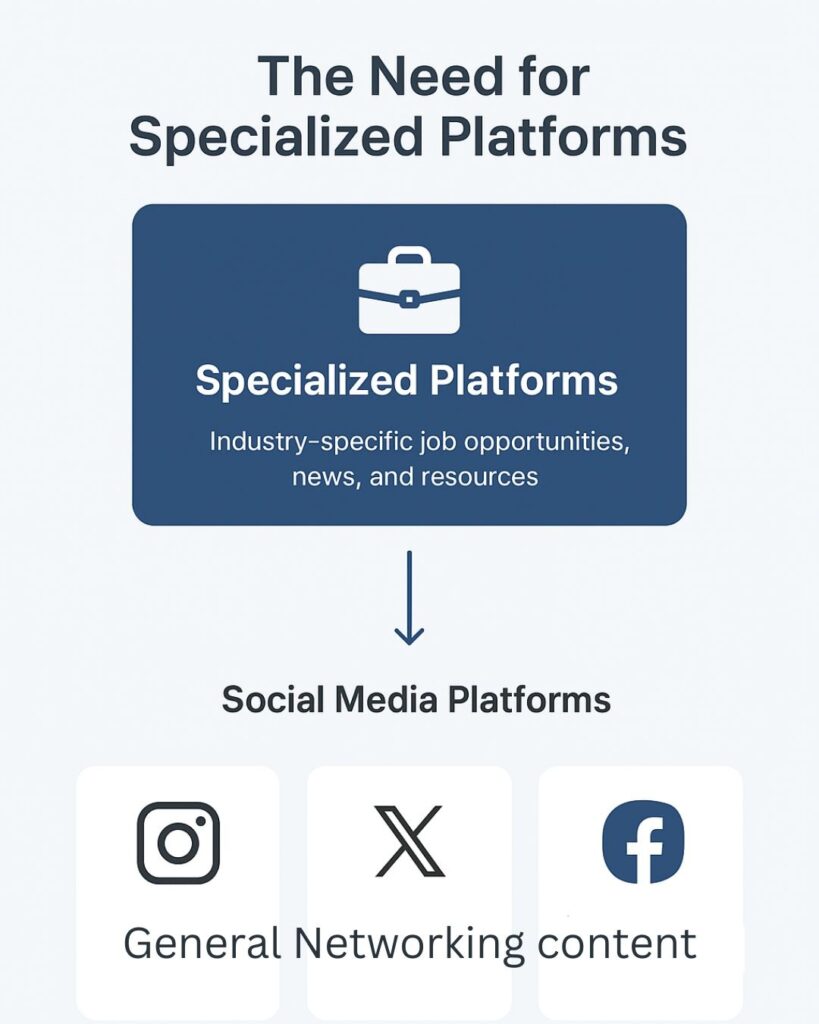
  • The Rise of Specialized Industry Platforms: Meeting the Needs of Modern Professionals

    In today’s fast-paced professional landscape, the demand for specialized industry platforms has never been higher. Professionals in industries like Aviation, Healthcare, and Technology face unique challenges that generic professional networks struggle to address. Platforms like LinkedIn, while widely recognized, are increasingly struggling to maintain active engagement, as users are often distracted by entertainment-driven social media platforms such as Instagram, TikTok, and others. As a result, professionals find it harder to access industry-specific insights, networking opportunities, and career-relevant updates on traditional platforms.

    Why Specialized Platforms Are the Need of the Hour

    The rise of specialized industries, with their complex regulations, rapidly evolving technologies, and sector-specific career pathways, demands dedicated platforms. Professionals need spaces that go beyond generic networking platforms that deliver industry news, skill development opportunities, mentorship, and job openings tailored to their expertise. Without these, valuable talent risks being disconnected from key opportunities, slowing personal and sector-wide growth.

    Overcoming Industry-Specific Challenges

    Professionals in these sectors require dedicated platforms to access industry insights, connect with peers, discover opportunities, and advance their careers. Generic platforms can leave them disconnected from critical sector-specific information and networking opportunities, slowing both professional and industry growth.

    How JobsReach Addresses These Gaps

    JobsReach is designed to bridge the gap left by generic professional networks. By offering dedicated, personalized platforms for each industry, JobsReach ensures that professionals have access to all the tools they need to grow, connect, and succeed.

    JobsReach empowers specialized industries
    • Industry Connections: JobsReach enables networking within your own sector, allowing professionals to share insights, best practices, and mentorship opportunities.
    • Discussion Forums: Engage in meaningful discussions about emerging trends, challenges, and innovations specific to your industry.
    • Opportunities & Career Growth: Access curated job listings and career paths that match your specialization.
    • Industry Updates: Stay informed with sector-specific news, research, and regulatory changes.

    Personalized Platforms for Career Growth

    JobsReach goes beyond generic networking by creating personalized, industry-specific experiences. Professionals can engage with relevant content, participate in discussions, and explore opportunities that match their career stage and expertise. This not only enhances individual growth but also strengthens the industry by ensuring that skilled professionals are connected, informed, and contributing to sector advancement.

    Driving Growth in Specialized Industries

    The rise of specialized industries demands equally specialized platforms. JobsReach is answering this need by providing dedicated spaces that foster networking, knowledge sharing, and career development. By focusing on personalized engagement, sector-specific insights, and meaningful connections, JobsReach strengthens industries while helping professionals thrive within their fields.

    Growth for professional career like aviation, healthcare and Tech industries.

    By connecting professionals to relevant opportunities, insights, and peers, JobsReach ensures that users remain engaged, informed, and empowered to grow in their careers.

    Specialized Industry Platforms: The Key to Staying Competitive

    The future of professional growth lies in focusing on specialized industries rather than generic platforms. By tailoring expertise and solutions to niche sectors, businesses and professionals can maintain a competitive edge and thrive in their fields.

    As professional networking evolves, specialized industries need platforms that truly understand their unique challenges and opportunities. JobsReach delivers on this promise, empowering professionals in Aviation, Healthcare, Technology, and other specialized sectors to connect, learn, and advance, bridging the gap left by generic professional networks.

    In a world where generic solutions fail to meet the nuanced needs of specialized professionals, JobsReach empowers industries and individuals alike. By providing tailored platforms, it bridges the gap between opportunity and expertise, enabling professionals to grow within their industry and ensuring industries thrive with a skilled, connected workforce.

  • 🇹🇷 Türkiye Aviation Outlook: Soaring Growth and Global Hub Dominance

    Türkiye’s aviation industry continues its aggressive ascent, reinforcing its position as a critical global air travel and cargo hub. Driven by the strategic expansion of its flag carrier, Turkish Airlines, and massive investments in world-class airport infrastructure, the sector is experiencing unprecedented growth.

    Aviation Industry in Turkey

    ✈️ Turkish Airlines: Expanding the Global Bridge

    Turkish Airlines (THY) remains the primary engine of the nation’s aviation success, relentlessly increasing its global footprint. The airline is actively executing a long-term strategy aimed at solidifying its status as a world leader:

    • Fleet and Capacity: THY continues its massive fleet expansion, aiming to grow its fleet to approximately 530 aircraft by the end of 2025 and over 800 by 2033. This has directly translated into a substantial increase in Available Seat Kilometers (ASK), reflecting robust operational growth.
    • Network Growth: The airline is one of the world’s most connected, flying to more countries than any other. New and reinstated routes for 2025 are focusing on strategic global links, including new US destinations like Minneapolis, and significant expansion in Africa and the Asia-Pacific (with potential new routes to New Zealand).
    • Low-Cost Focus: The launch of Ajet as a separately incorporated low-cost subsidiary is a key strategic move. It allows the THY Group to aggressively compete in the price-sensitive short-to-medium-haul market while the mainline carrier focuses on premium, long-haul, and high-yield routes.
    • Financial Resilience: Despite global economic volatility and higher operational costs, THY has maintained solid profitability and is strategically reducing its debt, securing its long-term financial stability.

    🏗️ Infrastructure: The Megahubs Powering Growth

    Türkiye’s investment in airport capacity is crucial to handling the surge in traffic and maintaining its transit supremacy.

    • Istanbul Airport (IST): Already a globally acclaimed facility (named World’s Best Airport by multiple authorities in 2025), IST is on track for a major capacity upgrade. Its current capacity of 90 million passengers is set to increase to 120 million by the end of 2025 with the completion of the second phase of investments, and a long-term goal of 200 million passengers.
    • Regional Expansion: Major projects are underway beyond the capital, most notably the Antalya International Airport Expansion. Phase one of this extensive project, expected to be completed in early 2025, will significantly increase the airport’s annual passenger capacity from 40 million to 80 million, supporting the country’s booming tourism sector.
    • Cargo Dominance: The air freight market is thriving, projected to reach over $7 billion by 2033. This growth is underpinned by Istanbul’s strategic location and the success of Turkish Cargo’s state-of-the-art SMARTIST facility, reinforcing the country’s role in global e-commerce and logistics.

    🚁 The Defense and Aerospace Sector

    The Turkish aerospace and defense market continues its trajectory toward self-reliance and global exports, valued at over $15 billion in 2025.

    • National Platforms: The domestic development of sophisticated systems like the KAAN fifth-generation fighter aircraft is a technological milestone.
    • MRO and Maintenance: A key development for commercial aviation is the planned Rolls-Royce and Turkish Technic joint venture for a new Maintenance, Repair, and Overhaul (MRO) center at Istanbul Airport by 2027. This facility will significantly enhance regional engine maintenance capabilities for major engine types, reducing reliance on foreign maintenance providers.

    🧑‍✈️ Bridging the Talent Gap: The JobsReach Aviation Solution

    Amidst this rapid expansion, the need for specialized aviation talent from pilots and engineers to MRO specialists is accelerating. Filling these critical roles efficiently is paramount to sustaining growth.

    JobsReach Aviation is playing a vital role in this talent ecosystem by connecting aviation professionals across the globe with direct career opportunities from airlines. The platform is designed to:

    • Enable Direct Application: Professionals can apply directly to open positions, dramatically reducing the time to process their candidature. This service is utilized by many domestic carriers, including new and emerging operators like Wizz Air who seek highly qualified staff quickly.
    • Targeted Recruitment: Utilizing the JobsReach OutReach capability, the platform helps airlines reach the best candidates in a highly targeted manner, ensuring a better match for niche, high-demand roles.
    • Streamlined Process: By focusing exclusively on the aviation industry, the platform offers a more efficient and industry-relevant hiring process for both employers and job seekers, supporting the continuous operational expansion across Türkiye and the world.
    JobsReach Aviation public profile
    JobsReach Aviation public profile

    💡 Outlook: A Path to Unrivaled Connectivity

    Passenger numbers across Turkish airports have soared, with the major hubs handling millions of passengers in the first half of 2025. This momentum, combined with sustained investment and THY’s relentless route development, suggests that Türkiye is successfully cementing its future as the central aviation hub connecting Europe, Asia, and Africa. The sector remains a vital pillar of the Turkish economy, promising continued job creation and commercial connectivity.