Category: insights

Insights Blogs

  • Social Media Platforms: The New Frontier of Entertainment and Its Limits for Professional Growth

    Over the past decade, social media platforms have evolved far beyond networking tools. They have become central hubs of entertainment, increasingly replacing traditional formats like television and movie theatres. Rather than passive consumption of scheduled content, modern audiences now experience real-time, interactive entertainment shaped by users themselves a cultural shift with profound effects on media consumption and social behaviour.

    Rise of Social Media platforms and the need for industry specialized platforms
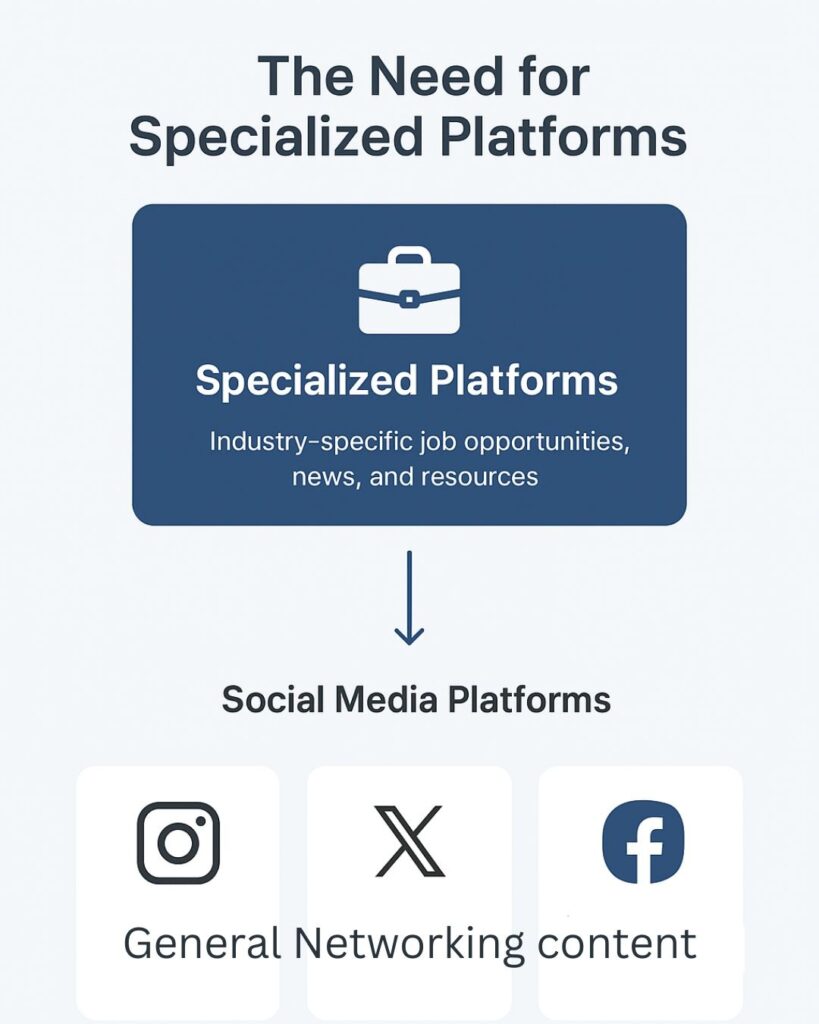
    Social media is overtaking traditional media, making specialized platforms indispensable in fields such as aviation, healthcare, and technology

    🌐 Social Media as the New Entertainment Powerhouse

    Today’s platforms like TikTok, YouTube, Instagram and others are not just places to connect with friends. They have become primary entertainment destinations, especially for Gen Z and younger viewers who prefer short-form, personalized, and algorithm-driven content over traditional broadcast shows and long-form movies.

    • Shift in viewing habits: Social video now accounts for significant portions of what used to be television viewing, with sources reporting social platforms contributing up to roughly 20% of all TV consumption.
    • Ad revenue transformation: Creator-driven content on platforms such as YouTube and TikTok is poised to surpass traditional media in advertising revenue marking a pivotal shift in where money and attention are flowing.
    • Interactive formats: Features like live-streaming, duet challenges, and short clips have turned users into both content creators and consumers, reshaping entertainment into a participatory ecosystem.

    This transformation is rooted in user-generated content, where creators entertain large audiences by sharing their daily lives, humour, talents, and opinions often exposing personal facets of their lives in public spaces to generate engagement and followers.

    🎭 The Social Media Entertainment Effect: Exposure for Attention

    Unlike traditional media, where professionals produce scripted shows or films, social platforms reward visibility and shareability. This often drives users to:

    • Exhibit parts of their personal lives publicly for entertainment.
    • Pursue viral reach by leaning into trends, challenges, and personal storytelling.
    • Prioritize content formats that maximize likes, comments and followers.

    This dynamic has cultural implications: content driven by personal exposure and relatability dominates feeds, and algorithms amplify what is more shareable or sensational over what is informative or educational.

    While this enhances entertainment value and social engagement, it also means many users focus on popularity metrics rather than meaningful skill-building or career progress.

    📉 Why Mainstream Social Media Is Least Likely to Support Professional Growth

    Although platforms like LinkedIn have evolved into professional networks, mainstream social media inherently prioritizes entertainment, virality, and broad engagement over career development. A few reasons for this include:

    🔹 Entertainment Over Expertise

    • Content that captures attention (funny, sensational, emotionally charged) often crowds out content that fosters professional thinking and development.
    • Many people are drawn more by entertainment than educational or career-related content meaning the platforms’ design incentivizes viral entertainment over structured professional narratives.

    🔹 Noise vs. Signal

    • With millions of posts per day, relevant expertise-driven content gets drowned out unless someone has already established a dedicated audience.
    • Metrics like “views” and “likes” signal popularity, not professional credibility or skill.

    🔹 Algorithm Bias

    • Algorithms optimize for engagement and attention, not career advancement. Consequently, users interested in professional content often have to actively search for it, rather than it being delivered organically.

    🔹 Limited Professional Tools

    • While some social platforms feature job listings or events, they lack the specialized tools for career progression like mentorship frameworks, industry-specific communities, role-based learning paths, or verified accomplishments.

    📊 The Rise of Specialized Professional Platforms

    Generic social media is poorly suited for structured career growth, which is why specialized platforms focused on professional development are gaining traction. Platforms like JobsReach illustrate this trend. According to the JobsReach article, such specialized industry platforms meet the needs of modern professionals by offering curated networking, tailored industry insights, relevant job opportunities, and sector-specific communities.

    Whereas LinkedIn operates at a broad level, specialized platforms go deeper by:

    • Providing industry-targeted updates and trends (e.g., regulatory updates for aviation, research news for healthcare).(JobsReach blog)
    • Offering forums and discussions designed for professional advancement.(JobsReach blog)
    • Helping professionals stay connected with peers and mentors within their field.(JobsReach blog)
    • Connecting users transparently with job opportunities that match specific skill sets.

    These focused solutions bridge the gap left by broad networks, which tend to dilute content relevance in favour of engagement and entertainment.

    Expanding the Scope: How JobsReach Drives Industry-Focused Professional Growth Beyond Mainstream Platforms

    While the original JobsReach article highlights the importance of niche platforms for professionals, it doesn’t fully capture the breadth of JobsReach’s impact across specialized industries. Platforms like JobsReach are not only connecting professionals in general, but actively promoting sectors such as Aviation, Healthcare, and Technology, offering targeted resources, insights, and communities for industry-specific growth.

    This approach helps professionals:

    • Stay focused on their industry: By connecting with peers, mentors, and opportunities specific to their field.
    • Access curated industry knowledge: Including updates, trends, and best practices relevant to their sector.
    • Advance skills and careers effectively: Through targeted learning, networking, and job-matching opportunities.

    Moreover, JobsReach and similar specialized platforms are emerging as the go-to destination for professional growth, bridging the gap left by mainstream social networks that prioritize entertainment and visibility over structured career development. By fostering industry-wide engagement, these platforms guide professionals toward meaningful advancement and provide tools for long-term success in their respective fields.

    This broader perspective demonstrates that professional growth thrives in specialized ecosystems, where content, connections, and opportunities are all aligned with industry needs something general social media cannot deliver at scale.

    Emerging industry specialized platforms for professional growth

    The Next Evolution of Social Media: Professional Growth Beyond Entertainment

    Social media has long dominated as a source of entertainment, reshaping how audiences consume content and shifting attention away from traditional television and movie theatres. Its interactive, fast-paced environment encourages creativity and visibility, but often prioritizes entertainment over structured career development.

    The next generation of social platforms addresses this gap by focusing on professional advancement and industry-specific engagement. Specialized platforms like JobsReach offer curated communities, targeted industry insights, and tailored opportunities that mainstream networks cannot. By fostering expertise-driven networking, mentorship, and career-focused collaboration, these platforms are becoming the essential spaces for meaningful professional growth, guiding professionals toward purposeful development beyond social entertainment.

  • The Rise of Specialized Industry Platforms: Meeting the Needs of Modern Professionals

    In today’s fast-paced professional landscape, the demand for specialized industry platforms has never been higher. Professionals in industries like Aviation, Healthcare, and Technology face unique challenges that generic professional networks struggle to address. Platforms like LinkedIn, while widely recognized, are increasingly struggling to maintain active engagement, as users are often distracted by entertainment-driven social media platforms such as Instagram, TikTok, and others. As a result, professionals find it harder to access industry-specific insights, networking opportunities, and career-relevant updates on traditional platforms.

    Why Specialized Platforms Are the Need of the Hour

    The rise of specialized industries, with their complex regulations, rapidly evolving technologies, and sector-specific career pathways, demands dedicated platforms. Professionals need spaces that go beyond generic networking platforms that deliver industry news, skill development opportunities, mentorship, and job openings tailored to their expertise. Without these, valuable talent risks being disconnected from key opportunities, slowing personal and sector-wide growth.

    Overcoming Industry-Specific Challenges

    Professionals in these sectors require dedicated platforms to access industry insights, connect with peers, discover opportunities, and advance their careers. Generic platforms can leave them disconnected from critical sector-specific information and networking opportunities, slowing both professional and industry growth.

    How JobsReach Addresses These Gaps

    JobsReach is designed to bridge the gap left by generic professional networks. By offering dedicated, personalized platforms for each industry, JobsReach ensures that professionals have access to all the tools they need to grow, connect, and succeed.

    JobsReach empowers specialized industries
    • Industry Connections: JobsReach enables networking within your own sector, allowing professionals to share insights, best practices, and mentorship opportunities.
    • Discussion Forums: Engage in meaningful discussions about emerging trends, challenges, and innovations specific to your industry.
    • Opportunities & Career Growth: Access curated job listings and career paths that match your specialization.
    • Industry Updates: Stay informed with sector-specific news, research, and regulatory changes.

    Personalized Platforms for Career Growth

    JobsReach goes beyond generic networking by creating personalized, industry-specific experiences. Professionals can engage with relevant content, participate in discussions, and explore opportunities that match their career stage and expertise. This not only enhances individual growth but also strengthens the industry by ensuring that skilled professionals are connected, informed, and contributing to sector advancement.

    Driving Growth in Specialized Industries

    The rise of specialized industries demands equally specialized platforms. JobsReach is answering this need by providing dedicated spaces that foster networking, knowledge sharing, and career development. By focusing on personalized engagement, sector-specific insights, and meaningful connections, JobsReach strengthens industries while helping professionals thrive within their fields.

    Growth for professional career like aviation, healthcare and Tech industries.

    By connecting professionals to relevant opportunities, insights, and peers, JobsReach ensures that users remain engaged, informed, and empowered to grow in their careers.

    Specialized Industry Platforms: The Key to Staying Competitive

    The future of professional growth lies in focusing on specialized industries rather than generic platforms. By tailoring expertise and solutions to niche sectors, businesses and professionals can maintain a competitive edge and thrive in their fields.

    As professional networking evolves, specialized industries need platforms that truly understand their unique challenges and opportunities. JobsReach delivers on this promise, empowering professionals in Aviation, Healthcare, Technology, and other specialized sectors to connect, learn, and advance, bridging the gap left by generic professional networks.

    In a world where generic solutions fail to meet the nuanced needs of specialized professionals, JobsReach empowers industries and individuals alike. By providing tailored platforms, it bridges the gap between opportunity and expertise, enabling professionals to grow within their industry and ensuring industries thrive with a skilled, connected workforce.

  • Google’s Strategy for Success: Innovation, Global Expansion, and Empowering the Workforce

    Google, a global leader in technology, has consistently driven innovation and shaped the digital landscape over the past few decades. From its humble beginnings as a search engine to its current position as a multi-faceted tech giant, Google’s strategic vision focuses on creating technology that makes the world more connected, efficient, and accessible. Today, Google’s strategy is driven by three core pillars: innovation, global expansion, and talent empowerment.

    Google's global Expansion: Reaching New Markets and Demands

    Similar to Google’s platforms, JobsReach is playing a crucial role in tackling talent shortages across key industries, empowering both individuals and businesses with innovative technological solutions.

    Innovation: Leading the Way with Cutting-Edge Technology

    Google has built its reputation on relentless innovation. Whether through products like Google Search, Android, Google Cloud, or AI-powered tools, Google constantly pushes the boundaries of what technology can do. Their AI-powered services, such as Google Assistant, Google Lens, and AI Overviews, reflect this commitment to making advanced technologies accessible to users globally.

    Google's innovation strategy

    In an era of continuous technological advancement, innovation goes beyond developing new ideas. it also involves addressing pressing challenges. One such challenge is the expanding talent gap in industries like aviation, healthcare, and technology, which hampers sector growth. This is where JobsReach steps in, offering solutions that empower businesses to find the talent they need, streamline recruitment processes, and address critical resource shortages in these key industries.

    Even Google has tried to address this challenge with its Google Cloud Talent Solutions, providing businesses with tools to build their own Applicant Tracking Systems (ATS). However, JobsReach goes a step further by not only offering an ATS solution but also focusing on directly solving the talent gap in key industries.

    Global Expansion: Reaching New Markets and Demands

    As Google expands its global footprint, it continues to adapt its offerings to meet the specific needs of diverse markets. Google’s services and products, including Google Cloud and Android, are available in nearly every country, catering to businesses, governments, and individual consumers.

    Google’s global expansion strategy is one of the cornerstones of its long-term success. By rolling out products and services in key markets across the world, Google ensures its technologies are accessible to everyone, regardless of geography. This expansion is not just about increasing market share, it’s also about adapting products to meet local demands and adhering to regulatory requirements.

    The expansion of Google’s services, such as AI Overviews, is aligned with its strategy to make cutting-edge technology accessible to global markets. However, in order to roll out AI-driven solutions in a way that complies with varying local regulations, Google carefully tailors its offerings to different regions. For example, while AI Overviews are available in countries like the United States, UK, India, Japan, Indonesia, Mexico, and Brazil, the European Union has its own regulatory framework (e.g., the AI Act) that influences the pace and scope of AI product launches.

    Google's gradual Rollout Strategy

    JobsReach Strategy: Revolutionizing Talent Acquisition Across Industries

    While Google is known for its technological innovations, one of its core strategies revolves around empowering individuals and businesses. JobsReach, an innovative recruitment platform, embodies this vision by focusing on solving the talent shortages in critical industries like aviation, healthcare, and technology.

    JobsReach’s strategy is tailored to meet the unique needs of each industry, providing opportunities for young talent to enter these fields and helping professionals find career advancement. While available globally, the platform adopts a phased approach to expansion, similar to Google’s strategy of scaling in stages.

    JobsReach stands out by targeting specific industries like Aviation, Healthcare, and Technology
    JobsReach stands out by targeting specific industries

    JobsReach Aviation: Focus on Europe, Then Expand to the U.S.

    The aviation industry faces a major talent shortage due to the increasing demand for skilled professionals in areas such as pilots, engineers, and airport staff. JobsReach Aviation is strategically focused on addressing this gap, beginning with the Netherlands and Europe.

    JobsReach collaborates with aviation companies in these regions to identify and recruit talent for roles ranging from entry-level positions to highly specialized expertise. Once a strong presence is established in Europe, JobsReach will expand its efforts to the U.S., which has a large and growing demand for aviation professionals. By focusing on regions with the most pressing needs, JobsReach ensures that it can make a meaningful impact on the aviation sector, helping businesses overcome staffing challenges.

    JobsReach Healthcare and Technology: Starting in the U.S., Expanding to Europe

    The healthcare and technology industries are facing similar challenges with talent shortages, especially in the U.S.. JobsReach Healthcare and Technology addresses these challenges by providing tailored recruitment solutions for businesses seeking to fill critical roles in these sectors.

    In healthcare, there is an increasing demand for doctors, nurses, and medical professionals, particularly as the population continues to age. In technology, sectors like software development, AI, and cybersecurity are growing at a rapid pace, creating a demand for skilled workers.

    JobsReach plans to begin its recruitment efforts in the U.S., where the need for healthcare and technology professionals is most urgent. Once the platform has made a significant impact in the U.S. market, it will then look to expand into Europe, where the demand for healthcare workers and tech talent is also on the rise.

    JobsReach’s Long-Term Vision

    The main goal of JobsReach is to create a global talent movement that addresses skill shortages in various industries while offering young professionals opportunities to grow and contribute to society. By focusing on key markets and expanding gradually, JobsReach tailors its solutions to meet the changing needs of each region. Over time, the platform aims to become a leading talent acquisition service.

    How JobsReach Aligns with Google’s Broader Strategy

    Just as Google has empowered businesses with innovative tools like AI and cloud computing, JobsReach is empowering industries with the talent they need to succeed. Both share a vision of using technology to drive growth, address global challenges, and create opportunities for individuals and businesses alike.

    JobsReach: Empowering Talent to Shape the Future
    JobsReach’s Long-Term Vision

    A Shared Vision for the Future

    Google’s strategy has always been about driving innovation, expanding its global reach, and empowering individuals and businesses. JobsReach embodies these same principles by using technology to bridge the talent gap in key industries like aviation, healthcare, and technology. With a phased expansion strategy targeting Europe and the U.S., JobsReach is positioning itself as a key player in the future of talent acquisition, ensuring that businesses have the resources they need to grow and succeed.

  • Search Wars – The Fight for Control, Revenue, and Innovation

    Google reportedly paid Apple around $20 billion in 2022 to secure its position as the default search engine on Apple devices, emphasizing the high stakes in the search engine market. Similarly, Microsoft has made significant investments in Bing, with CEO Satya Nadella revealing that the company has spent approximately $100 billion to enhance its capabilities and compete with established players like Google.

    OpenAI has entered the race with SearchGPT, an AI-powered search engine integrated into ChatGPT, marking a strategic effort to challenge traditional search paradigms and offer an innovative alternative to dominant platforms. Meanwhile, nations like China and Russia have prioritized the development of their own search engines such as Baidu and Yandex to serve domestic needs and reduce reliance on foreign technology.

    The competition in the search engine space stems from its vast economic potential, control over information, technological innovation, and strategic importance, making it a critical arena for both companies and countries.

    What drives companies and nations to compete for dominance in the search engine industry?

    Revenue Potential

    Search engines generate massive revenues through advertising. Google’s business model, for instance, heavily relies on search-based advertising, contributing the bulk of its $280 billion annual revenue (as of 2022). Competitors like Microsoft and OpenAI see search as a lucrative opportunity to capture advertising market share.

    Control Over Information

    Search engines serve as gateways to information. Dominating this space provides significant control over the dissemination of knowledge, public opinion, and trends. Governments like China and Russia prioritize developing domestic search engines to safeguard their sovereignty and control the narrative in their regions.

    Technological Leadership

    Search is a frontier for cutting-edge AI and machine learning technologies. Companies like OpenAI aim to innovate with AI-powered search to challenge the traditional keyword-based approach and revolutionize how people find information.

    Data Collection

    Search engines are invaluable sources of data on user behavior, preferences, and needs. Access to such data enables companies to refine their algorithms, improve their services, and develop more effective advertising models.

    Strategic Positioning

    Having a strong presence in search engines aligns companies as central players in the digital economy. Microsoft’s investment in Bing is a strategic move to increase its competitiveness against Google and to integrate AI features into its products, creating an ecosystem advantage.

    Localization and Independence

    Countries like China and Russia have developed search engines like Baidu and Yandex to localize content and reduce reliance on foreign technology. This approach aligns with their broader goals of digital sovereignty and national security.

    Expanding Ecosystems

    Companies are embedding search into broader ecosystems. Google integrates search with Android and Chrome, Apple leverages it in iOS and macOS, and Microsoft combines Bing with its enterprise products and AI advancements. These integrations create a seamless user experience, driving customer loyalty.

    LinkedIn and Job Boards – Dominating the Professional Landscape and Generating Revenue

    LinkedIn has become a key player in the professional network space, combining social networking with career development. It generates revenue through talent solutions, advertising, and premium subscriptions. In 2023, LinkedIn’s revenue surpassed $15 billion.

    Job boards like Indeed and ZipRecruiter are also dominating the market, offering platforms for employers to post job listings and attracting candidates. These platforms earn revenue through job postings and ads, with Indeed adopting a pay-per-application model.

    How LinkedIn and Job Boards Like Indeed Drive Revenue in the Digital Job Market
    Dominating the Professional Landscape

    This dual dominance of LinkedIn and specialized job boards in the professional database space has transformed the industry into a lucrative revenue generator, driven by premium subscriptions, advertising, and corporate partnerships.

    JobsReach – Revolutionizing Job Search by Focusing on Industry-Specific Opportunities

    While LinkedIn and job boards like Indeed dominate the professional networking space, they often rely on vast resource databases and email alerts, which can lead to irrelevant or incomplete job opportunities. JobsReach differentiates itself by focusing on specific industries like Aviation, Healthcare, and Technology, creating dedicated platforms that cater to the unique needs of professionals in these sectors.

    JobsReach stands out by targeting specific industries like Aviation, Healthcare, and Technology

    JobsReach understands the nuances of these industries and offers a space where professionals can stay updated on industry trends and job opportunities. Unlike the broad approach of other platforms, JobsReach promotes relevant job openings to a targeted audience through major social media channels, ensuring that both active and passive job seekers are informed as soon as opportunities arise.

    This approach eliminates the frustration of irrelevant job searches and offers a stress-free way for professionals to discover career opportunities. By directly connecting employers with the right candidates in a focused environment, JobsReach helps save recruitment costs and simplifies the hiring process. This creates a win-win for both job seekers and employers, offering a more efficient, industry-specific platform for career growth.

    Competition in Search Engines and Job Search Platforms

    The competition in both the search engine and job search markets is intense, driven by the need for revenue, innovation, and control over information. Search giants like Google dominate with vast resource databases, while newer players like OpenAI introduce AI-driven alternatives. Similarly, job boards like LinkedIn and Indeed focus on broad audiences but often fall short in delivering relevant opportunities.

    JobsReach stands out by targeting specific industries like Aviation, Healthcare, and Technology, providing professionals with timely, relevant job listings. By offering a more focused and efficient job search experience, JobsReach is reshaping the industry, proving that in both sectors, success lies in offering value and relevance to users.

  • Top Social Media Earners and JobsReach’s Strategy to Transform Recruitment

    In the digital age, social media platforms have become powerful tools for individuals and organizations to amplify their reach, engage with target audiences, and generate substantial revenue. Celebrities and influencers have mastered this art, earning millions by leveraging their massive online followings. Platforms like JobsReach are observing these trends and incorporating similar strategies to revolutionize industries like recruitment, particularly in aviation, healthcare, and technology.

    People are engaged and active on social media due to its dynamic, interactive, and personalized content
    People are engaged and active on social media

    The Social Media Earnings Powerhouse

    Social media platforms such as Instagram, YouTube, and TikTok have transformed celebrities into lucrative brands. Here are some top earners from these platforms in 2024

    Cristiano Ronaldo

    • Platform: Instagram
    • Earnings: $47.8 million annually
    • Why Successful?: With over 600 million followers, Ronaldo’s posts combine aspirational lifestyle content with endorsements from global brands like Nike and Clear.

    2. Lionel Messi

    • Platform: Instagram
    • Earnings: $500,000 per post
    • Why Successful?: Messi’s collaborations with Apple TV, Budweiser, and Adidas highlight his global appeal beyond the soccer field.

    3. MrBeast (Jimmy Donaldson)

    • Platform: YouTube
    • Earnings: $85 million annually
    • Why Successful?: MrBeast’s high-impact videos and philanthropic projects drive massive engagement, complemented by product lines like Feastables.

    4. Kylie Jenner

    • Platform: Instagram
    • Earnings: $16.8 million annually
    • Why Successful?: With 399 million followers, Kylie’s beauty empire thrives on social media marketing that blends personal insights and business promotions.

    5. Kevin Hart

    • Platform: Instagram
    • Earnings: $28.1 million annually
    • Why Successful?: Hart leverages his comedy brand while promoting personal ventures like Gran Coramino tequila and VitaHustle.

    These celebrities demonstrate how authenticity, strategic partnerships, and content tailored to their audience can translate into immense financial success on social media platforms.

    JobsReach: Adapting Social Media Strategies for Recruitment

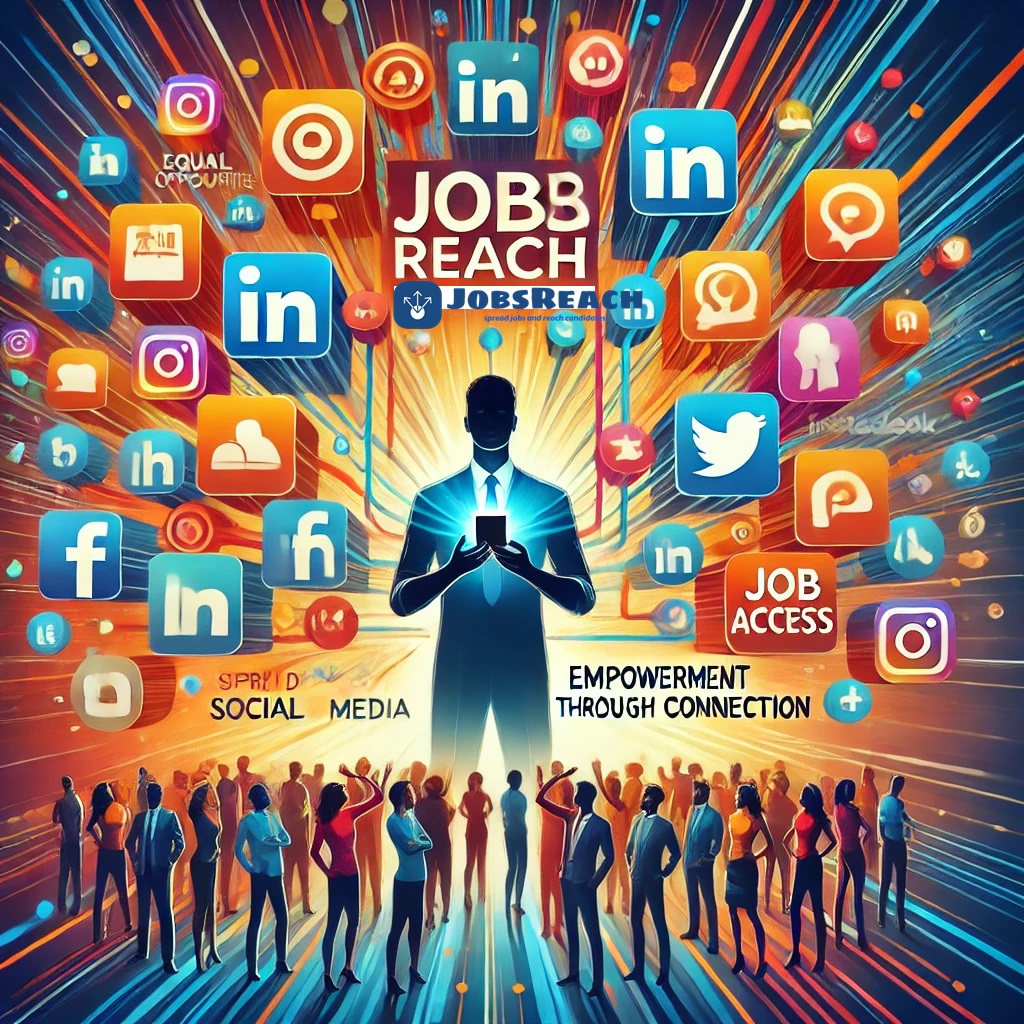
    JobsReach is dominating Social Media channels to spread job opportunities
    JobsReach is leading the way on social media, connecting people with job opportunities

    While celebrities monetize their online presence to promote products and build their brands, platforms like JobsReach are adopting similar strategies to disrupt the recruitment industry. Their focus is on industries like aviation, healthcare, and technology, where demand for skilled talent is ever-growing.

    1. Leveraging Platforms to Engage Talent

    JobsReach recognizes that job seekers and professionals spend significant time on platforms like Instagram, Pinterest, Twitter, and even TikTok. By sharing targeted and engaging content, they meet potential candidates where they are most active. Social media is no longer just for connecting with friends or promoting products, it’s a powerful tool for transforming industries.

    While platforms like LinkedIn boast massive professional databases, they often lack active engagement from users. This shift has allowed platforms like Instagram, YouTube, and TikTok to capture greater attention, thanks to their dynamic and interactive environments.

    • Aviation: JobsReach posts visually captivating content showcasing advanced work environments, cutting-edge technology, and global travel opportunities to appeal to tech-savvy, adventurous candidates.
    • Healthcare: Heart-warming testimonials and real-life stories of healthcare professionals demonstrate the meaningful impact of these careers.
    • Technology: Highlighting innovation and growth opportunities, JobsReach’s campaigns attract coders, engineers, and IT specialists.

    2. Showcasing Employer Brands

    Similar to how influencers highlight their personal brands, JobsReach uses social media to showcase the unique cultures and benefits of partnering organizations. Potential hires gain insights into workplaces before applying, improving alignment and interest.

    3. Personalization through Data

    Much like social media celebrities use analytics to tailor their content, JobsReach leverages advanced algorithms to craft campaigns targeting the right talent. For example, a developer might see a tech-focused opportunity that matches their skill set, while a nurse might be exposed to a healthcare role in a nearby hospital.

    4. Creating Compelling Video Content

    The rise of video content on platforms like YouTube and TikTok has not gone unnoticed. JobsReach produces short, impactful videos showcasing job opportunities, employer testimonials, and day-in-the-life features that resonate with job seekers.

    5. Engaging Passive Talent

    Many professionals are not actively searching for jobs but are open to compelling opportunities. JobsReach’s strategy of delivering creative and engaging content ensures that even passive talent is drawn into the recruitment pipeline.

    Why Social Media?

    Social media is no longer just for connecting with friends or promoting products, it’s a powerful tool for transforming industries. The success of celebrities like Cristiano Ronaldo, Kylie Jenner, and Mr Beast demonstrates the immense potential of these platforms. Platforms like JobsReach are taking inspiration from these trends, adapting them to create a new era in recruitment. By harnessing the power of social media, JobsReach is connecting skilled professionals with meaningful opportunities in aviation, healthcare, and technology, shaping the future of work.

    JobsReach is Revolutionizing Recruitment with AI

    JobsReach is revolutionizing recruitment by leveraging AI to solve employer’s challenges and reduce dependency on sourcing agencies. By automating job postings with industry-standard recommendations, integrating pre-application filtering through customized screening questions, and evaluating candidate’s skills against job requirements, JobsReach ensures precise and efficient hiring. This approach enables businesses to hire on demand, reduce planning time, and fulfil vacancies without delays. With its AI-driven processes, JobsReach simplifies recruitment like never before, empowering employers to save time, cut costs, and maintain direct control over talent acquisition.

  • How JobsReach is Solving Key Recruitment Challenges and Contributing to Society

    JobsReach is effectively addressing core recruitment challenges by leveraging AI and a social media strategy to streamline the hiring process and maximize societal impact. Here’s how JobsReach’s innovative approach tackles each major issue and contributes to the broader community:

    Refining Job Requirements and Attracting the Right Candidates

    Recruiters often struggle with precisely defining job requirements and crafting attractive advertisements for a broad audience.

    JobsReach AI assists recruiters in clearly defining job requirements for diverse roles across industries, with support for multiple languages, ensuring that job descriptions are precise and globally accessible. Additionally, JobsReach offers inbuilt templates to help recruiters create compelling job advertisements with ease, making postings visually appealing and easy to understand.

    Social Impact:

    By making job descriptions accessible and attractive, JobsReach broadens opportunities for potential candidates across language and location barriers, helping to foster an inclusive hiring environment.

    JobsReach transforms the hiring and recruitment by introducing a new approach for the modern era.

    Efficient Candidate Screening and Evaluation

    Screening and evaluating a large volume of applicants for relevant skills and experience can be time-consuming for recruiters.

    JobsReach AI evaluates candidate profiles against job requirements, automatically scoring candidates on skills and experience relevance. This AI-driven rating allows recruiters to either quickly verify or provide feedback to candidates with pre-generated responses, enabling a faster, more efficient shortlisting process.

    Social Impact:

    This efficient screening process not only saves recruiter’s time but also enhances the candidate experience by providing timely feedback, thus building a transparent, more responsive hiring process.

    Verifying Candidate Experience and Authenticity

    Ensuring the authenticity of a candidate’s experience is essential to avoid costly onboarding errors, but verifying this can be challenging.

    JobsReach enables candidates to request feedback from former colleagues or managers, allowing recruiters to gain more confidence in the candidate’s authenticity. Additionally, candidates can upload supporting documents, such as certifications and qualifications, which are validated by JobsReach’s verification mechanisms.

    Drawback & Mitigation:

    Although AI-driven cross-checks with social profiles provide an initial verification layer, JobsReach recognizes the limitations of solely relying on this data. By including feedback from former colleagues and supporting documents, JobsReach ensures a comprehensive and trustworthy approach to candidate validation.

    JobsReach feedback mechanism ensures employers validate the authenticity of the candidates
    Social Impact:

    This thorough validation system not only aids recruiters but also provides candidates with the tools to demonstrate their credibility. This transparency promotes fairness and helps reduce hiring errors that may otherwise lead to workplace disruptions.

    Maximizing Outreach Through Targeted Job Ads

    Reaching a large, relevant candidate pool across multiple platforms can be costly and logistically complex.

    JobsReach automatically distributes job ads across multiple social media platforms, broadening the reach beyond single-platform solutions like LinkedIn or Indeed. This targeted distribution ensures that job ads reach suitable candidates across different channels, maximizing visibility.

    Social Impact:

    By extending job visibility across channels, JobsReach helps job seekers from various backgrounds discover and apply for relevant positions. This approach promotes equitable access to career opportunities and enhances diversity in applicant pools.

    Supporting Career Growth in Resource-Scarce Sectors

    Focus on Key Industries:

    JobsReach focuses on sectors with resource scarcity, such as Aviation, Healthcare, and Technology. By creating a specialized platform for these industries, JobsReach is not only helping experienced professionals grow their careers but also opening doors for new entrants to gain valuable job experience.

    Social Impact:

    This industry focus helps address unemployment by creating entry-level opportunities for freshers while supporting experienced professionals in advancing their careers. JobsReach’s commitment to building a skilled workforce in high-demand sectors contributes to societal well-being and economic growth by reducing skill gaps and enabling a sustainable career pipeline.

    JobsReach Movement

    JobsReach leverages AI and social media to overcome significant recruitment challenges, with a socially responsible approach that prioritizes transparency, inclusivity, and equitable job access. By addressing inefficiencies in the hiring process and focusing on sectors with high job potential, JobsReach is creating a positive ripple effect in society, providing growth opportunities for professionals and helping to alleviate unemployment by creating accessible career paths for new entrants.

  • Top 3 Hiring and Recruitment Challenges and How AI Can Solve Them

    Based on interviews with recruiters across various enterprises, here are the main challenges they face in posting and closing job vacancies, along with AI-driven recommendations and potential drawbacks:

    JobsReach AI is enabling the recruiters to define any job requirements in any language without deep insights about the job function.
    1. Clarifying Internal Requirements and Attracting Suitable Candidates

    WE ARE HIRING, WE NEED YOU

    Challenge

    Accurately defining job requirements and communicating them to attract the right candidates is challenging for recruiters. Misalignment between job postings and the actual role can result in mismatched applications.

    AI Solution

    AI-driven job description tools can analyze similar roles in the market, suggesting keywords and phrases that resonate with target audiences. Natural language processing (NLP) algorithms can also rephrase requirements in simple, compelling language that aligns with the expectations of high-quality candidates, leading to more accurate and attractive job descriptions.

    2. Efficient Screening and Shortlisting

    Challenge

    Sorting through a large number of applications to identify qualified candidates is time-consuming and can lead to overlooking strong candidates if manual filters are applied too quickly.

    AI Solution
    JobsReach AI helps recruiters to screen and evaluate candidates efficiently

    AI-powered applicant tracking systems (ATS) can automate initial resume screening by comparing applicant profiles to job requirements, ranking candidates based on their fit. Additionally, AI can use predictive analytics to highlight candidates with strong potential, speeding up the shortlisting process and allowing recruiters to focus only on the most promising candidates.

    3. Verifying Candidate Experience and Authenticity

    Challenge

    Confirming that candidates’ claimed experience and skills are authentic is crucial to avoid costly errors during or after onboarding.

    AI Solution

    AI can cross-reference candidate information with public profiles, certifications, and professional networks to provide a preliminary authenticity check. It can also conduct skill-based assessments to validate specific competencies.

    Drawbacks

    Relying solely on publicly available profiles, such as LinkedIn, for validation can be risky since candidates can update or exaggerate these profiles without external verification. AI may not detect these discrepancies, leading to potential over-reliance on unverified information. To counteract this, combining AI validation with manual checks — such as reference calls to previous colleagues or supervisors — can offer a more accurate confirmation of a candidate’s real experience and skills. This hybrid approach ensures a balanced view of a candidate’s background, blending technology efficiency with human insight.

    The good news is that JobsReach is effectively addressing all these challenges through AI and a strategic social media approach. Read on to discover how JobsReach is tackling these issues and making a meaningful contribution to today’s societal challenges.

  • Why Job Boards Fall Short While Recruitment Agencies Thrive in Filling Vacancies

    In today’s digital landscape, job boards have become a prominent tool for connecting job seekers with employers. Platforms like LinkedIn, Indeed, and Monster facilitate millions of applications worldwide. However, despite their expansive reach, job boards often struggle to compete with recruitment agencies when it comes to fulfilling open vacancies efficiently. Recruitment agencies have managed to maintain a critical role in the hiring process due to their personalized approach, specialized skills, and deep industry knowledge. Below are some reasons why job boards face challenges while recruitment agencies continue to thrive in the complex landscape of hiring.

    1. Lack of Personalized Candidate Engagement

    Job boards are built for high-volume job listings and applications but lack the nuanced approach needed for complex hiring processes. While job boards can post roles and manage applications, they lack the personal touch that agencies provide by engaging candidates directly. Recruitment agencies interact one-on-one with potential hires, understanding their career goals, skillsets, and cultural fit within the company. This personalized approach not only ensures better matches but also enhances candidate engagement—a critical factor in closing more vacancies effectively.

    2. Screening Limitations

    While many job boards now integrate Applicant Tracking Systems (ATS) and filtering options, their screening capabilities remain largely surface-level. Job boards rely on keywords and basic qualifications to match candidates to roles. However, recruitment agencies bring a more sophisticated assessment to the table, diving deep into candidates’ experiences, motivations, and long-term goals. This enables agencies to recommend candidates who are not only qualified but also aligned with the company’s culture and mission, increasing the likelihood of a successful hire.

    3. Passive Candidate Recruitment

    One of the most significant advantages of recruitment agencies is their ability to reach passive candidates—those who are not actively job-hunting but may be open to new opportunities. Job boards primarily cater to active job seekers and lack the resources to actively pursue candidates who aren’t actively looking. Recruiters, however, often cultivate extensive professional networks, which they use to tap into passive talent pools. This proactive approach is crucial for hard-to-fill positions and high-skill roles, where passive candidates often make up a significant portion of qualified professionals.

    4. Employer Brand Advocacy

    Recruitment agencies don’t just recruit; they act as brand ambassadors for the companies they represent. Job boards, by contrast, provide a relatively impersonal platform for job postings. Agencies promote the unique qualities of their clients’ workplaces, showcasing benefits, company culture, and values in a way that resonates with top candidates. In competitive industries, this brand advocacy can be the difference between securing top talent and losing them to a competitor.

    5. Complex Roles Require Specialized Knowledge

    For high-skill or niche roles, recruitment agencies often excel due to their industry-specific expertise. Many agencies specialize in particular sectors, allowing them to build a nuanced understanding of the skills, certifications, and personality traits required for specialized positions. Job boards, while effective for entry-level or more generic roles, struggle with this level of specialization. Candidates with niche skills may not actively search job boards as frequently, knowing that specialized agencies are more likely to provide tailored and credible job opportunities.

    6. Job Boards Face Oversaturation and Competition

    Job boards face the challenge of oversaturation, with many job listings often competing for the attention of job seekers on the same platforms. This high volume can make it difficult for individual job posts to stand out, especially without robust employer branding efforts. Recruitment agencies, on the other hand, manage a curated list of job opportunities tailored to specific candidates, allowing them to present roles that match the candidate’s skills and interests without getting lost in a sea of job postings.

    7. Candidate Experience and Relationship Building

    One of the major disadvantages of job boards is that they cannot provide candidates with guidance or feedback throughout the hiring process. Recruitment agencies, however, build long-term relationships with candidates, offering career advice, preparing them for interviews, and keeping them informed. This hands-on approach not only ensures a better candidate experience but also fosters loyalty, encouraging candidates to return to the agency for future job searches. A positive candidate experience is crucial to maintaining a strong talent pipeline, which is an area where job boards typically fall short.

    8. Higher Flexibility in Negotiations

    When it comes to negotiating salaries, benefits, and other employment terms, job boards lack the direct human involvement that agencies offer. Recruitment consultants actively manage this part of the hiring process, serving as intermediaries who understand the needs of both parties and can facilitate negotiations. Job boards, in contrast, offer little to no support during the negotiation phase, which can create gaps in communication and lead to unsuccessful or delayed hires.

    9. Agencies Provide Post-Hire Support

    Recruitment agencies often provide post-hire support, ensuring that the candidate is well-settled and performing satisfactorily. They may conduct follow-ups with both the employee and employer, addressing any potential concerns that could lead to early turnover. Job boards, once a candidate is hired, do not offer any such support, leaving companies to manage retention on their own. This additional service offered by agencies can be critical in retaining talent, especially in roles with high turnover rates.

    10. Access to Confidential and Executive-Level Roles

    Certain positions, particularly at the executive level, require a high degree of confidentiality that job boards simply cannot offer. These roles are often filled through headhunting and require specialized expertise and discretion. Recruitment agencies are well-equipped to handle these sensitive roles, leveraging their networks and industry knowledge to connect high-level candidates with executive opportunities, without the public exposure of a job board listing.

    While job boards offer broad reach and convenience, they often fall short in delivering the high-quality, tailored matches that recruitment agencies can provide. Agencies fulfil more vacancies not only because they understand the nuanced needs of both employers and candidates but also because they actively manage relationships, conduct thorough screenings, and offer critical support throughout the hiring process. As businesses continue to seek candidates with the right mix of skills and cultural fit, recruitment agencies are likely to remain an invaluable part of the hiring ecosystem, offering a level of service and expertise that job boards, for all their merits, struggle to match. However, JobsReach is redefining this landscape by using data insights to effectively target and engage specialized candidates in sectors like Aviation, Healthcare, and Technology. By sharing job opportunities across multiple social media channels and honing in on location and job title-based targeting, JobsReach not only reaches broader talent pools but also outperforms recruitment agencies by delivering more precise, high-quality matches in these competitive fields.

  • The Hiring Struggle: Why Job Boards Lag Behind and How JobsReach Delivers Smarter Talent Solutions

    In today’s job market, digital platforms like job boards are essential for listing open positions and connecting job seekers with employers. However, despite their visibility and convenience, job boards face unique challenges that prevent them from achieving the high fulfilment rates seen with recruitment agencies. Recruitment agencies continue to dominate the hiring process due to their more personalized, targeted, and proactive approaches. Recognizing these limitations, JobsReach leverages a strategy that combines data insights and social media reach to overcome the hurdles traditional job boards face, making job opportunities more accessible and targeted for job seekers and employers alike.

    JobsReach’s Approach to Candidate Engagement

    One significant limitation of job boards is their lack of personal engagement with candidates. Unlike traditional job boards, JobsReach actively engages candidates across multiple social media channels, creating a broader and more interactive reach. By distributing job vacancies on platforms like LinkedIn, Facebook, Instagram, and Twitter, YouTube, JobsReach effectively increases visibility while meeting candidates where they already spend time. This approach fosters engagement and builds stronger connections with candidates, similar to how recruitment agencies create personalized experiences for potential hires.

    Improving Candidate Screening through Targeted Job Postings

    Traditional job boards often rely on keyword-based filtering and simple qualification requirements, limiting their ability to screen effectively. JobsReach overcomes this by using data insights to target candidates by job title, experience, and location. Rather than taking a broad approach, JobsReach narrows down job postings to reach candidates whose profiles are a close match for each role. This focused targeting enhances the accuracy of candidate matching, ensuring that employers receive applications from candidates with the most relevant skills and backgrounds, reducing time and resources spent on initial screenings.

    Reaching Passive Candidates with Strategic Social Media Distribution

    Passive candidates, who aren’t actively job-hunting but may be open to opportunities, are often overlooked by job boards, which primarily cater to active seekers. JobsReach tackles this issue by distributing job listings across social platforms, reaching passive candidates who may be casually exploring job-related content. By expanding outreach beyond job boards, JobsReach is able to access a larger talent pool, appealing to both active and passive candidates. This approach significantly increases the chances of connecting with professionals who may not be searching directly but are open to new opportunities. Read more about why JobsReach outperforms professional platforms like LinkedIn.

    Effective Employer Branding through Social Media Channels

    Employer branding is a major challenge for job boards since they provide only limited space for companies to showcase their unique cultures, values, and benefits. JobsReach addresses this by strategically highlighting each employer’s brand through tailored social media campaigns, presenting the companies’ values, work environments, and employee benefits across multiple channels. This visibility gives candidates a clearer understanding of the organizations they’re considering, fostering interest and attracting those who align well with each company’s culture, a method traditionally seen in recruitment agencies.

    Targeted Social Media Marketing for Niche and Specialized Roles

    For niche roles that require specialized knowledge or rare skill sets, job boards often struggle to reach suitable candidates. JobsReach uses data-driven social media targeting based on job title and location to reach professionals with specific expertise. By directing job postings to specific candidate groups who fit these requirements, JobsReach is able to cater to roles that are traditionally harder to fill. This targeted approach reduces the broad reach of job boards, narrowing down the audience to those most likely to be interested and qualified.

    Handling Oversaturation with Targeted Content Delivery

    Oversaturation is a frequent issue with job boards, as job seekers may become overwhelmed by the number of listings and find it challenging to identify the right opportunities. JobsReach counters this problem by using social media algorithms and data insights to prioritize and personalize job listings for relevant candidate groups. By delivering targeted content that aligns with candidates’ interests, qualifications, and locations, JobsReach can ensure that the right candidates see the right job opportunities, making it easier to attract top talent without overwhelming them with irrelevant listings.

    Enhanced Candidate Experience through Ongoing Interaction

    One limitation of job boards is that they typically do not provide candidates with ongoing feedback or updates throughout the application process. JobsReach improves candidate experience by maintaining communication through social media, allowing candidates to stay engaged and informed about new roles, application updates, and hiring trends. This interaction mirrors the continuous engagement offered by recruitment agencies and creates a more satisfying experience for job seekers, who feel connected and informed even if they aren’t actively pursuing a role at that moment.

    Flexible and Data-Driven Job Promotions

    In many cases, job boards lack flexibility in terms of promoting job listings to the right audience. JobsReach solves this with a data-driven approach that uses insights on job title, industry, and location to ensure that job postings reach qualified candidates. Through social media promotions, JobsReach can dynamically adjust targeting to reach specific demographics, making it possible for employers to advertise jobs with a high degree of specificity. This not only increases the visibility of listings but also ensures that companies can find the talent they need more efficiently.

    JobsReach’s Innovative Approach to Solving Job Board Challenges

    JobsReach leverages data insights and multi-platform social media targeting to overcome many of the common challenges associated with traditional job boards. By focusing on candidate engagement, personalized job matching, and enhanced employer branding, JobsReach combines the wide reach of job boards with the tailored, interactive approach seen in recruitment agencies. This unique strategy allows JobsReach to fulfil vacancies more effectively and to provide employers with the targeted recruitment solutions they need to build stronger, more capable workforces in an increasingly competitive hiring market.

  • NVIDIA vs Intel vs ASML

    NVIDIA, Intel, and ASML are major players in the semiconductor and technology industry, but their roles and primary use cases differ significantly. Here’s a breakdown of how each company contributes to different fields

    NVIDIA

    Primary Focus: Graphics Processing Units (GPUs), AI, and high-performance computing.

    Key Use Cases:

    • Gaming: NVIDIA is widely known for its GeForce GPUs, which dominate the gaming market, providing high-quality graphics and real-time rendering.
    • Artificial Intelligence (AI) and Machine Learning (ML): NVIDIA’s CUDA platform and Tensor Cores are widely used for AI training, deep learning, and neural network applications. Their GPUs are essential in data centers for AI research.
    • Autonomous Vehicles: NVIDIA’s Drive platform is a major player in the autonomous vehicle industry, offering AI-driven computing platforms for self-driving cars.
    • High-Performance Computing (HPC): Used in supercomputing, NVIDIA GPUs accelerate scientific research, simulations, and complex computational tasks across industries.
    • Healthcare: NVIDIA GPUs are used for medical imaging, drug discovery, and AI-driven diagnostics, improving the speed and accuracy of healthcare research.

    Intel

    Primary Focus: Central Processing Units (CPUs), semiconductor manufacturing, and integrated technology solutions.

    Key Use Cases:

    • Personal Computing: Intel is a global leader in CPUs, powering a vast range of laptops, desktops, and workstations. Their Core and Xeon processors are the backbone of consumer and business devices.
    • Data Centers: Intel’s Xeon processors are widely used in cloud infrastructure, enterprise servers, and data centers, offering scalable performance for data processing and storage.
    • 5G Networks: Intel is involved in developing technology for 5G infrastructure and networks, providing components that drive the communication networks of the future.
    • Internet of Things (IoT): Intel processors are embedded in smart devices, IoT systems, and industrial automation applications, enabling connected solutions for homes, cities, and businesses.
    • Autonomous Systems: Intel’s Mobileye division focuses on computer vision and driver-assistance technologies for autonomous vehicles, competing with NVIDIA in the self-driving sector.

    ASML

    Primary Focus: Lithography machines for semiconductor manufacturing.

    Key Use Cases:

    • Semiconductor Manufacturing: ASML provides extreme ultraviolet (EUV) lithography systems, which are critical for producing the most advanced and smallest chips in the world. These chips power everything from smartphones to supercomputers.
    • Chip Fabrication: ASML’s machines are essential for chipmakers like TSMC, Samsung, and Intel to produce cutting-edge chips. They enable Moore’s Law to continue by allowing manufacturers to fit more transistors onto a single chip.
    • Advanced Technology Nodes: ASML’s technology is used to create the most advanced chips (5nm, 3nm, and below) for AI, 5G, quantum computing, and other cutting-edge applications.
    • R&D in Semiconductor Industry: ASML also plays a role in research and development for future generations of semiconductors, helping to push forward innovation in chip design and manufacturing techniques.

    Key Differentiators

    • NVIDIA is primarily focused on GPU technologies and AI-driven applications, excelling in high-performance computing, AI, and gaming.
    • Intel dominates in CPU technologies and data center infrastructure, covering a wide range of computing needs from consumer electronics to enterprise solutions.
    • ASML is unique in providing the most advanced semiconductor manufacturing equipment, specializing in lithography systems that are critical to producing cutting-edge chips for global tech industries.

    JobsReach

    JobsReach can significantly enhance the visibility and engagement of job opportunities by utilizing social media and AI to actively attract potential candidates. Here’s how

    How JobsReach Can Promote Jobs Across Major Industries via Social Media and AI

    Social Media Campaigns for Key Industries:

    • Targeted Advertising: Develop specialized campaigns on platforms like Instagram, Twitter, Pinterest, and Facebook, TikTok, YouTube and Linked In and many other channels and forums focusing on professionals across major industries such as aviation, healthcare, IT, and more. For example, tailor ads for roles like aircraft engineers, registered nurses, or software developers, ensuring they reach the right talent pool.
    • Industry-Specific Content: Share engaging content such as behind-the-scenes videos, job tips, and industry insights to attract talent across various fields. Use platforms like YouTube and Twitter to showcase aviation, healthcare, IT, and other career paths, building interest and engagement.
    • Job Posting Automation: Regularly post job opportunities with detailed descriptions and application links for roles in aviation, healthcare, tech, and other sectors across social media channels using tools like Buffer or Hootsuite. Automation helps maintain consistency and ensures broad reach.

    By leveraging a combination of social media strategies and AI-powered personalization, JobsReach can actively connect professionals across diverse industries with relevant job opportunities, optimizing reach and engagement to attract the right candidates.