Category: insights

Insights Blogs

  • Job Market in the Netherlands 2024: Key Trends, Opportunities, and Salaries

    Highlights: Trends in the Netherlands Job Market

    • The Netherlands currently has 400,000 job vacancies across various sectors.
    • Jobs in the financial sector in the Netherlands offer salaries around €72,000.
    • As a gateway to Europe, the Netherlands is one of the top countries for employment and business.
    • There are over 120,000 job vacancies in the healthcare sector.
    • The Netherlands is a land of opportunity for professionals, offering high-paying jobs to highly skilled workers.

    *Are you looking for jobs in Netherlands? Find the right one with JobsReach – Job search platform

    Netherlands Job Market 2024-2025

    The Netherlands job market in 2024 is highly resilient, maintaining steady growth despite economic uncertainties. The country’s GDP, currently at 1 trillion euros, is projected to increase by 4.62% over the next decade. High-paying positions are available in sectors such as Sales and Marketing, Finance, Human Resources, Healthcare, and Academia.

    International students with the right skills and experience significantly enhance the Netherlands’ job market, with about 22,000 joining the workforce in 2023. Migrant workers from countries like Germany, Italy, and India are drawn to the Netherlands for its high-paying jobs and flexible working conditions. Many enter through the highly skilled migrant visa, which companies utilize to recruit top-tier professionals. The Netherlands is renowned for its welcoming stance towards international workers, valuing and recognizing their talents and contributions.

    Top Cities in the Netherlands

    Amsterdam – The capital city known for its historic canals, vibrant cultural scene, and major financial hub.

    Rotterdam – Famous for its modern architecture, bustling port, and dynamic nightlife.

    The Hague – The seat of the Dutch government and home to numerous international organizations and embassies.

    Utrecht – Known for its medieval old town, beautiful canals, and a strong educational sector.

    Eindhoven – A technology and design hub, often referred to as the “Silicon Valley” of the Netherlands.

    Maastricht – Rich in history with picturesque streets, it’s a center for European politics and education.

    Groningen – A lively university city with a youthful population and vibrant cultural offerings.

    Almere – Known for its contemporary architecture and extensive green spaces

    Leiden – Renowned for its prestigious university and charming, historic city center.

    Nijmegen – One of the oldest cities in the Netherlands, known for its historical sites and lively festivals.

    Haarlem – A picturesque city with historic buildings, museums, and close proximity to Amsterdam.

    Trends in the Netherlands Job Market for 2024

    Here are the key job market trends in the Netherlands for 2024:

    • Employers are offering flexible contracts to boost productivity.
    • The Netherlands aims to bridge the gap between permanent and flexible employment to maintain balance.
    • There are 500,000 job vacancies, driven by the growth of start-ups in the country.
    • Many companies prefer hiring migrant workers due to the high volume of applications from this group.
    • As an economic powerhouse with a growing GDP, the Netherlands continues to have substantial job opportunities.
    • The Netherlands is known for its attractive housing benefits, with low rent costs and additional allowances.

    In-Demand Skills in the Netherlands

    Here is a list of skills that are highly sought after in the Netherlands:

    • Technical skills
    • Problem-solving abilities
    • Effective communication
    • Conflict resolution skills
    • Soft skills

    You can explore the most in-demand jobs in the Netherlands.

    In-Demand Jobs and Average Salaries in the Netherlands

    The following table provides a list of in-demand jobs along with their average salaries.

    The top five jobs in the Netherlands are as follows:

    IT Sector Jobs in the Netherlands

    • Job Openings: The Netherlands has 37,000 job vacancies in the IT sector, highlighting a strong demand for tech talent.
    • Specializations: There is an urgent need for technology specialists, particularly those with expertise in automation and advanced technologies.
    • Market Size: The IT sector in the Netherlands has a substantial market share, reported at USD 46 billion.
    • Opportunities: The sector offers diverse career paths, including roles in software development, cybersecurity, data analysis, and IT infrastructure management.
    • Growth: The IT industry continues to expand, driven by technological advancements and increasing digitalization across various sectors.

    *Are you looking for Information Technology sector jobs in Netherlands?

    Fintech Jobs in the Netherlands

    • The Netherlands is leading in technological advancements, leading to 89,000 job vacancies in the Fintech sector.
    • Professionals with expertise in AI-driven automated accounting are particularly sought after and can command high salaries.
    • There is a strong demand for financial analysts in the country.
    • Experienced accounting professionals can expect average salaries ranging from €70,000 to €72,000.
    • Investment in the stock market has grown significantly from approximately USD 9 billion in 2010 to USD 256 billion in 2024.
    • Interest in cryptocurrencies like Ethereum and Bitcoin has also surged, with investments reaching USD 200 billion in 2023.

    Engineering Jobs in the Netherlands

    • Job Openings: The Netherlands has a substantial number of engineering job vacancies, reflecting strong demand in various sectors.
    • Average Salary: Engineers in the Netherlands earn between €48,000 and €50,000 annually, depending on experience and specialization.
    • Talent Needs: There is an ongoing need for skilled engineers from around the world to address gaps in expertise and labor.
    • Market Share: The engineering sector contributes significantly to the Dutch economy, with a market share of USD 13.69 billion.
    • Opportunities: The sector offers diverse opportunities across fields such as civil, mechanical, electrical, and software engineering, driven by innovation and infrastructure development.

    *Are you looking for Engineering job in Netherlands?

    Aviation Jobs in the Netherlands

    Aviation jobs in the Netherlands span various sectors, including airlines, airports, aircraft maintenance, and aerospace engineering. Key roles include:

    • Pilots & Flight Attendants: Employed by airlines like KLM and Transavia.
    • Aircraft Technicians & Engineers: Focused on maintenance and development.
    • Air Traffic Controllers & Ground Crew: Working at airports like Schiphol.
    • Logistics & Cargo Handlers: Managing air freight operations.
    • Flight Instructors & Aviation Trainers: Educating future aviation professionals.

    *Are you looking for Aviation jobs in Netherlands?

    Healthcare Jobs in the Netherlands

    • The healthcare sector has a significant number of job vacancies, reflecting high demand.
    • Professionals in healthcare roles are needed to address various medical and support needs.
    • Average salaries in healthcare vary depending on the role and experience.
    • The sector is actively recruiting from both domestic and international talent pools.
    • The Netherlands offers a strong healthcare infrastructure and supportive working conditions for medical professionals.

    *Are you looking for Healthcare jobs in Netherlands?

    Logistics Jobs in the Netherlands

    • The logistics sector in the Netherlands is expanding, with numerous job vacancies available.
    • Roles in logistics cover a wide range of functions, including supply chain management, warehousing, and transportation.
    • The average salary in logistics varies by position and experience level.
    • The Netherlands is a key logistics hub in Europe, known for its advanced infrastructure and strategic location.
    • The sector actively seeks skilled professionals to manage and optimize supply chain operations.

    Benefits of Working in the Netherlands

    • High Quality of Life: The Netherlands offers a high standard of living with excellent healthcare, education, and infrastructure.
    • Competitive Salaries: The country provides attractive salaries and benefits across various sectors.
    • Work-Life Balance: Dutch work culture emphasizes a good work-life balance, with reasonable working hours and ample vacation time.
    • Strong Job Market: There are numerous job opportunities across diverse industries, including technology, finance, healthcare, and engineering.
    • Social Security: Employees benefit from robust social security systems, including health insurance and pension schemes.
    • International Environment: The Netherlands is highly international, with many English-speaking workplaces and a welcoming attitude towards expatriates.
    • High Quality of Work Environment: Modern offices, innovative workspaces, and a supportive work culture contribute to a positive work environment.
    • Cultural Richness: The country is known for its rich cultural heritage, vibrant cities, and diverse cultural experiences.
    • Excellent Transportation: The Netherlands boasts an efficient public transportation system and well-maintained roads, making commuting convenient.

    Many employees find they can focus better and complete tasks more efficiently when working remotely. Explore Remote Work Statistics & Trends In 2024.

    Essential Strategies for Navigating the Netherlands Job Market

    1. Research the Industry: Gain a clear understanding of the demand for your skills and identify key sectors that are actively hiring. Stay informed about industry trends and salary benchmarks.
    2. Network Actively: Build and leverage professional connections through networking events, industry meetups, and platforms like LinkedIn. Networking can lead to valuable job opportunities and insights.
    3. Customize Application Materials: Tailor your CV and cover letter to meet Dutch job market expectations and the specific requirements of each position you apply for.
    4. Acquire Relevant Experience: Ensure you have the necessary experience and qualifications that match the demands of the Dutch job market, including any relevant certifications or local language skills.
    5. Use Job Portals and Recruiters: Explore job opportunities through Dutch job boards and recruitment agencies. Websites such as JobsReach, Indeed.nl, LinkedIn and Glassdoor.nl can be useful for finding openings.
    6. Understand Work Authorization: For international candidates, be knowledgeable about visa and work permit requirements. The highly skilled migrant visa is often used by non-EU professionals.
    7. Prepare for Interviews: Familiarize yourself with common Dutch interview practices, such as competency-based questions. Research the company and be ready to demonstrate how your skills fit the role.
    8. Learn Dutch: While many Dutch professionals speak English, learning Dutch can improve your job prospects and help with integration into both the workplace and local community.
    9. Consider Relocation Assistance: If relocating from abroad, use relocation services to assist with finding housing, handling administrative tasks, and settling into the Netherlands.
    10. Stay Updated: Keep abreast of changes in employment laws, job market conditions, and emerging trends to effectively adapt your job search strategy.

    How can JobsReach help you?

    JobsReach helps you to find your dream job in a short time

    • Distribute job vacancies to targeted candidates
    • Unlimited opportunities
    • Personalized job Notifications
    • Write personalized motivation letter with JobsReach AI
    • Update profile and auto generate resume in pdf format
    • Share Jobs to Friends
    • Ask recommendations from colleagues
    • Receive feedback for the jobs applied
    • Many more features

    You can explore the top job sites in the Netherlands to find the best talent in 2024.

  • Remote Work Statistics & Trends In 2024

    New data highlights the extensive impact of remote work on professionals, employers, and the broader workforce. JobsReach, the premier career service for remote and hybrid work, has released the 2024 Report. The report reveals that a significant majority of people prefer either fully remote (51%) or hybrid (46%) job setups, and it delves into the latest data, statistics, and insights regarding the current state of remote work.

    The JobsReach 2024 Report offers a detailed, numerical analysis of the wide-reaching effects of remote work on various key areas. These include job and hiring trends, employee wellbeing and productivity, multi-generational workforces, and the future of work, among others.

    2024 State of Remote Work Overview

    JobsReach Report discovered that 63% of individuals prioritize “having remote work” over salary (61%), a flexible schedule (55%), work-life boundaries (54%), and having a good boss (48%). According to JobsReach Work Insights Survey, 95% of workers desire some form of remote work. Specifically:

    • 54% want to work from home full-time
    • 41% prefer a hybrid work arrangement
    • Only 5% favor full-time office work

    Women show a stronger preference for fully remote work environments than men, with 58% of women identifying remote work as ideal, compared to 42% of men who prefer to work from home full-time. A Gallup survey indicated that 8 in 10 people are working in either a hybrid or fully remote setup. Owl Labs reported that 67% of managers anticipate changes in their employer’s remote and hybrid work policies within the next year, despite 79% of managers believing their teams are more productive when working remotely.

    Remote Talent Attraction & Retention

    JobsReach Report revealed that 56% of professionals know someone who has quit or plans to quit due to return-to-office mandates. In a JobsReach survey, the primary reasons workers expressed interest in changing careers were:

    • Remote work options (50%)
    • Higher pay (48%)
    • Better work-life balance (46%)

    Gallup found that employers benefit from a larger talent pool, a stronger employee value proposition, and reduced turnover.

    Employer Benefits & Cost Savings

    Research from Global Workplace Analytics indicates that businesses lose $600 billion annually due to workplace distractions. Remote work can mitigate these losses by reducing attrition and unscheduled absences while boosting productivity. In fact, a JobsReach survey revealed that 77% of professionals feel more productive working remotely than in a traditional office setting. Additionally, JobsReach Generations at Work Report found that 80% of Gen Z and Gen X and 76% of millennials report higher productivity when working from home compared to the office.

    The JobsReach Work Insights Survey also noted that nearly one-third (30%) of professionals believe remote and hybrid work positively impacts their career growth. You can check out Report on Candidate Experience.

    JobsReach helps employers in clearly defining job requirements for candidates using AI. It also suggests salary expectations based on current industry standards and trends to attract suitable candidates without missing out on top talent. Operating on the principle of transparency, JobsReach ensures that every job published on the platform discloses salary ranges, perks, and other benefits. This information is widely distributed to attract the right candidates for JobsReach’s partner companies.

    Remote Worker Financial Savings

    JobsReach estimates that remote workers save, on average, $6,000 or more annually, while employers can save up to $11,000 per remote employee. According to JobsReach Remote Work & RTO Pulse Report, 63% of professionals are willing to accept a salary decrease to work remotely, with 17% willing to take a 20% pay cut. However, pay reductions might not be necessary, as WFH Research has found that remote workers earn an average of $19,000 more than their in-office counterparts. You can look through Salaries in the Netherlands 2024.

    Remote Employee Mental & Physical Health

    According to JobsReach Report, a significant majority of respondents believe that remote work has a positive impact on employees’ mental (93%) and physical health (90%). JobsReach 2023 Work Insights Survey found that 96% of workers think a remote or hybrid work arrangement would be best for their mental health. The same survey reported that 48% of respondents identified “decreased stress levels” as the top health benefit of remote work. Other benefits cited include:

    • Less burnout (36%)
    • Healthier food choices (35%)
    • Reduced anxiety and depression (34%)
    • Improved overall mental health (33%)
    • Better sleep (32%)
    • Increased exercise (30%)
    • Improved overall physical health (28%)

    A JobsReach survey conducted with Mental Health America revealed that employees with flexible work options reported better mental health compared to those without, who were nearly twice as likely to experience poor or very poor mental health.

    Challenges of Remote Work

    JobsReach Work Insights Survey identified several key challenges associated with remote work:

    • Not getting out often enough (28%)
    • Overworking/working more (28%)
    • Working across time zones (19%)
    • Developing strong relationships at work (19%)
    • Troubleshooting technology issues (18%)
    • Dealing with non-work distractions (17%)
    • Feeling “invisible” to the boss (16%)

    Multi-Generational Support of Remote Work

    JobsReach Report reveals strong support for remote and hybrid work options across generations: Gen Z (40%), millennials (56%), and Gen X (75%). Nearly half of millennials (45%) and about two-thirds of Gen X (62%) prefer working remotely full-time. Although only 22% of Gen Z workers favor a fully remote setup, a significant majority (73%) support a hybrid work environment. The same survey found that only 11% of Gen Z are working remotely full-time, compared to 27% of millennials and 42% of Gen X. This limited access to remote work for Gen Z may contribute to their feeling that their identity is too closely tied to their job (88%), compared to 68% of millennials and 52% of Gen X.

    Remote Work by Location

    Research by WalletHub indicates that not all states are equally conducive to remote work, with some offering more favorable conditions than others. Based on 12 metrics, Delaware, Utah, Maryland, Connecticut, New Jersey, and the District of Columbia are among the best locations for remote work.

    You can explore the top job sites in the Netherlands to find the best talent in 2024.

    Future Projections: Remote Work Is Here to Stay

    JobsReach has observed a steady increase in remote and hybrid job postings over the years. Certain career fields and companies have consistently posted a high volume of remote and hybrid roles, making them strong prospects for job seekers. You can also find the most in-demand jobs in the Netherlands.

    Top Companies for 100% Remote Jobs

    1. CVS Health
    2. Robert Half International
    3. UnitedHealth Group
    4. Kelly
    5. Thermo Fisher Scientific
    6. Randstad
    7. Kforce
    8. BCD Travel
    9. Aston Carter
    10. Aquent

    The Top Careers for Remote Jobs

    1. Computer & IT
    2. Marketing
    3. Accounting & Finance
    4. Project Management
    5. Medical & Health

    Top Companies for Hybrid Jobs

    1. Robert Half International
    2. Kelly
    3. LHH – Lee Hecht Harrison
    4. Creative Financial Staffing – CFS
    5. Randstad
    6. New York Life
    7. Allied Irish Bank – AIB
    8. Lincoln Financial Group
    9. Aston Carter
    10. Elevance Health

    The Top Careers for Hybrid Jobs

    1. Accounting & Finance
    2. Administrative
    3. HR & Recruiting
    4. Computer & IT
  • Report on Candidate Experience

    Is candidate experience important?

    Candidate experience refers to the interaction a candidate has with a potential employer throughout the hiring journey, spanning from job posting to job offer.

    Many businesses have encountered numerous hiring challenges this year, including reduced applicant numbers, evolving job seeker expectations, and heightened competition for top talent.

    In addressing these challenges and ensuring optimal team recruitment, how crucial is candidate experience? Does every aspect of the hiring process significantly influence your ability to secure the right individual for your team?

    To answer these questions, we conducted a survey of 500 recent job applicants, analyzing their feedback on their hiring process experiences. Our goal was to determine one fundamental query: Does candidate experience truly make a difference?

    The conclusion is clear: yes. The candidate’s experience during a company’s hiring process profoundly influences their decision to accept or decline a job offer.

    What are job seekers seeking when they apply for jobs?

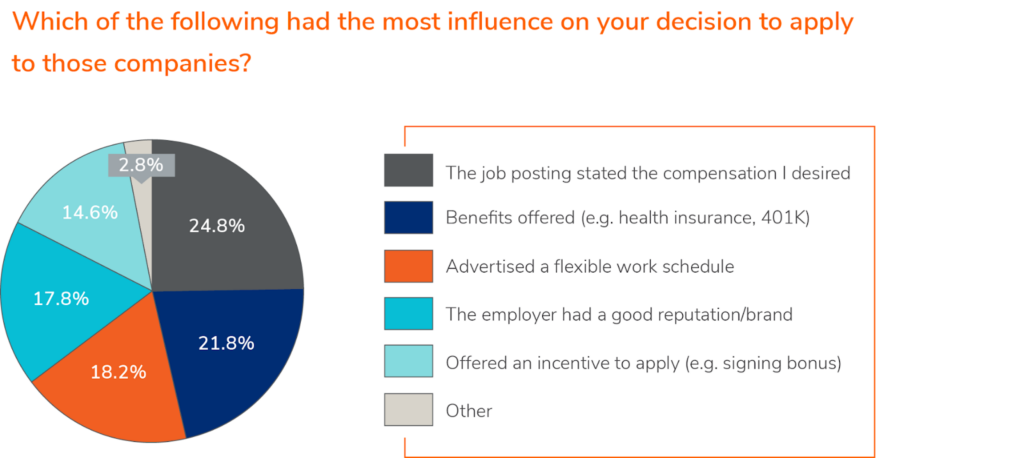
    In the past year, 49% of job seekers have contemplated leaving their current job, with dissatisfaction over pay being the primary reason. Therefore, it’s not unexpected that when asked what influenced their decision to apply for a new job, the top response was “the job posting listed the compensation I was seeking.”

    reasons job seekers apply to jobs

    Do job seekers truly care about the hiring process?

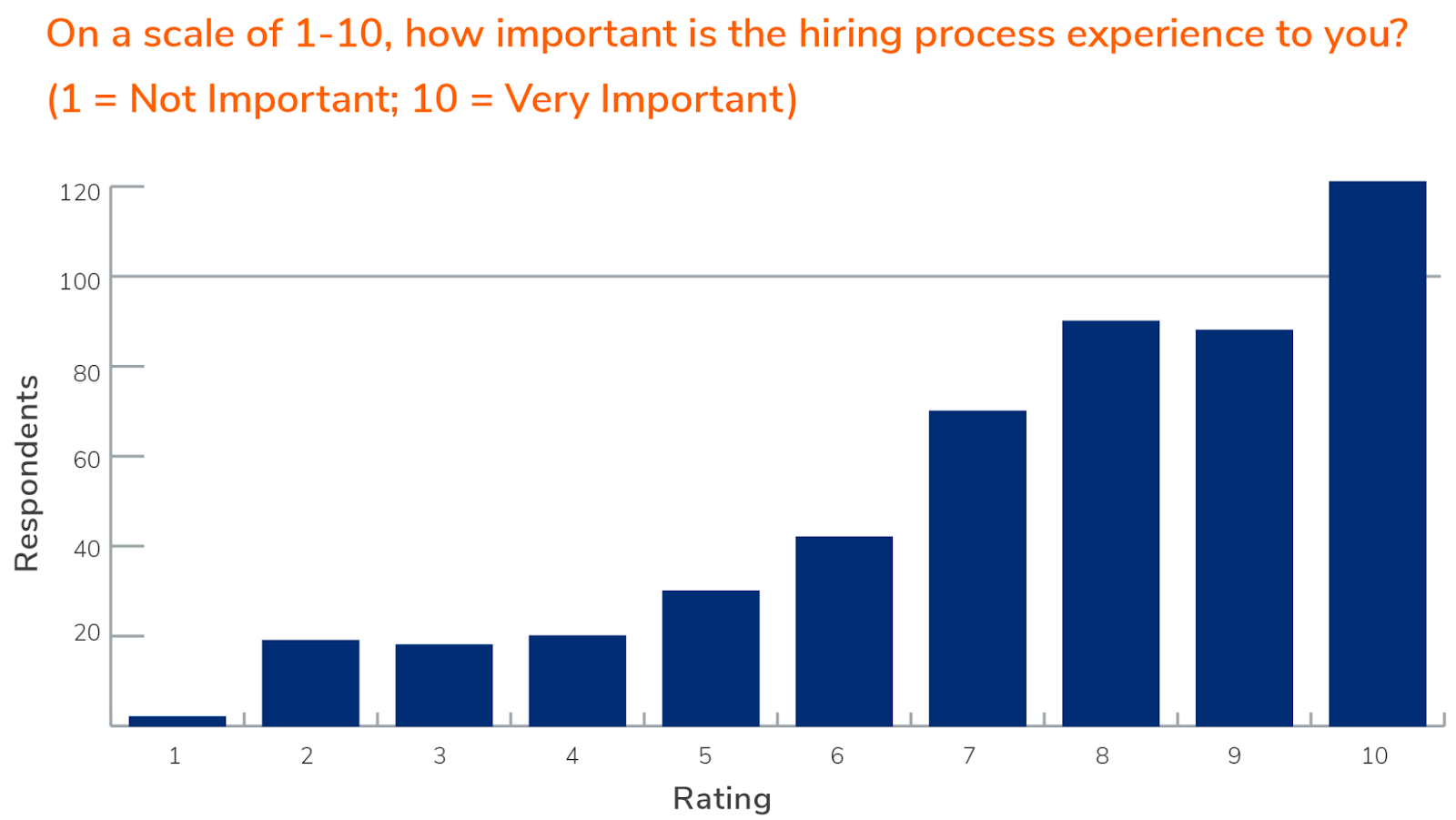
    how important is the hiring process to job seekers

    We asked job seekers to rate the importance of the hiring process to them. The overwhelming majority gave it a rating between 7 and 10, indicating that most candidates pay close attention to how a company conducts its hiring process. Very few considered it of low importance.

    Regarding their current or most recent employer, 83% of employees rated their candidate experience in the hiring process as positive. Additionally, 76% of candidates stated that a positive experience influenced their decision to accept a job offer. Explore to find the most in-demand jobs in the Netherlands.

    What are the consequences of negative candidate experiences?

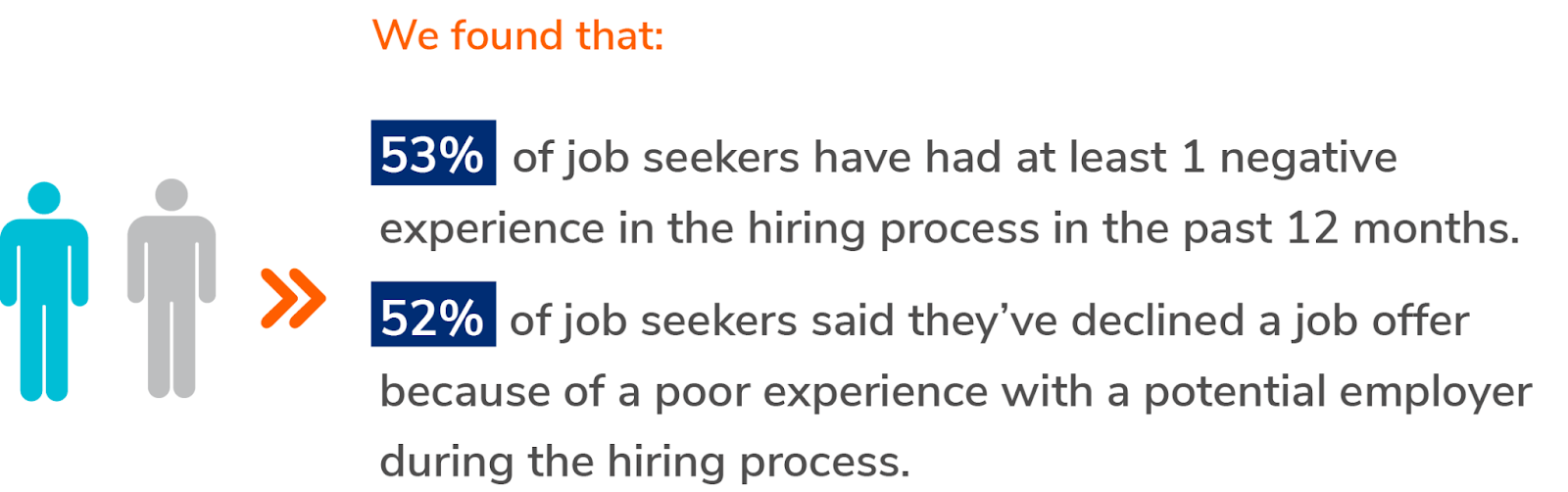
    Our findings reveal that 53% of job seekers have encountered at least one negative experience during the hiring process in the past year, and 52% have declined a job offer due to a poor experience.

    impact of a negative candidate experience

    Consider the countless hours your business invests in hiring and recruiting. If you’ve created a negative candidate experience, half of your offers will be declined. As a result, employers often have to settle for their second or third choice for a role, leading to the biggest challenge businesses face today: making the right hires.

    What contributes to a negative candidate experience?

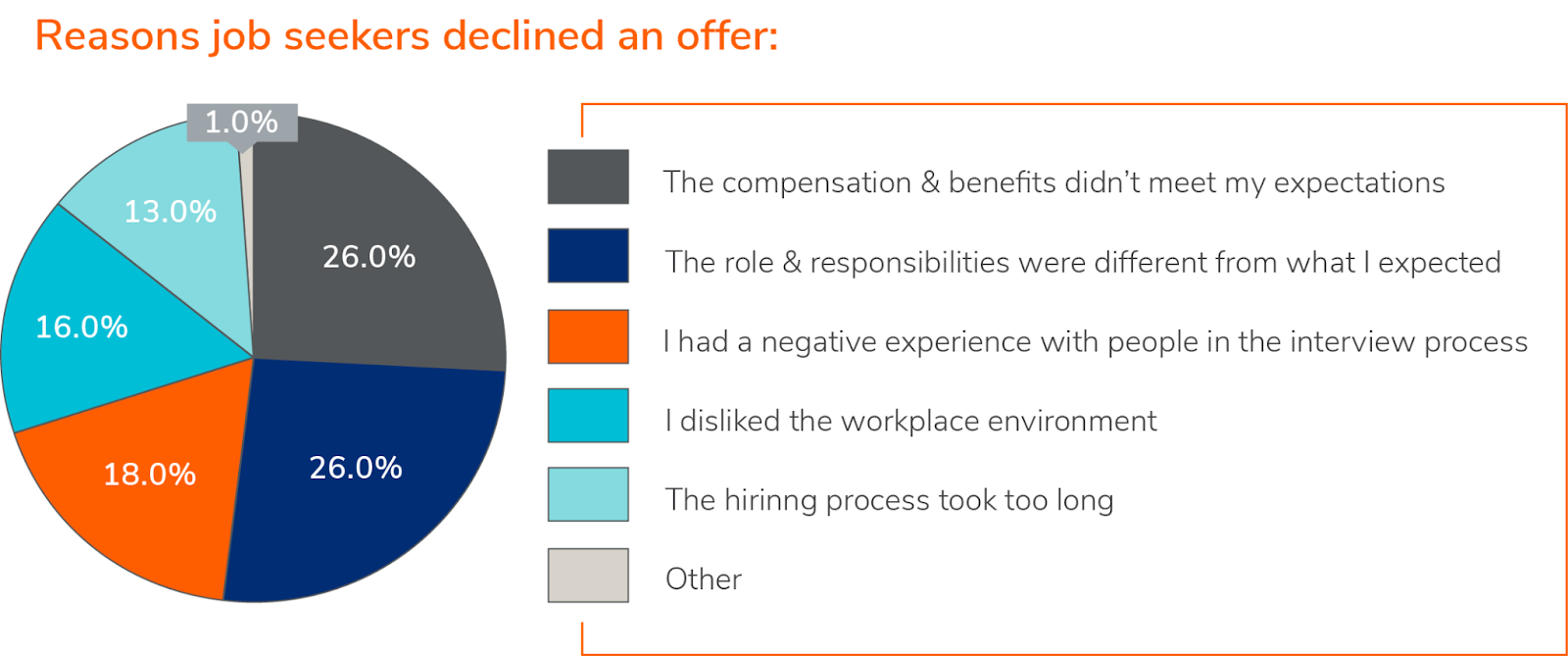
    When we looked at the reasons job seekers classified those experiences as being negative, here’s what we found:

    reasons job seekers decline an offer

    The top two reasons candidates turned down job offers were “the compensation and benefits not meeting expectations” and “the role and responsibilities were different than I expected”

    How does the candidate experience affect your employer brand?

    The impact of a poor candidate experience goes beyond the disappointment of a declined job offer—it has serious consequences for your employer brand, or your business’s reputation as a workplace.

    • 35% of candidates reported leaving a negative review online after a negative experience.
    • 60% of candidates reported leaving a positive review online after a positive experience.

    This is significant because more than half of job seekers abandon their interest in a company after reading negative reviews on employer review sites like Glassdoor and JobSage. Don’t let negative candidate reviews define your employer brand and cause you to miss out on top talent.

    Candidate ghosting 

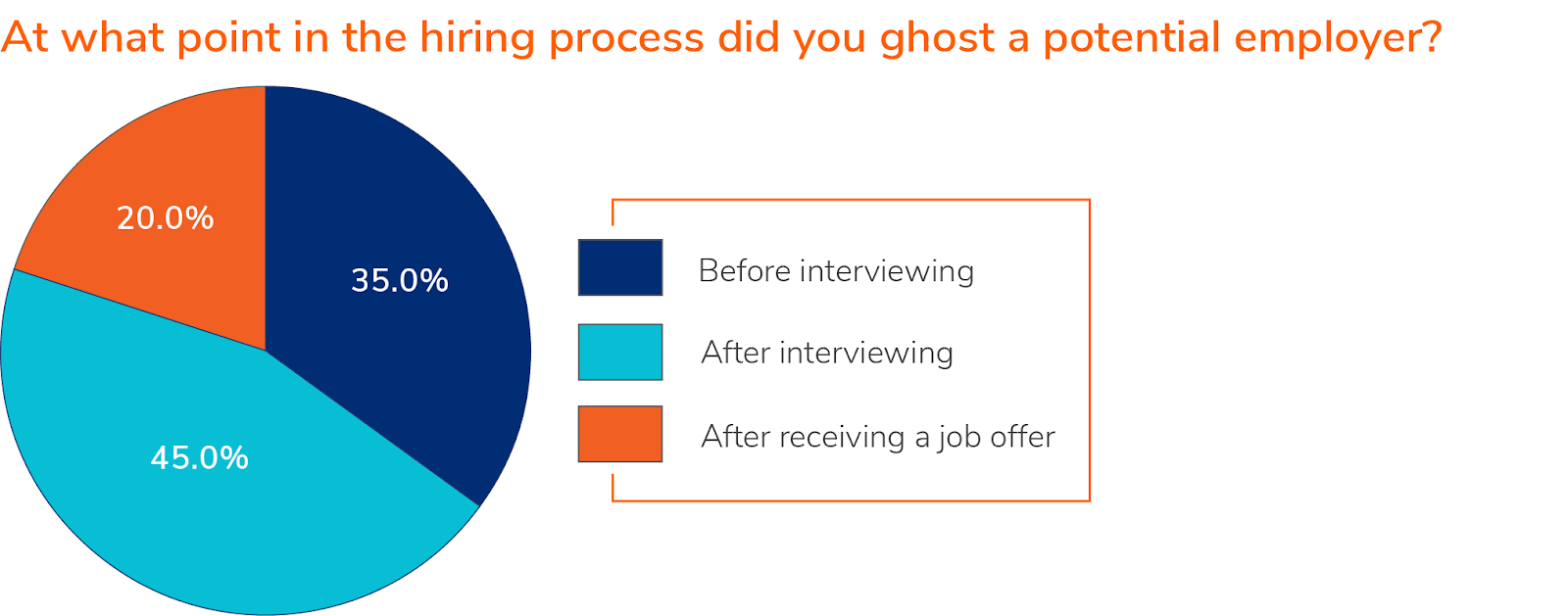
    Candidate ghosting refers to the increasingly common issue where a candidate suddenly stops responding during the hiring process. This can manifest as a candidate not showing up for a scheduled interview or abruptly ceasing all communication after initial contact. It’s always frustrating when a candidate ghosts, but our findings show that 45% of ghosting incidents occur after the interview stage.

    when do candidates ghost

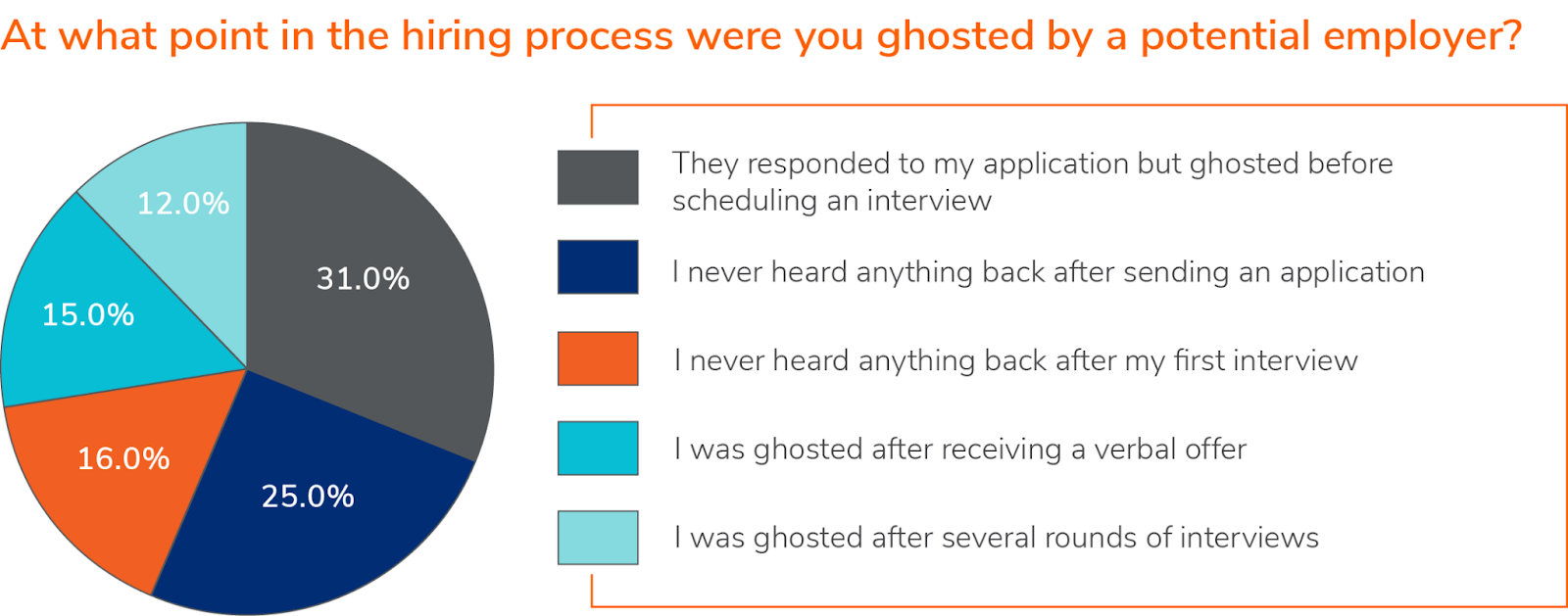
    However, it’s important to recognize that ghosting isn’t one-sided—employers have also been guilty of this behavior. In fact, 53% of candidates reported being ghosted by an employer. Additionally, 31% mentioned that after receiving an initial response to their application, the employer then ghosted them before scheduling an interview.

    when do employers ghost

    Employer ghosting can significantly harm the candidate experience and potentially damage your employer brand. Even if you decide not to hire someone, the impression you leave with them could affect your ability to attract other top candidates in the future.

    Ways to enhance the candidate experience

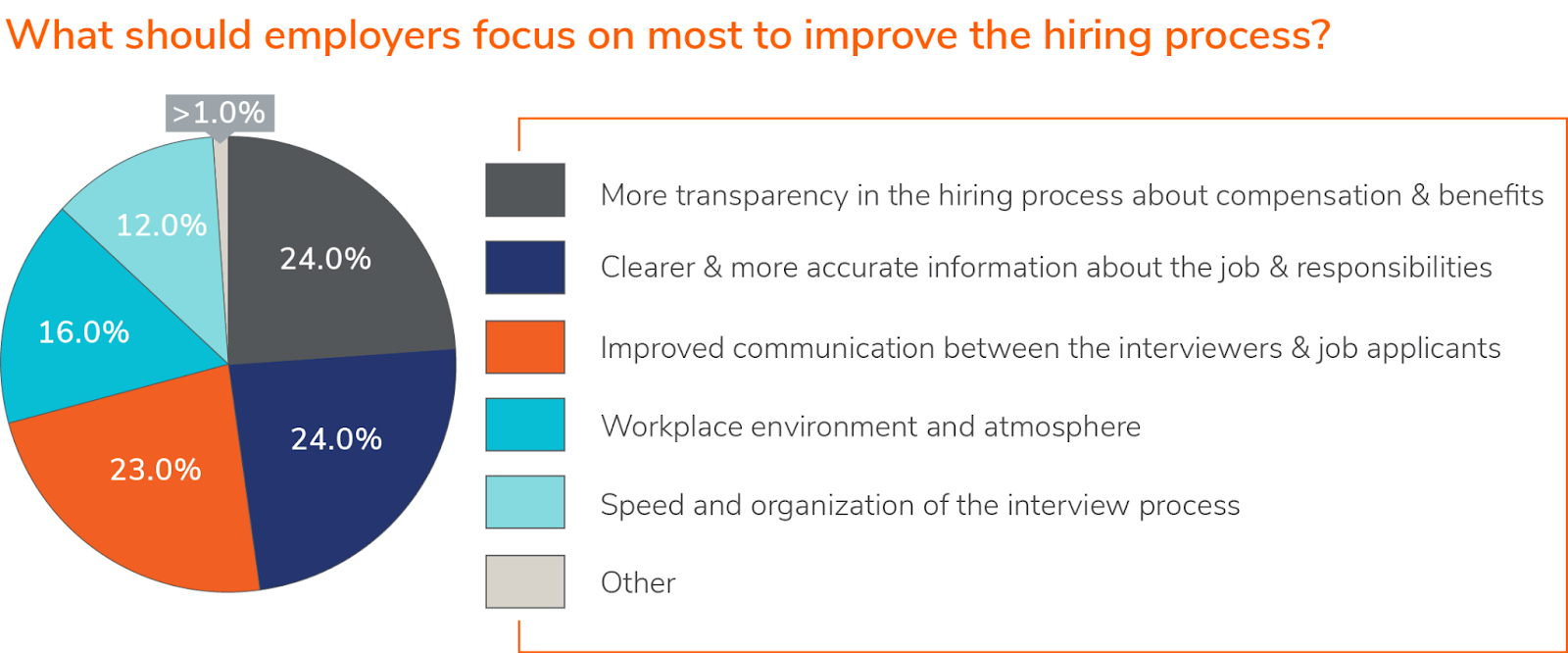
    Here’s what we found when we asked job seekers to identify what employers could do to improve the hiring process that would have the most impact on candidate experience. 

    how to improve the candidate experience
    1. Enhance transparency in the hiring process regarding compensation and benefits.
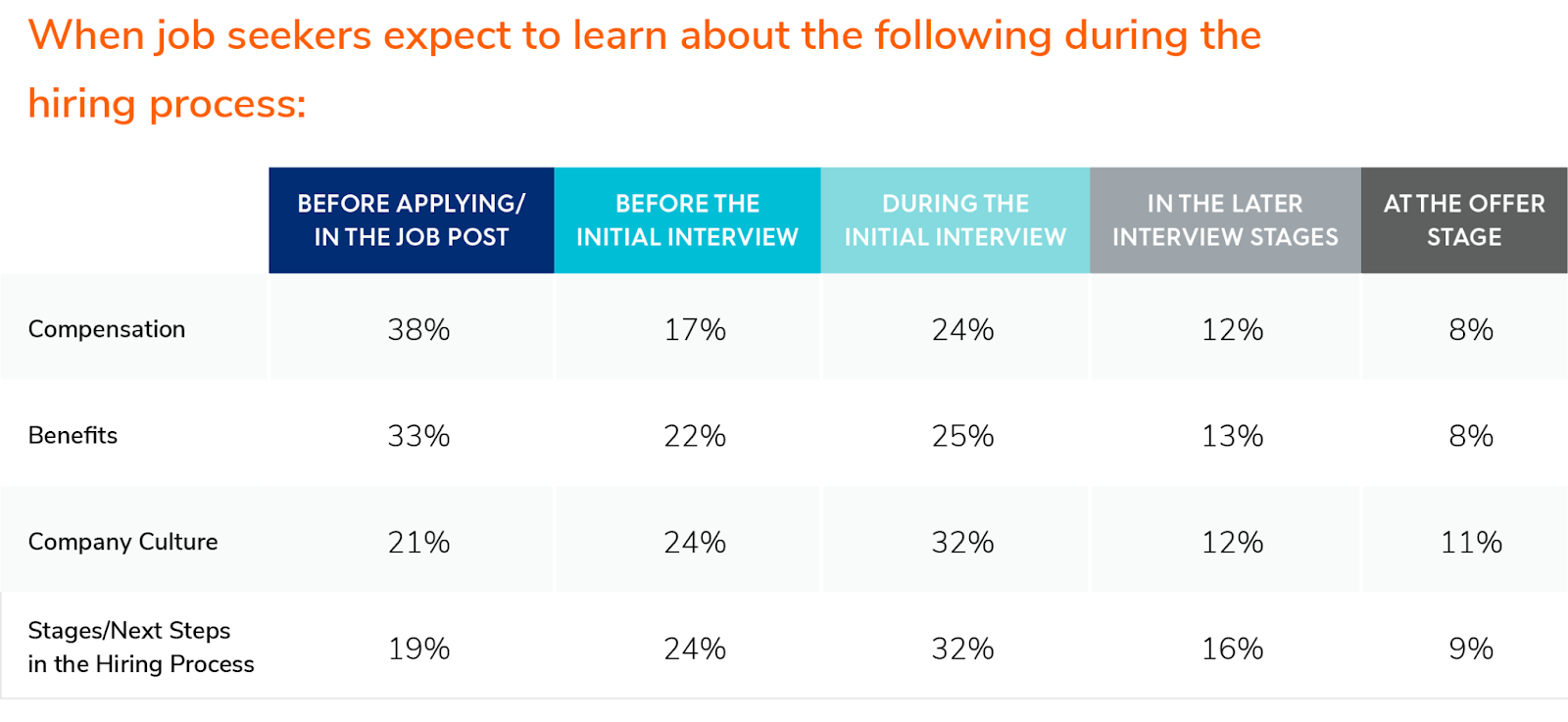
      Job seekers seek comprehensive details about a position earlier in the hiring process to make informed decisions. For instance, 38% of job seekers anticipated being informed about compensation from the outset of the job posting. This presents a significant and straightforward opportunity for employers to improve the candidate experience while also enhancing the effectiveness of their applicant screening process, as candidates will self-assess suitability based on this information.
      • JobsReach fosters transparency between job seekers and employers, keeping applicants updated at every step. 
        Even if a candidate isn’t selected, employers can provide constructive feedback to help them improve.
    what job seekers expect to learn during the hiring process

    According to a job seeker we interviewed, “Compensation and benefits are seldom discussed until after a rigorous and inconvenient interview process. Employers should prioritize upfront communication about what applicants care about most—salary, benefits, and working conditions, including career advancement opportunities.”

    1. Ensure job postings provide clear and accurate information about the role and its responsibilities.
      Take the necessary steps to ensure that your job postings are comprehensive and accurately depict the responsibilities of the position. Candidates rely on these postings to envision themselves working for your company. If they discover later that the information is inaccurate, they will feel their time has been wasted.
      • In JobsReach, job postings are clearly and accurately describe the role and its responsibilities.
    2. Enhance communication between interviewers and job applicants.
      Prompt and frequent communication with potential employers is highly valued by applicants and contributes significantly to a positive candidate experience. It’s crucial to maintain this throughout the entire hiring process, not just with selected candidates.

    Here are some strategies to improve communication with candidates:

    • Respond to all applicants promptly after they apply—Consider automating this process with email templates or using text recruiting.
    • Clearly communicate the steps and timeline of the hiring process upfront—32% of candidates expect to receive information about the next steps during the initial interview. Provide candidates with a clear understanding of what to expect.
    • Keep candidates informed about their status in the hiring process—If a candidate reaches out to you for an update, it’s a sign that communication could be improved. Remember, candidates often pursue multiple opportunities simultaneously, and keeping them informed can help you retain top candidates and avoid missing out on your preferred choices. Explore Remote Work Statistics & Trends In 2024.

    Conclusion

    𝐉𝐨𝐛𝐬𝐑𝐞𝐚𝐜𝐡 is a next-generation platform for jobs that directly connects ideal candidates with relevant job opportunities and completely removes the need for intermediary staffing and recruitment agencies to find new job opportunities.

    JobsReach engages with ideal candidates wherever they are, promotes job opportunities, raises awareness of their future potential, and transforms them into prospective candidates.

    𝐉𝐨𝐛𝐬𝐑𝐞𝐚𝐜𝐡 allows employers to request feedback and recommendations from candidates’ former colleagues to verify their qualifications and experience.

  • Expenses for LinkedIn Recruiter in 2024

    LinkedIn, the largest professional networking platform with over 1 billion users across more than 200 countries, introduced LinkedIn Recruiter in 2008. This new staffing solutions product offered premium features and services tailored to meet the specific needs of corporate staffing departments.

    The tool has become a popular choice for talent acquisition specialists and recruiters to find and engage with candidates on the platform. However, its pricing remains somewhat mysterious. In this article, we’ll explore the costs of LinkedIn’s recruiter packages and discuss whether they offer good value for money. You can also checkout Key Trends, Opportunities, and Salaries in the Netherlands.

    What is LinkedIn Recruiter? 

    LinkedIn Recruiter is a premium service provided by LinkedIn, tailored specifically for recruiters. It functions as an enhanced version of a standard LinkedIn profile, enabling recruiters to access a broader talent pool, obtain contact information for potential candidates, and manage the recruitment process more efficiently.

    LinkedIn Recruiter is an entirely separate platform that enables recruiters to search for candidates using Boolean search, a method that refines online searches through specific keywords and operators. Recruiters can then contact candidates via InMails, private messages that allow direct communication with other LinkedIn members without requiring a prior connection.

    What are some of its benefits?

    LinkedIn Recruiter beats a regular LinkedIn profile in the following ways: 

    Advanced search filters: Find candidates based on specific criteria such as skills, location, education, industry, and more.

    Direct candidate outreach: Send InMails and identify candidates who are available to message. You can also send bulk messages through your dashboard.

    Pipeline management: Add candidates to a “project” to organize your messaging and receive alerts when they change jobs or get promoted.

    What are LinkedIn’s recruitment packages? 

    LinkedIn Recruiter comes in two packages: 

    Recruiter Lite

    This option is cost-effective, designed for individual recruiters or small teams, and includes the following features:

    • Network access visibility: Up to 3rd-degree connections
    • Search filters: 20+ filters
    • Search alerts: 10
    • InMail messages: 30

    Recruiter Corporate

    This is the premium and most powerful solution. 

    • Network access visibility: Full access to all profiles
    • Search filters: All search filters
    • Search alerts: 50
    • InMail messages: 150

    LinkedIn Recruiter’s pricing considerations

    LinkedIn does not disclose the prices of its recruitment products upfront and determines charges on a case-by-case basis. The actual costs are disclosed by their sales team after assessing your company and specific requirements. They then provide a customized price based on the following factors:

    • License Quantity: The cost per seat decreases marginally with larger license purchases.
    • Company Size and Industry: Larger companies and those in competitive industries may incur higher costs.
    • Geographical Location: Pricing varies based on location.

    LinkedIn Recruiter expenses

    According to industry research and reports, here are estimated costs:

    • Recruiter Lite: Approximately $170 per month for one license, with $270 per month for licenses 2 to 5.
    • Recruiter Corporate: Roughly $12,960 per seat annually (equivalent to about $1,080 per month).

    Extra charges associated with LinkedIn Recruiter

    InMails :

    InMails are messages sent to individuals outside your network. With Recruiter Corporate, you receive a monthly allocation of 150 InMails, and with Recruiter Lite, you receive 30.

    If you’re new to recruitment or entering a new market, relying solely on your monthly InMail allowance may not be sufficient to engage potential candidates, especially considering the average response rate of 18-25%.

    So, what are the costs for additional InMails? They are priced at a significant $10 each. This means that if you need an extra 100 InMails, and typically expect 18-25 responses, it would cost you $1,000.

    Job posting :

    If you intend to advertise a job opening on LinkedIn to attract qualified candidates, note that posting a single job is free. However, unpaid job posts do not rank on the first page and have limited visibility in searches.

    Similar to other job boards, increasing the visibility of your job post requires purchasing promoted posts and setting a budget. The higher your budget, the higher your job post will rank.

    Alternatively, LinkedIn offers a contract model through its Talent Solutions department. You can specify criteria for a role (e.g., Machine Learning Engineer, San Francisco, 7+ years of experience), set up the job post to run for six months, and get billed at the end of the period based on the number of qualified candidates who apply.

    Is it worth it?

    Typically, the answer to this question would be a resounding no. However, since LinkedIn’s inception in 2003, it has come to dominate the recruitment sector. Today, competing effectively often necessitates investing in a LinkedIn Recruiter corporate license and a substantial number of InMails.

    Is there an alternative? 

    There are several alternatives to purchasing a costly LinkedIn Recruiter license:

    Free options:

    • Utilize your connections: LinkedIn permits you to send up to 100 connection requests per week. Once connected, you can message individuals at no cost, so maximize this option.
    • Use an email-finding tool: Basic LinkedIn searches still allow you to find candidates, though limited to a certain number of pages without a premium subscription. You can identify candidates and extract their email addresses using free trials of email scraping tools like ContactOut or Lusha.
    • Create content: Building your personal brand by sharing relevant and valuable content on LinkedIn is effective in attracting potential candidates. Write blogs, LinkedIn posts, and host webinars discussing industry trends and insights.

    Job boards

    Consider signing up for various job boards like Indeed, Monster, or Glassdoor to post job listings and attract candidates actively seeking new opportunities. Here’s a synopsis of why opting for a job board might be preferable over LinkedIn Recruiter:

    • Active job seekers: Job boards draw users actively searching for new roles, unlike LinkedIn where not all users may be actively looking. This ensures you reach a pool of candidates more likely to apply, potentially streamlining your hiring process.
    • Cost-effectiveness: Job boards often offer more budget-friendly options compared to LinkedIn Recruiter subscriptions, with tiered pricing structures based on your specific needs.
    • Enhanced visibility: Posting on relevant job boards expands your company’s visibility beyond existing networks, attracting a broader array of talent that may not be accessible through LinkedIn alone.

    However, keep in mind the following considerations:

    • Limited access to candidate profiles: Job boards typically do not provide the same level of detailed candidate information as LinkedIn Recruiter.
    • High volume of applications: Expect to receive numerous applications, including many from candidates who may not be suitable for the role. This necessitates significant time and effort to filter through applications.
    • Passive candidate pool: Up to 70% of the workforce consists of passive candidates who are not actively seeking new opportunities. Relying solely on active job seekers may limit your access to potential talent.

    JobsReach

    A compelling alternative to LinkedIn Recruiter is JobsReach, an AI-powered recruitment platform that utilizes AI and social media strategies to precisely identify desired candidates without relying on traditional Boolean searches and share job vacancies and attract ideal applicants.

    JobsReach standard subscriptions

    Here are its primary features:

    • No Candidate database: JobsReach does not rely on candidate database to match candidates, It reaches wider audience through social media platforms where potential candidates are actively engaged.
    • Precision and customization: JobsReach enables highly specific searches based on criteria such as job title, location, company history, skills, published work, and niche expertise.
    • Contact details: Gain access to accurate contact information including emails and phone numbers to directly reach out to candidates, similar to LinkedIn.
    • Personalized outreach: JobsReach provides Inbox service to send personalized communication with other registered members.
    • Talent Insights: Utilize data-driven recruitment insights to understand a company’s talent strategy in depth.

    JobsReach, powered by GeniusArena Software B.V., revolutionizes modern recruitment by offering access to millions of talents, scalable candidate engagement, and data-driven insights at a fraction of the cost compared to LinkedIn Recruiter. JobsReach provides standard and flexible subscription plans, allowing small and medium enterprises as well as large corporations to hire the right candidates cost-effectively.

  • JobsReach Vs. Indeed Vs. LinkedIn: Which job board will assist you in securing your next hire?

    Table of Contents

    • JobsReach vs. Indeed vs. LinkedIn: At a Glance
    • How do the platforms compare?
    • Conclusion

    In our present economy, workers hold significant leverage, granting them the ability to choose among employers. Therefore, when hiring, it’s essential to distinguish yourself appropriately to attract the right candidates who can contribute to your company’s objectives.

    A crucial aspect of this process is placing your job listing in the appropriate venue. While there are numerous online job boards available, two prominent platforms stand out as favorites among candidates across various industries and locations. In this examination of Indeed versus LinkedIn, we’ll explore the advantages and disadvantages of each platform and offer guidance on determining the most suitable platform for connecting with potential job applicants for your company.

    JobsReach vs. Indeed vs. LinkedIn: At a Glance

    JobsReach, Indeed and LinkedIn stand out as premier platforms for job seekers, yet each offers a distinct user experience (UX). Indeed prioritizes aligning employers with candidates who fit posted job listings, whereas LinkedIn emphasizes assisting individuals in expanding their professional networks and advancing their careers by connecting with others. While job listings are a supplementary feature on LinkedIn, they are not the primary focus.

    Typically, employers can avail themselves of the opportunity to post open positions for free on both platforms simultaneously. However, the disparity in how each platform facilitates connections with candidates may influence where you allocate your resources to engage with the most suitable individuals.

    JobsReach

    JobsReach for a next-generation job platform that stands out by attracting ideal candidates for every job opportunity through a targeted mass social media recruitment strategy, rather than relying on a large candidate pool like Indeed or LinkedIn.

    𝐉𝐨𝐛𝐬𝐑𝐞𝐚𝐜𝐡 allows employers to request feedback and recommendations from candidates’ former colleagues to verify their qualifications and experience.

    JobsReach engages with ideal candidates wherever they are, promotes job opportunities, raises awareness of their future potential, and transforms them into prospective candidates.

    Indeed

    Best used as

    Job search engine

    Cost for Sponsored Jobs

    $5 to $499

    per day

    Stands out for

    On-platform virtual interviews

    Editor’s Take

    Indeed has recently outpaced its rivals to emerge as the most visited online job board in the United States, with an impressive 63.7 million monthly users. It has become one of the primary destinations for job seekers seeking opportunities, making it a highly desirable platform for employers to showcase their listings.

    Employers have the option to post job openings on Indeed at no cost, with the additional opportunity to enhance visibility through sponsorship. Sponsored posts operate within a daily budget set by the employer, ranging from $5 to $499 per day, with payment based on a variable rate for each click on the listing. Moreover, employers can access a database of job seekers’ résumés and communicate with potential candidates through a monthly subscription.

    Indeed surpasses its competitors in search functionality. While the platform offers features such as career advice, company reviews, and salary comparisons akin to other job posting sites, its primary focus lies in its job search utility.

    Pros & Cons
    • #1 job search site in the U.S.
    • Low-cost job ads
    • On-platform virtual interviews
    • Subscription required to contact candidates in résumé database
    • No free trial for Indeed Resume Search
    • Popular site means more competition for candidates

    LinkedIn

    Best used as

    Professional network

    Cost for Sponsored Jobs

    Daily budget of your choice

    Stands out for

    Free network to search and contact candidates

    Editor’s Take

    LinkedIn, primarily a social network, offers both advantages and disadvantages compared to traditional job boards. With a network of 770 million users, it provides extensive reach, though not all users are actively seeking jobs. The platform serves various purposes, from connecting with colleagues to researching sales prospects.

    Integrating job search capabilities into an active social network allows LinkedIn to leverage extensive user activity to identify strong candidates for positions. This continuous engagement means many users are active on the platform even when they aren’t job hunting, making it an excellent venue for building relationships beyond the confines of job descriptions and résumés. Job seekers can discover opportunities through your company’s platform activity, in addition to traditional job listings.

    Users can search for relevant profiles—acting as dynamic résumés—and contact most users for free. Job postings can be made at no cost, with the option to promote them using a daily budget. Companies with significant hiring needs can upgrade to a Premium account with a Recruiter seat, providing enhanced search capabilities, easier contact options, and a comprehensive recruiter dashboard.

    Pros & Cons
    • Utilization of comprehensive public data and applicant activity
    • Free profile searches and candidate outreach
    • Establish and maintain ongoing connections with candidates and new hires
    • Expensive monthly subscription for Premium features
    • Job seekers might be less active compared to those on dedicated job board sites

    How do the platforms compare?

    JobsReachIndeedLinkedIn
    Free Posting OptionYesYesYes
    Cost for Premium PostsNAPay-per-click pricing based on a daily budget between $5 and $499 per dayCost per unique view on a daily budget you choose
    Search RésumésYes, subscription required to contact candidatesYes, subscription required to contact candidates ($100 to $250 per month)No, but profile search is free and open to all users
    Employer DashboardFreeFreeIncluded with free posting, advanced features with Recruiter Lite for $119.99 per month
    Unique FeaturesThe job posting will be shared on social media to directly reach potential candidates.Schedule and conduct virtual interviews on-platformSocial network, learning resources for ongoing employee engagement
    Free TrialOne free monthN/A (free by default)One free month of Premium
    Customer SupportOnline FAQs, email support formOnline FAQs, email support formOnline FAQs, email support form; live chat and phone number for sales

    Job listings on both platforms are similar, but the context for connecting with candidates is quite different. Indeed functions mainly as a search engine, whereas LinkedIn operates primarily as a social network. Job seekers visit Indeed to find information on available positions, while they use LinkedIn to cultivate professional relationships. Keep this context in mind when developing your strategy for promoting and recruiting for open roles.

    Highlighting Top Applicants

    As applications flood in on these popular networks, you need a method to quickly vet them. Indeed leverages the information in your job listing to rank top applicants based on their résumés, placing them at the top of your list for easy identification.

    LinkedIn uses its extensive user data to match applicant profiles with your job listing and company profile, highlighting the top candidates for you.

    Applicant Ranking

    As applications arrive on LinkedIn, you can assess and rank candidates’ suitability for the role. When you mark candidates as “good,” LinkedIn uses their profile and application information to display the job listing to similar job seekers.

    On Indeed, you can rank your top candidates, and the platform will automatically decline the other applicants on your behalf.

    Virtual Interviews

    Through Indeed, you can arrange a virtual interview with a candidate and conduct it directly on the platform.

    Conclusion

    The process of posting jobs on Indeed versus LinkedIn is quite similar—you can post for free and enhance a listing based on your budget. However, the fundamental purpose of each platform creates a unique experience in connecting with candidates.

    LinkedIn may be more suitable for a small company aiming to establish a personal connection with candidates before hiring. Job seekers have the opportunity to follow your company’s profile and review current and former employees to gauge their potential fit within the team. Additionally, reaching out via direct message on LinkedIn might feel more personal compared to a message on a job-search platform.

    Indeed is designed to streamline the hiring process with effortless job posting, integration with applicant tracking systems (ATSs), and on-platform interviews. Its search engine functionality is highly accurate and beneficial for job seekers, potentially increasing the visibility of your post to the right audience.

    In most scenarios, leveraging both platforms for free can be advantageous in reaching a broader audience. Assess your priorities and target candidate pool to determine where to allocate more resources, whether boosting listings or utilizing advanced hiring tools. Explore about Which Job Board Is the Best For Your Business?

    JobsReach revolutionizes the hiring process by not solely relying on candidate databases and the 15-25% of active job seekers. It effectively targets the remaining 75% who are passive job seekers while still engaging active candidates. Leveraging social media, JobsReach connects candidates with potential opportunities and ensures all potential candidates are informed about the opportunities available for them to take the next step in their career paths. This approach attracts the right talent to quickly fill employers’ vacancies directly without the need for intermediaries or additional investments.

  • Indeed Vs. Monster Vs. JobsReach : Which Job Board Is the Best For Your Business?

    Monster vs. Indeed vs. JobsReach: At a Glance

    JobsReach, Indeed and Monster provide convenient options for posting jobs, creating customized applications, tracking applicants throughout the hiring process, and managing postings effortlessly. They also offer subscription plans tailored to the anticipated number of requests or clicks from potential candidates in response to your postings.


    JobsReach

    Free Plan

    Yes

    Screening Questions

    Yes

    Free Trial

    One month

    Editor’s Take

    JobsReach is a next-generation job platform that connects candidates with matching opportunities effortlessly, right where they are engaged. Unlike traditional platforms that require job seekers to spend significant time searching and applying for jobs, JobsReach simplifies the process.

    JobsReach tackles the inefficiencies of traditional hiring methods by using advanced technology to cut hiring expenses for companies.
    JobsReach offers an innovative approach to filling vacancies with qualified candidates without inflating costs and without any intermediaries.

    Employers can start using JobsReach for free with the introductory Free plan. JobsReach provides adaptable subscription choices such as Weekly, Monthly, and Yearly plans, customized to meet diverse employer requirements. The Weekly subscription is priced at 40 Euros, while the Monthly Business Plan costs 125 Euros and the Monthly Enterprise Plan costs 1250 Euros. Opting for the Yearly subscription offers savings of over 17% on the total cost. Additionally, JobsReach provides both manual and recurring subscription choices, enabling employers to manage their costs efficiently while benefiting from a next-generation job platform.

    Pros & Cons
    • Has its own ATS
    • AI creates job description
    • Smart screening questions designed to optimize initial candidate evaluations
    • Salary recommendations aligned with industry standards
    • AI-generated feedback on the candidate’s suitability for the open position
    • No integration with other job boards
    • limited number of companies adapted to next-gen job platform
    • Can’t integrate your own ATS

    Indeed

    Free Plan

    Yes

    Screening Questions

    Yes

    Free Trial

    Not needed, it’s free

    Editor’s Take

    Sixty-one million people worldwide use Indeed every month for job hunting. Indeed simplifies the job search process by sending alerts when new positions match a seeker’s criteria. Moreover, it’s free for employers to post job listings, making it an excellent option for those on a budget. However, to increase visibility, you might want to invest in promoting your job listing. You can set your budget and only pay when a candidate views your post.

    Indeed also provides screener questions, allowing you to customize queries for potential candidates to streamline the applicant pool. If you sponsor a post, you gain access to Instant Match, enabling you to invite candidates who align with your job description to apply.

    Pros & Cons
    • There are over 200 million resumes in its database
    • It’s free
    • Gauge an applicant’s skill with an assessment
    • It doesn’t syndicate your job post to other boards
    • Some applicants mass apply to jobs they aren’t qualified for
    • High volume of competition

    Monster

    Free Plan

    Yes

    Screening Questions

    No

    Free Trial

    Four days

    Editor’s Take

    Monster offers three paid plans: Starter, Standard, and Premium. The Starter plan costs $279 per month, providing one active job slot and up to 50 resume views. The Standard plan, at $399 per month, includes three active job slots, cross-posting to hundreds of other job boards for 30 days, and 150 resume views. The Premium plan offers five active job slots, the same cross-posting as the Standard plan, and 250 resume views.

    Opt for the Starter plan if you have a single job opening, the Standard plan for small but growing teams, and the Premium plan for rapidly expanding teams. With Monster+, you can post jobs for free but won’t have access to Monster’s résumé database. You can promote these listings on a pay-per-click basis.

    Struggling to create an effective job description? Monster has the solution. Select from a collection of over 500 templates to create a compelling job description. Not only does Monster offer guidance on customizing these templates for your specific role, but it also excels in educating candidates. Throughout their job search journey, candidates receive valuable tips and advice from Monster.

    Pros & Cons
    • Has its own ATS
    • 500-plus job description templates
    • Monster+ lets you post jobs for free
    • No screening questions
    • Must have a Standard plan or higher for cross-posting
    • Can’t integrate your own ATS

    Monster has two separate divisions: the regular Monster and Monster+ (beta). With Monster, you can integrate your own applicant tracking system (ATS) and search its resume database. Meanwhile, with Monster+, you can post jobs for free and opt to sponsor the listing for a fee, although access to its resume database is not included.

    Indeed boasts a database of over 200 million resumes and functions as an aggregator, displaying your job postings alongside others sourced from external platforms. Both platforms offer the option to promote your listings on a pay-per-click (PPC) basis, ensuring payment only when the ad performs, such as when someone clicks on your listing.

    Choose Indeed if you’re aiming to attract international candidates, as it operates as one of the premier job boards in 63 countries. While Monster operates in 14 countries, it is primarily suited for local and regional hiring. Additionally, Indeed is the preferred platform for roles requiring skills verification, thanks to its offering of over 150 online skills assessments. Although Monster also provides a candidate evaluation tool, it lacks skills verification through assessments. Monster is better suited for positions where skills can be verified through alternative means, such as checking a nurse’s license in a state database.

    Consider JobsReach for a next-generation job platform that stands out by attracting ideal candidates for every job opportunity through a targeted mass social media recruitment strategy, rather than relying on a large candidate pool like Indeed or Monster.

    How Indeed and Monster and JobsReach Stack Up

    IndeedMonsterJobsReach
    PricingOnly pay-per-click for sponsored listingsFree to over $649 per monthFree to over €40 per week
    €125 per month for Business
    €1250 per month for Enterprise
    Free Plan
    Resumes in DatabaseMore than 200 millionNot advertisedNot advertised
    Skills AssessmentXX
    Sponsored Listings
    ✓ – Pay-per-click
    ✓ – Pay-per-clickStandard subscription
    Candidate Evaluation Tool
    Free TrialNot needed, it’s freeFour days30 days

    Free Plan

    Posting jobs on Indeed is complimentary, and you have the option to enhance the visibility of your listing through paid promotion on a pay-per-click (PPC) basis. On the other hand, Monster+ provides a free posting option and also offers PPC job advertisements.

    Free Trial

    No free trial is required for Indeed since it’s entirely free to post jobs and does not provide any paid subscription plans. However, with Monster’s paid plans, you can enjoy a four-day free trial to explore its features.

    Pricing

    The cost of advertisements on either Indeed or Monster is determined by your bid and budget since they operate on a pay-per-click (PPC) basis.

    Resumes in Database

    Both Monster and Indeed offer a resume database feature, but only Indeed discloses the quantity. Indeed boasts a database of over 200 million resumes worldwide.

    Skills Assessment

    Indeed excels in the skills assessment domain, as Monster does not offer this feature. Skills assessments aid in evaluating a candidate’s suitability for the role they will undertake, bypassing the need to solely rely on self-reported skills.

    Sponsored Listings

    Monster and Indeed both provide sponsored job listings based on performance, utilizing the pay-per-click (PPC) model. You establish the bid and budget, and payment is only triggered when a candidate engages with your listing, such as by clicking on it to view details. This method offers excellent control over your budget.

    Candidate Evaluation Tools

    Sorting through hundreds of applications can be overwhelming. That’s where candidate evaluation tools come in handy. JobsReach and Monster assigns a score to candidates based on their alignment with your requirements. Indeed goes a step further by verifying the skills listed on candidates’ resumes, assisting you in selecting the most qualified candidate.

    Conclusion

    JobsReach, Indeed and Monster are excellent choices for recruitment purposes. However, if you require someone with a precise skill set, Indeed emerges as the superior option. While Monster offers a skills assessment feature, it doesn’t match the comprehensive depth of Indeed’s offerings. Moreover, Monster lacks the capability to verify the skills listed on a candidate’s resume, potentially resulting in hiring errors. Opt for JobsReach or Monster when dealing with skills that aren’t readily verifiable through online assessments, such as nursing, where you can verify a candidate’s license through a state database instead. You can also explore job board will assist you in securing your next hire.

    JobsReach revolutionizes the hiring process by not solely relying on candidate databases and the 15-25% of active job seekers. It effectively targets the remaining 75% who are passive job seekers while still engaging active candidates. Leveraging social media, JobsReach connects candidates with potential opportunities and ensures all potential candidates are informed about the opportunities available for them to take the next step in their career paths. This approach attracts the right talent to quickly fill employers’ vacancies directly without the need for intermediaries or additional investments.

  • 5 Reasons Job Seekers Aren’t Applying to Your Job Posting.

    You have a job vacancy and are eager to begin hiring. Being a great company with a fantastic opportunity, you might think finding the perfect candidate should be straightforward. However, despite posting the job online, you may not have received the expected flood of qualified applicants.

    Perhaps you’re finding it challenging to attract applicants when you advertise an open position, and you’re uncertain about the reasons. You’ve started to recognize that there are numerous excellent companies with multiple job openings, and enticing applicants to consider your role may require additional effort. But what specific aspects do applicants prefer – or dislike – in a job advertisement?

    As part of our 2024 Applicant Expectations Report, we surveyed recent job seekers to uncover what drives them to apply to job postings. Their feedback reveals important insights into potential mistakes in job postings that might be limiting your applicant pool.

    Keep reading to discover how you can enhance your job postings based on the feedback from job seekers, thereby improving your chances of making the optimal hire for your team. You can check out Report on Candidate Experience.

    What motivates job seekers to apply for jobs?

    Let’s begin by discussing what job seekers seek in a job posting and the factors that most influence their decision to apply. In our survey, we asked job seekers to select the top three aspects of a job posting that excite them the most.

    Here are some of their answers: 

    • Benefits and perks provided by the company
    • The listed compensation range
    • Remote/Flexible work option
    • The company’s reputation/brand

    You can use this information to determine what your job posting might be missing. Let’s take a closer look at the reasons job seekers aren’t applying to your open jobs and what you can do about it. 

    Why aren’t people applying to my job?  

    1. You’re not leading with benefits and perks 

    Job seekers consistently tell us that benefits and perks are just as crucial as competitive compensation. They want this information upfront, before applying or interviewing. They won’t waste time on a job they’re uncertain about. Additionally, providing this information early on demonstrates that your company values transparency.

    One job seeker remarked, “Compensation and benefits are seldom mentioned until after applicants endure a lengthy and inconvenient interview process. Employers need to be upfront about what matters most to applicants—salary, benefits, and work conditions, including opportunities for upward mobility.”

    2. There’s no compensation listed 

    46% of job seekers identified compensation as a primary reason they are excited to apply to job postings. Naturally, people want to be well-compensated for their work, so offering a competitive salary is essential. However, even that won’t help much if you’re not transparent about the salary in the job posting.

    There are several reasons why omitting compensation details from your job posting might cause you to miss out on applicants. Candidates are busy, and applying to jobs takes time and effort, so they want to ensure their effort is worthwhile. Many qualified individuals won’t take the time to apply if they’re uncertain about what you’re offering.

    Additionally, including compensation details can save you time by helping candidates self-select in or out of the opportunity. This prevents you from investing time and resources in moving someone through the hiring process only to discover a disagreement on compensation terms at the offer stage.

    Moreover, pay transparency has become a legal requirement in several cities and states. Major job boards, such as JobsReach, Indeed, are now removing job postings in these areas that don’t list compensation.

    If your job posting is not attracting as many applicants as expected, the absence of compensation details could be the reason.

    Transparency with JobsReach

    JobsReach helps employers in clearly defining job requirements for candidates using AI. It also suggests salary expectations based on current industry standards and trends to attract suitable candidates without missing out on top talent. Operating on the principle of transparency, JobsReach ensures that every job published on the platform discloses salary ranges, perks, and other benefits. This information is widely distributed to attract the right candidates for JobsReach’s partner companies.

    3. No remote or flexible working options

    In a Flex Jobs study 2024, 32% of respondents expressed a preference for a hybrid work environment, while 65% preferred to work remotely full-time. Similarly, our own survey revealed that remote and flexible working options are highly attractive to job seekers.

    If you already offer remote or hybrid work options, make sure to include these details in your job description. If remote work is not possible, consider other ways to add flexibility to your employees’ schedules. For instance, do you have a generous time-off policy or allow employees to swap shifts through a scheduling app? Highlight how you support a flexible working environment to attract potential candidates. Explore Remote Work Statistics & Trends In 2024.

    4. You don’t have a compelling employer brand 

    When job seekers browse through job boards, weighing different opportunities, one aspect that catches their attention is a job posting that highlights a company’s employer brand. Job seekers are aware of their options, and they are drawn to companies with positive reputations.

    The primary method of building your employer brand is by being a desirable place to work. Employees who hold a favorable view of your workplace are more inclined to provide compelling testimonials, which you can feature on your careers page.

    Furthermore, ensure positive candidate experiences during the hiring process. This not only aids in organically fostering a good reputation but also enables you to actively manage your employer brand online through platforms like GlassDoor and JobSage.

    Company Page on JobsReach

    JobsReach empowers partnered companies posting job vacancies to create a company page, allowing them to showcase their brand, work culture, and details like work-life balance. This enables job seekers to gain a better understanding of their future employer and company culture. Such information attracts potential job seekers to consider various factors beyond compensation, such as packages and perks.

    A stellar reputation distinguishes you amidst numerous job postings, increasing the likelihood of job seekers applying for your open positions and ultimately accepting job offers later in the process.

    5. Not enough focus on skills in your job posting 

    We requested job seekers to articulate what aspects they find appealing in a job posting.

    One recurring theme was the preference for skills-first hiring, which underscores the significance of skills and proficiency over rigid prerequisites such as particular degrees or experience.

    By incorporating skills into your job description, job seekers are inclined to perceive themselves as qualified for the role and resonate with the position. For instance, while someone might refrain from applying due to a specific degree requirement, the inclusion of criteria like “strong communication skills” or “leadership experience” could prompt them to perceive themselves as a better match.

    Explore to find the most in-demand jobs in the Netherlands.

  • The Top jobs in demand in the Netherland

    These are the top jobs in demand in the Netherlands.

    Thinking about working abroad in the Netherlands? There are so many to help you create your future.

    In this article, we delve into current job market trends in the Netherlands and highlight some of the most in-demand jobs, aiming to help you find your dream role in this remarkable country, which is ranked as the fifth happiest in the world!

    Amsterdam has become a hub for innovative technology and IT businesses, drawing in both startups and global corporations. The Dutch capital is also celebrated for its welcoming attitude towards foreign nationals, hosting over 180 different nationalities and establishing itself as a multicultural hub full of potential.

    Where to work in The Netherlands?

    While the Netherlands is often praised for its bicycles, canals, and tulips, it is equally recognized by both locals and expatriates for its excellent work-life balance. If you’re thinking about relocating to work and live in the Netherlands, there are several fantastic locations to consider.

    The top 4 cities for digital careers in The Netherlands are:

    1. Amsterdam
    2. Utrecht
    3. Rotterdam
    4. The Hague

    As the global demand for digital skills increases, the Netherlands is no exception. With its rapidly growing digital economy, there are numerous career opportunities for individuals with digital expertise, whether they are already in the country or considering relocation. However, competition is also on the rise.

    We offer plenty of advice to help candidates stand out for the right reasons and secure their dream roles with potential employers!

    • Make your LinkedIn profile stand out 
    • Update your CV
    • Write an amazing cover letter
    • Join JobsReach, the ultimate job platform, surpassing LinkedIn

    What are the most rapidly expanding and sought-after job opportunities in the Netherlands for 2024?

    According to LinkedIn’s Jobs on the Rise 2024 report the fastest growing jobs in the Netherlands this year include: 

    • product analyst
    • sales development representative 
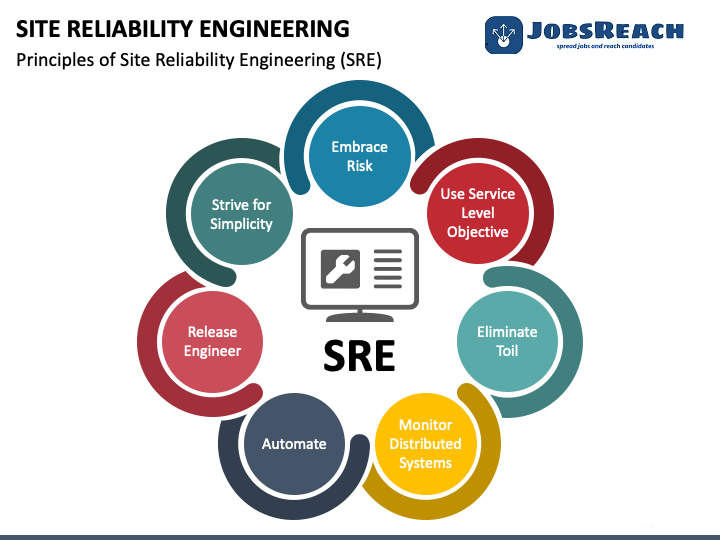
    • site reliability engineer 
    • data engineer. 

    Your JobsReach or LinkedIn profile provides an avenue to narrate your unique story without constraints on word count, serving as an effective means to attract job offers directly through the platform.

    JobsReach AI helps you create persuasive cover letters for every job you apply to, using your profile and job requirements to increase your chances of getting an interview.

    Hot jobs in the Netherlands: Technology

    According to a study conducted by multiple companies, the Netherlands holds the second position globally in demand for engineers, accounting for 13% of all job listings. Among the sought-after positions is the Site Reliability Engineer, tasked with enhancing a company’s IT environment and infrastructure through the use of software tools. Essential skills for this role encompass Site Reliability Engineering, Kubernetes, and Terraform.

    Another highly sought-after position in the Netherlands for 2024 is the Product Analyst role, which aids businesses in evaluating a product’s performance and providing suggestions for enhancements. Key skills for this role typically encompass product analysis, SQL, and Tableau.

    Highly sought-after positions in the Netherlands: Cybersecurity roles

    With one of the largest Internet exchanges globally, known as the Amsterdam Internet Exchange (AMS-IX), the Netherlands boasts high rates of internet connectivity. Consequently, there’s a growing need for Cybersecurity Specialists to safeguard data and fortify internal networks against potential digital threats.

    Interested in this area? The essential skills include Cybersecurity, Information Security, and a good grasp of Ethical Hacking.

    In-demand jobs in the Netherlands: Customer Success Specialists

    Although numerous positions listed here are centered around technology, there’s often a requirement for a human touch to enrich the user experience within a company.

    Popular roles currently trending include:

    • Account Manager
    • Account executive
    • Sales Manager
    • Business Development Manager

    Most common skills for this role require Software as a Service (SaaS), business software and enterprise technology sales. 

    In-demand jobs in the Netherlands: Digital Marketing 

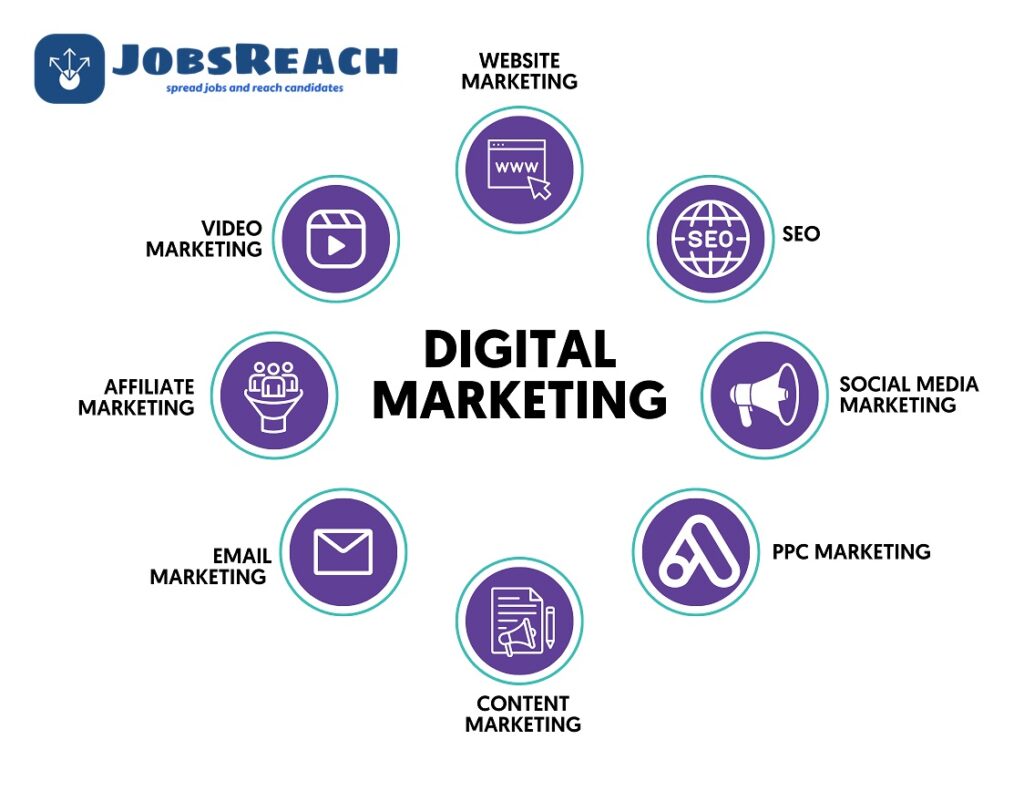
    Due to the rising popularity of the internet and the growing demand for online media content, digital marketing is rapidly expanding in the Netherlands. The country now ranks among the top 10 largest digital advertising markets in Europe and is emerging as an innovative tech hub.

    The role of Growth Manager is trending in 2024. If you’re interested in identifying growth opportunities for a company, this could be your ideal position.

    Essential skills for this position include growth hacking, conversion optimization, analytics, and marketing strategy. Taking a course in growth hacking can help you develop these skills, which differ from traditional marketing methods.

    Other popular jobs in demand in the Netherlands in the digital marketing sector include:

    • Social Media Marketing Manager
    • Social Media Coordinator
    • Social Media Manager
    • Marketing Assistant
    • Marketing Executive

    What is it like to work in the Netherlands?

    Due to its excellent work/life balance, the Netherlands is regarded as one of the best countries to live in. While they emphasize a strong work ethic, they are equally dedicated to enjoying their leisure time.

    The work culture in terms of hours is similar to that of the rest of Europe. Full-time employees generally work between 36 and 40 hours a week, typically from Monday to Friday. Some freelancers or contract workers prefer a four-day week, working longer hours over fewer days, while others choose part-time roles. Full-time employees are guaranteed a minimum of 20 days (four weeks) of annual leave each year.

    you may qualify for the Dutch ‘30% ruling’, which permits 30% of your salary to be paid tax-free for up to eight years to cover relocation expenses. More details about these conditions are available on the Dutch tax office website.

    How JobsReach is leading the next revolution in recruitment

    All current job platforms including Linked In, Indeed, Zip Recruiter etc are performing well based on the traditional approach which enforces the
    job seekers to dedicate their time to search and apply for vacancies published through one of these platforms.


    JobsReach is taking the hiring approach to next evolution where it reaches the candidates with relevant opportunities wherever they are actively engaged during their daily life. In the JobsReach next revolution, it changes the way how people can easily find the jobs on their doorsteps where
    they are engaged and cannot miss out the opportunities in front of them instead of struggling to find right opportunities.

    You can explore the top job sites in the Netherlands to find the best talent in 2024.

  • The 5 best job sites in the Netherlands to find top talent in 2024

    If your company is based in the Netherlands, or you’re looking for Dutch-speaking employees for your international business, you need to know the right job sites in the Netherlands to post your job opening to. That’s where this article comes in.

    Posting your job ad to the right job boards can help you speed up your talent attraction efforts. But when it comes to international recruitment (or recruiting in different languages), finding those top job sites can be a bit more tricky. Luckily, we can help!

    At JobsReach, we specialize in European recruitment, specifically emphasizing the Netherlands. We support companies globally in efficiently finding both local and international candidates by facilitating seamless global job distribution to swiftly fill open positions. After refining job requirements using the  JobsReach AI assistant, vacancies are promoted as Job Ads across all major social media platforms to broaden outreach, attract potential candidates, and encourage direct applications for suitable opportunities.

    5 best job sites in the Netherlands in 2024

    We’ve included both premium and free job posting sites in the Netherlands, so you can even find top Dutch talent on a budget. Below are 5 of the top Dutch job boards on the web that will help you find and hire talent faster.

    Werk.nl

    Werk.nl is a government job board as it is managed by the Employee Insurance Agency (UWV), a Dutch governmental organisation. It’s an excellent platform for employers looking to hire in the Netherlands.

    Werk.nl is a free Dutch job site, which means you can try out this job posting site even on a small budget. As a generalist job search engine, the platform helps employers and job seekers from across the job market connect with each other and is filled with thousands of talented professionals looking to find a job in the Netherlands.

    Easily post jobs to the platform yourself by creating an account or post to multiple job boards, like Werk.nl and the others listed below, at the same time with a multiposting solution like JobsReach.

    Nationale Vacaturebank

    Nationale Vacaturebank is one of the largest and best job sites in the Netherlands. Their website has been chosen as the “Most Popular Job Site in the Netherlands” by the Website of the Year elections for ten years in a row.

    This generalist job portal in the Netherlands has a vast database of job listings across various industries and job functions. With 2.1 million monthly visits and 1 million CVs, this portal gives you access to a large talent pool of Dutch professionals.

    Regardless of the talent you are looking for, chances are you can find your next hire on Nationale Vacaturebank. Employers can easily post and promote their job vacancies to attract the right professionals for their open roles.

    LinkedIn

    LinkedIn is currently the world’s largest professional networking site. According to LinkedIn’s own user statistics as of 2023, the site has over 900 million members worldwide, spread across over 200 countries and territories.

    Although a global rather than a specifically Dutch job board, the platform is often – just like in most countries in the EU and the rest of the world – an invaluable resource when you are looking for a qualified candidate.

    Aside from free job listings, LinkedIn also offers a paid service that allows you to further and more effectively promote your job postings and reach a wider audience.

    Indeed

    Whereas LinkedIn is the largest professional network, Indeed is the largest job board in the world. The job site reports over 300 million unique visitors worldwide every month across more than 60 countries, including the Netherlands.

    Indeed is another generalist job site, which means you can find and attract talented people for any type of role or industry. Due to the size of Indeed, this site offers some of the highest possible reach for your Dutch job ads.

    JobsReach

    JobsReach is particularly useful for international companies looking to attract right talents from anywhere in the world.

    Tips for posting your ad to Dutch job sites

    The list above contains both generalist and niche job boards. And that’s one of the first things to be aware of when planning to place your advertisement.

    Large generalist sites, such as LinkedIn or Indeed, will give you high visibility and reach as their sites have millions of visitors every month. But this also means reaching the most qualified, specialised talent can be difficult, as your ad might reach many unqualified candidates instead.

    In contrast, innovative job platforms like JobsReach are tailored to individual industries, ensuring that your opportunities are directed towards targeted industries and candidates. This increases the likelihood that all potential candidates reached by your ad are well-suited for the role.

    While your advertisement may have a wide reach, the responses received are likely to be more focused compared to generalist sites, enhancing the probability of connecting with the most suitable candidates. This is because only potential candidates are attracted to the opportunity and express interest through social media recruitment, while others may simply ignore it.

    Often, recruiters decide to use a mix of both generalist and niche platforms to maximise their reach and tap into several talent pools at once. This way, they increase their chances to find a job seeker suitable for their open position.

    Now, posting your ad to Dutch job sites is easy and straightforward. You can create an account on one of the job ad portals mentioned above, build your job ad, and post it to the portal of choice. As such, you can create accounts for each of these sites to distribute your ad across different sites.

    Alternatively, you can streamline your process and reach a wider audience by utilizing multiposting platforms. These platforms enable you to post your job to multiple channels simultaneously, saving you time and effort.

    Take JobsReach as an example, you can effortlessly multipost your job advertisement to various platforms such as Google Jobs, Facebook, Instagram, Twitter, LinkedIn, Pinterest, Reddit, and more simultaneously, all without investing excessive time. By utilizing the 1-month free trial, you can publish up to 10 jobs per day and reach a broad audience for your open vacancies.

    When posting your job ad on Dutch job sites, it’s essential to tailor your content to the local audience and include keywords that resonate with potential candidates. Ensure your ad is clear, concise, and highlights the unique benefits of the role and your company culture. Additionally, You can also find the most in-demand jobs in the Netherlands.

  • The Future of Remote Working Jobs Across All Industries

    The landscape of work has undergone a profound transformation over the past few years, driven by rapid technological advancements and an unprecedented global pandemic. Remote working, once considered a perk or an exception, has become a fundamental aspect of the modern workplace. As we look to the future, it’s clear that remote working is not just a temporary shift but a permanent change reshaping every industry. JobsReach is at the forefront of this evolution, playing a crucial role in spreading remote opportunities across the globe.

    The Evolution of Remote Work

    Remote work’s rise began with advancements in communication technology, enabling teams to collaborate seamlessly across geographies. However, it was the COVID-19 pandemic that accelerated its adoption. Companies were forced to adapt quickly, realizing the benefits of remote work, including increased flexibility, reduced overhead costs, and access to a global talent pool.

    Benefits of Remote Work Across Industries

    1. Technology and IT: The tech industry has been a pioneer in remote work. With the nature of their jobs being inherently digital, tech companies have seamlessly transitioned to remote operations. This shift has allowed them to attract top talent from around the world without geographical constraints.
    2. Healthcare: Remote work in healthcare has expanded beyond telemedicine. Administrative roles, medical billing, and even some diagnostic tasks are now being performed remotely. This not only enhances efficiency but also improves work-life balance for healthcare professionals.
    3. Finance and Banking: The finance sector, traditionally office-bound, has embraced remote work for roles like financial analysis, accounting, and customer service. This transition has led to increased productivity and a broader talent pool.
    4. Education: The education industry has seen a surge in online learning platforms and remote teaching roles. This shift has made education more accessible, allowing educators to reach students globally and offering flexibility in course delivery.
    5. Marketing and Creative Industries: Marketing, advertising, and creative fields have thrived in a remote environment. Creative professionals can collaborate virtually, leveraging digital tools to produce high-quality content and campaigns.
    6. Manufacturing and Logistics: Even industries traditionally reliant on physical presence are incorporating remote elements. Roles in management, customer service, and supply chain coordination are increasingly being performed remotely.

    The Future of Remote Work

    As we move forward, several trends will shape the future of remote work

    • Hybrid Work Models: Many companies are adopting hybrid models, combining remote and in-office work. This approach offers flexibility while maintaining some level of physical collaboration.
    • Advanced Collaboration Tools: Continued advancements in technology will lead to even more sophisticated collaboration tools, making remote work more efficient and interactive.
    • Focus on Well-being: Companies will place greater emphasis on employee well-being, offering support for mental health and work-life balance in remote settings.
    • Global Talent Pool: Remote work breaks down geographical barriers, allowing companies to tap into a global talent pool and fostering greater diversity and inclusion.
    • Sustainability: Reduced commuting and lower office energy consumption contribute to a more sustainable work environment.

    JobsReach: Spreading Remote Opportunities Globally

    JobsReach is a dynamic platform committed to connecting talents with job opportunities worldwide. In the era of remote work, JobsReach plays a pivotal role in spreading remote opportunities across the globe.

    • Diverse Job Listings: JobsReach offers a wide array of remote job listings across various industries, ensuring that job seekers can find opportunities that match their skills and preferences.
    • Global Reach: By eliminating geographical barriers, JobsReach enables employers to find the best talent regardless of location, and job seekers to explore opportunities worldwide.
    • Career Resources: JobsReach provides valuable resources, including resume tips, interview preparation, and career development advice tailored to the remote work environment.
    • Networking Opportunities: The platform fosters a global community of professionals, allowing members to network, share experiences, and support each other in their career journeys.
    • Real-time Updates: JobsReach keeps its members informed about the latest remote job openings and recruitment trends, helping them stay ahead in a competitive job market.
    The future of remote working jobs is bright and promising, with every industry adapting to and benefiting from this flexible work model. As remote work continues to evolve, platforms like JobsReach are essential in facilitating the transition, spreading opportunities, and connecting talents across the globe. Embracing remote work not only enhances productivity and job satisfaction but also paves the way for a more inclusive and sustainable future of work.