As European aviation accelerates toward its 2030 net-zero ground operations targets, two major hubs, Schiphol Airport (AMS) and Copenhagen Airport (CPH)are emerging as leaders in hydrogen adoption. While both share the same end goal, their strategies reveal two distinct philosophies: Schiphol’s focus on high-impact pilot projects versus Copenhagen’s broader, system-wide integration.
Airports are no longer only infrastructure providers they are becoming active energy hubs within a rapidly evolving hydrogen ecosystem.
Europe’s Hydrogen Framework: From Policy to Deployment
Hydrogen development in Europe is being driven by a coordinated policy and industrial framework aimed at achieving climate neutrality by 2050.
The EU Hydrogen Strategy and ReFuelEU Aviation initiative are accelerating:
- Large-scale green hydrogen production through renewable-powered electrolysis
- Deployment of Power-to-X (PtX) technologies for synthetic aviation fuels
- Development of regional hydrogen hubs linking airports, ports, and industrial clusters
- Integration of hydrogen into both ground operations and future propulsion systems
This systemic approach positions hydrogen as a critical enabler—not only for decarbonizing ground support equipment (GSE), but also for scaling e-SAF (electro-sustainable aviation fuel) production.
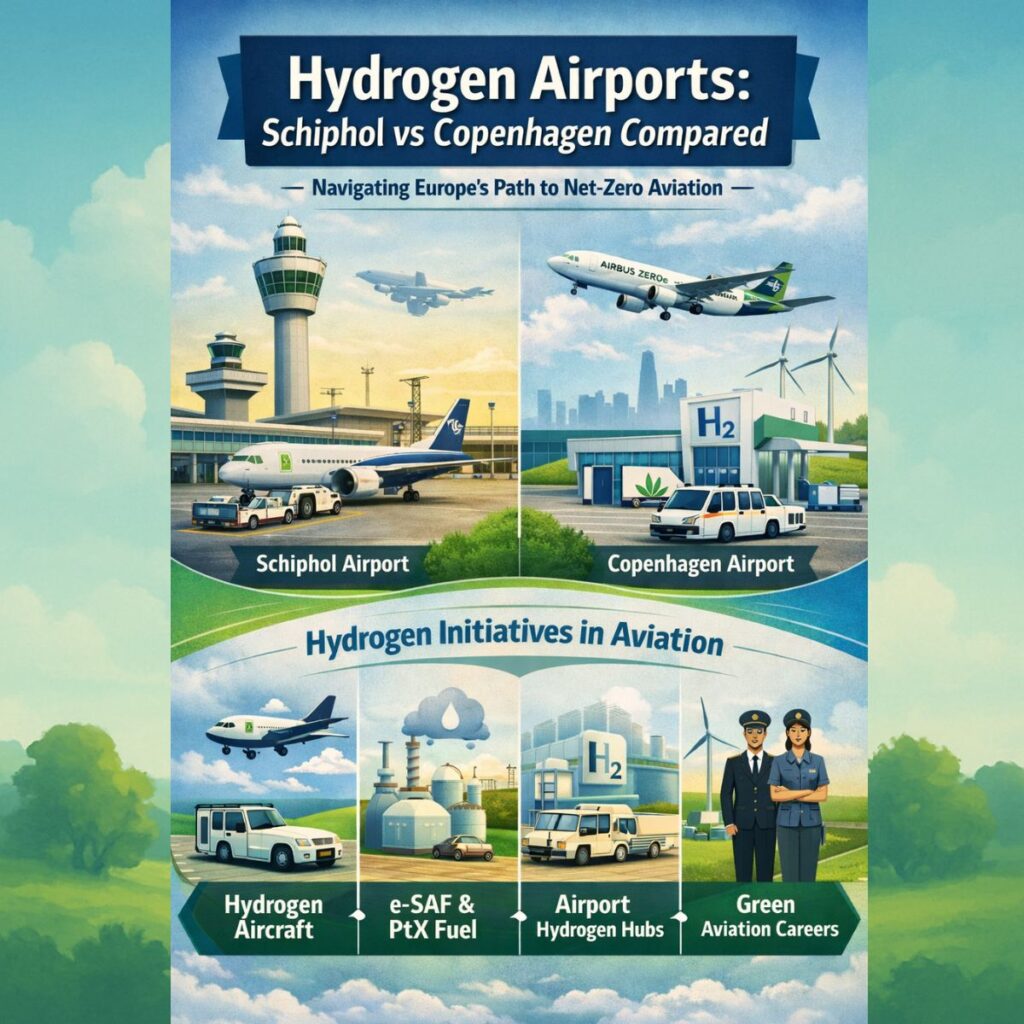
Schiphol Airport (AMS): High-Performance Pilot Applications
Schiphol’s hydrogen strategy is characterized by targeted deployment in high-utilization, operationally critical assets, where battery-electric alternatives present limitations in energy density and turnaround time.
Key initiatives include:
- Hydrogen Ground Power Units (H2-GPUs)
Deployed as a world-first application, these units provide consistent electrical power to aircraft at the gate, supporting cockpit systems and onboard operations without the constraints of battery recharge cycles. - Hydrogen-Electric Aircraft Towing
A hydrogen-powered pushback tractor has demonstrated the capability to tow narrow-body aircraft such as the Boeing 737, achieving up to 90 pushback cycles per refueling with refueling times of approximately 10 minutes. - Safety-Critical Fleet Applications
Hydrogen is being evaluated for vehicles requiring continuous readiness, including airside safety and emergency response units, where operational downtime is not acceptable. - Airside Refueling Infrastructure
A dedicated hydrogen refueling station has been deployed to support continuous pilot operations and validate real-world performance.
Schiphol’s approach aligns with a “proof-of-performance” model, prioritizing operational reliability and efficiency in demanding use cases before broader scaling.
Copenhagen Airport (CPH): System-Wide Integration
Copenhagen Airport is advancing a holistic hydrogen deployment model, integrating hydrogen across a wide spectrum of ground operations while aligning with national energy strategy.
Key elements include:
- Fleet-Wide Transition of Ground Support Equipment
Hydrogen-powered vehicles—including baggage tractors and service units—are being introduced to replace diesel across multiple operational categories. - Integration with the Fjord PtX Project
Copenhagen’s hydrogen strategy is closely linked to Denmark’s Power-to-X ecosystem, enabling the co-production of hydrogen and e-SAF for aviation use. - Contribution to Emissions Reduction Targets
Ground support equipment accounts for approximately 9% of airport-related nitrous oxide emissions, positioning hydrogen adoption as a key lever in achieving 2030 climate objectives. - Hydrogen Hub Development
Infrastructure planning is aligned with broader regional hydrogen networks, supporting long-term scalability and supply security.
For additional operational insight, see this industry feature:
👉 https://aviation.jobsreach.net/social/sharepulse/copenhagen-airport-pioneers-hydrogen-fueled-ground-support-vehicles
Copenhagen’s strategy reflects a “scale-and-integrate” model, embedding hydrogen within a broader national and regional energy system.
Additional Hydrogen Initiatives Across the Aviation Industry
While airport-led strategies provide immediate operational impact, the wider aviation sector is advancing hydrogen across aircraft development, infrastructure, and fuel production.
Aircraft Development and Propulsion Innovation
Airbus is leading hydrogen aircraft development through its ZEROe programme, focused on fuel-cell-powered commercial aircraft with entry-into-service targeted in the mid-2030s.
These developments are closely linked to emerging hydrogen aviation careers and skills demand, creating new opportunities across engineering, operations, and energy systems.
Hydrogen Infrastructure and Airport Ecosystems
The Hydrogen Hubs at Airports initiative is supporting global airport readiness by advancing:
- Hydrogen production and supply integration
- Cryogenic storage and distribution
- Airside refuelling infrastructure
This reinforces the role of airports as energy hubs within the hydrogen economy.
Hydrogen-Derived Aviation Fuels (e-SAF and PtX)
Hydrogen is a key enabler of e-SAF production in Europe, where it is combined with captured CO₂ to create synthetic aviation fuel.
This pathway:
- Enables decarbonization without requiring new aircraft
- Supports regulatory compliance under ReFuelEU Aviation
- Aligns with renewable energy and carbon capture strategies
Projects across Europe are accelerating the commercialization of this fuel pathway.
Industry Collaboration and Policy Alignment
Hydrogen adoption is being supported by strong collaboration between:
- Aircraft manufacturers
- Airlines
- Airports
- Energy providers
This ecosystem approach is essential to address infrastructure, certification, and supply chain challenges.
A Multi-Pathway Approach to Decarbonization
The aviation sector is adopting a layered transition strategy:
- Short term: Sustainable aviation fuels (SAF)
- Medium term: Hydrogen in ground operations and regional aviation
- Long term: Hydrogen-powered commercial aircraft
This reflects the complexity of achieving full aviation decarbonization.
Hydrogen and e-SAF: Connecting Ground and Sky
Hydrogen serves a dual role in aviation:
- Direct use in ground vehicles and future aircraft
- Feedstock for synthetic aviation fuels (e-SAF)
This integration enables a holistic decarbonization pathway, linking airport operations with flight energy supply.
Comparative Analysis
| Dimension | Schiphol (AMS) | Copenhagen (CPH) |
|---|---|---|
| Strategic Model | Targeted pilot deployment | System-wide integration |
| Operational Focus | High-demand, mission-critical assets | Broad GSE replacement |
| Infrastructure | On-site refueling (pilot phase) | Regional hydrogen hub integration |
| Energy Ecosystem Link | Operational validation | PtX and e-SAF integration |
| Scalability Approach | Performance-first scaling | Infrastructure-led expansion |
Aviation Industry Implications
The approaches adopted by Schiphol and Copenhagen highlight two viable pathways for airport operators:
- Performance-driven validation, ensuring hydrogen meets operational requirements in the most demanding environments
- Ecosystem integration, aligning airport operations with national energy and fuel production strategies
For the aviation sector, these models are not mutually exclusive. Rather, they represent complementary phases of adoption within a broader transition.
What would be the future?
Hydrogen is transitioning from pilot experimentation to operational deployment across Europe’s aviation sector. Airports are playing a central role—not only as infrastructure providers but as energy integrators within a decarbonized aviation system.
Schiphol demonstrates how hydrogen can deliver immediate operational value in critical applications. Copenhagen illustrates how hydrogen can scale across an entire airport ecosystem while linking directly to future aviation fuels.
Together, they signal a clear direction for the industry:
the path to net-zero aviation will be built on both targeted innovation and system-wide integration.
References Used in This Article
- Schiphol: a testing ground for hydrogen – Overview of TULIPS pilots with hydrogen vehicles at Schiphol.
https://www.schiphol.nl/en/sustainability/blog/schiphol-a-testing-ground-for-hydrogen - TULIPS programme at Schiphol – Details of the European partnership and its hydrogen projects.
https://www.schiphol.nl/en/innovation/tulips - World first at Schiphol: airport tests the first hydrogen GPU – News about the hydrogen-powered Ground Power Unit pilot.
https://news.schiphol.com/world-first-at-schiphol-airport-tests-the-first-hydrogen-gpu/ - Stationary Hydrogen Refuelling Station at Schiphol – Details on the temporary hydrogen refuelling installation.
https://www.ekinetix.nl/en/projects/hydrogen-projects/stationary-hydrogen-refuelling-station-at-schiphol/ - A first at Schiphol: pilot with hydrogen-powered vehicles in daily operations – Coverage of hydrogen tow tractors and vehicles in operations.
https://news.schiphol.com/a-first-at-schiphol-pilot-with-hydrogen-powered-vehicles-in-daily-operations/ - Copenhagen Airport sustainably buys SAF for business travel – Recent initiative showing SAF adoption at CPH. https://www.cph.dk/en/about-cph/press/news/2026/02/copenhagen%20airport%20buys%20sustainable%20aviation%20fuel%20for%20business%20travel
- Fjord PtX about the plant – Information on the Danish Power‑to‑X eSAF production plant https://www.fjord-ptx.com/about-the-plant/
- Danish front‑runners sign milestone agreement to drive sustainable aviation transformation – Collaboration supporting eSAF development involving Copenhagen Airport. https://www.sasgroup.net/newsroom/press-releases/2024/danish-front-runners-sign-milestone-agreement-to-drive-sustainable-aviation-transformation/
Leave a Reply