In Europe, aviation hiring is highly seasonal, especially for airlines, airports, ground handling, and tourism-related operations.
Here’s the typical hiring calendar:
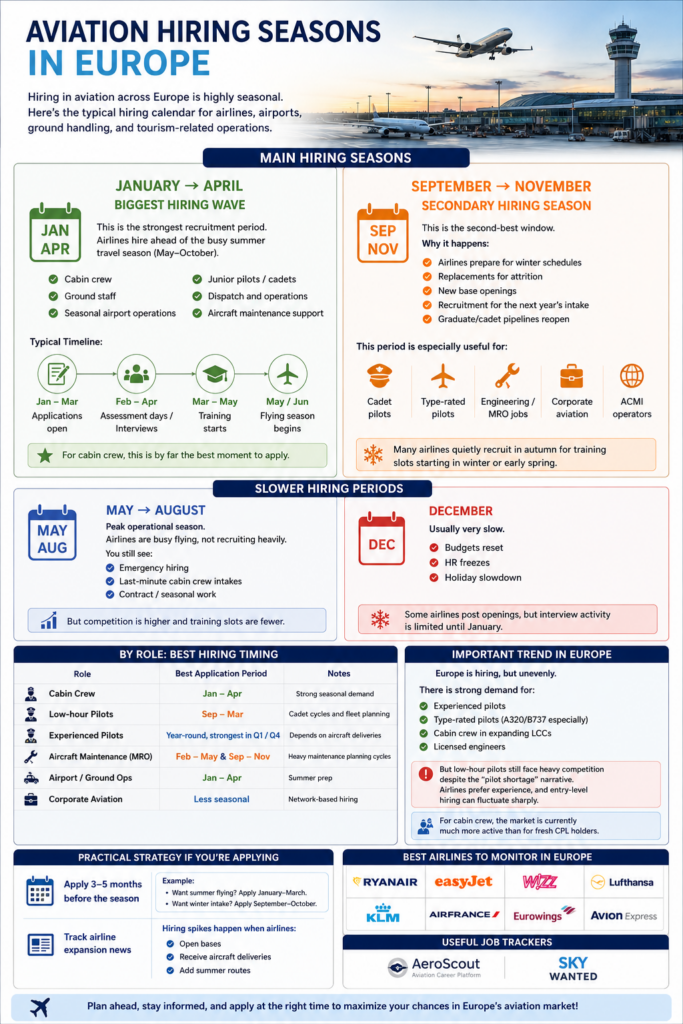
Main hiring seasons
January → April (biggest hiring wave)
This is the strongest recruitment period.
Airlines hire ahead of the busy summer travel season (May–October), especially for:
Cabin crew
Ground staff
Seasonal airport operations
Junior pilots / cadets
Dispatch and operations
Aircraft maintenance support
Low-cost carriers like Ryanair, easyJet, and Wizz Air often launch recruitment drives during Q1 for summer operations.
Typical timeline:
Applications open: Jan–March
Assessment days/interviews: Feb–April
Training starts: March–May
Flying season begins: May/June
For cabin crew, this is by far the best moment to apply.
September → November (secondary hiring season)
This is the second-best window.
Why it happens:
Airlines prepare for winter schedules
Replacements for attrition
New base openings
Recruitment for the next year’s intake
Graduate/cadet pipelines reopen
This period is especially useful for:
Cadet pilots
Type-rated pilots
Engineering/MRO jobs
Corporate aviation
ACMI operators
Many airlines quietly recruit in autumn for training slots starting in winter or early spring.
Slower hiring periods
May → August
Peak operational season.
Airlines are busy flying, not recruiting heavily. You still see:
Emergency hiring
Last-minute cabin crew intakes
Contract/seasonal work
But competition is higher and training slots are fewer.
December
Usually very slow.
Budgets reset
HR freezes
Holiday slowdown
Some airlines post openings, but interview activity is limited until January.
By role: best hiring timing
Role
Best application period
Notes
Cabin Crew
Jan–Apr
Strong seasonal demand
Low-hour Pilots
Sep–Mar
Cadet cycles and fleet planning
Experienced Pilots
Year-round, strongest in Q1/Q4
Depends on aircraft deliveries
Aircraft Maintenance (MRO)
Feb–May & Sep–Nov
Heavy maintenance planning cycles
Airport/Ground Ops
Jan–Apr
Summer prep
Corporate Aviation
Less seasonal
Network-based hiring
Important trend in Europe right now
Europe is hiring, but unevenly.
There is strong demand for:
Experienced pilots
Type-rated pilots (A320/B737 especially)
Cabin crew in expanding LCCs
Licensed engineers
But low-hour pilots still face heavy competition despite the “pilot shortage” narrative. Reddit discussions from European pilots repeatedly mention that airlines prefer experience, and entry-level hiring can fluctuate sharply.
For cabin crew, the market is currently much more active than for fresh CPL holders.
Platforms like JobsReach Aviation are helping reshape how professionals connect within the aviation industry. By focusing on industry-specific networking, JobsReach Aviation enables pilots, cabin crew, engineers, and other aviation professionals to build meaningful connections, share insights, and discover opportunities directly within their field. This creates a more targeted and relevant ecosystem where employers and candidates can engage beyond traditional job boards and strengthen long-term professional relationships. 👉 https://jobsreach.net/aviation.html
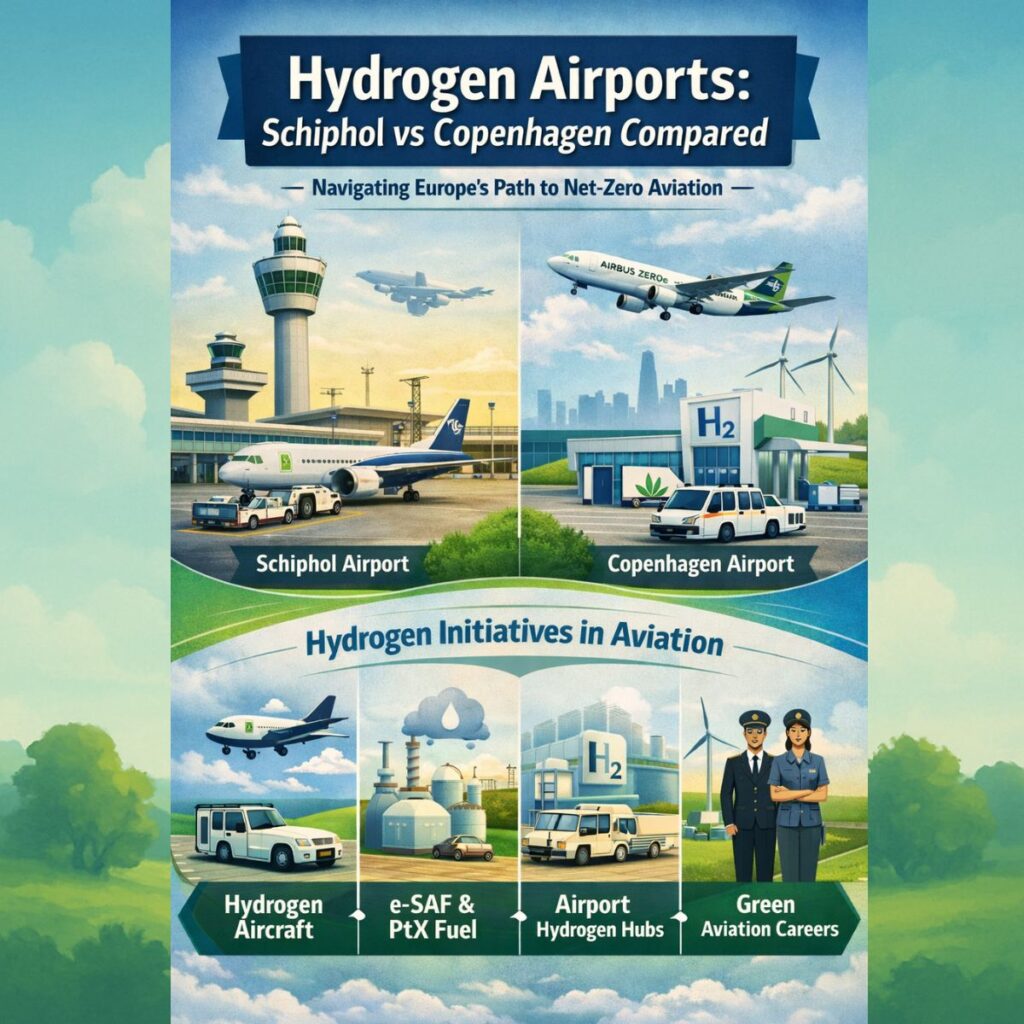
As European aviation accelerates toward its 2030 net-zero ground operations targets, two major hubs, Schiphol Airport (AMS) and Copenhagen Airport (CPH)are emerging as leaders in hydrogen adoption. While both share the same end goal, their strategies reveal two distinct philosophies: Schiphol’s focus on high-impact pilot projects versus Copenhagen’s broader, system-wide integration.
Airports are no longer only infrastructure providers they are becoming active energy hubs within a rapidly evolving hydrogen ecosystem.
Europe’s Hydrogen Framework: From Policy to Deployment
Hydrogen development in Europe is being driven by a coordinated policy and industrial framework aimed at achieving climate neutrality by 2050.
The EU Hydrogen Strategy and ReFuelEU Aviation initiative are accelerating:
Large-scale green hydrogen production through renewable-powered electrolysis
Deployment of Power-to-X (PtX) technologies for synthetic aviation fuels
Development of regional hydrogen hubs linking airports, ports, and industrial clusters
Integration of hydrogen into both ground operations and future propulsion systems
This systemic approach positions hydrogen as a critical enabler—not only for decarbonizing ground support equipment (GSE), but also for scaling e-SAF (electro-sustainable aviation fuel) production.
Schiphol Airport (AMS): High-Performance Pilot Applications
Schiphol’s hydrogen strategy is characterized by targeted deployment in high-utilization, operationally critical assets, where battery-electric alternatives present limitations in energy density and turnaround time.
Key initiatives include:
Hydrogen Ground Power Units (H2-GPUs) Deployed as a world-first application, these units provide consistent electrical power to aircraft at the gate, supporting cockpit systems and onboard operations without the constraints of battery recharge cycles.
Hydrogen-Electric Aircraft Towing A hydrogen-powered pushback tractor has demonstrated the capability to tow narrow-body aircraft such as the Boeing 737, achieving up to 90 pushback cycles per refueling with refueling times of approximately 10 minutes.
Safety-Critical Fleet Applications Hydrogen is being evaluated for vehicles requiring continuous readiness, including airside safety and emergency response units, where operational downtime is not acceptable.
Airside Refueling Infrastructure A dedicated hydrogen refueling station has been deployed to support continuous pilot operations and validate real-world performance.
Schiphol’s approach aligns with a “proof-of-performance” model, prioritizing operational reliability and efficiency in demanding use cases before broader scaling.
Copenhagen Airport (CPH): System-Wide Integration
Copenhagen Airport is advancing a holistic hydrogen deployment model, integrating hydrogen across a wide spectrum of ground operations while aligning with national energy strategy.
Key elements include:
Fleet-Wide Transition of Ground Support Equipment Hydrogen-powered vehicles—including baggage tractors and service units—are being introduced to replace diesel across multiple operational categories.
Integration with the Fjord PtX Project Copenhagen’s hydrogen strategy is closely linked to Denmark’s Power-to-X ecosystem, enabling the co-production of hydrogen and e-SAF for aviation use.
Contribution to Emissions Reduction Targets Ground support equipment accounts for approximately 9% of airport-related nitrous oxide emissions, positioning hydrogen adoption as a key lever in achieving 2030 climate objectives.
Hydrogen Hub Development Infrastructure planning is aligned with broader regional hydrogen networks, supporting long-term scalability and supply security.
Copenhagen’s strategy reflects a “scale-and-integrate” model, embedding hydrogen within a broader national and regional energy system.
Additional Hydrogen Initiatives Across the Aviation Industry
While airport-led strategies provide immediate operational impact, the wider aviation sector is advancing hydrogen across aircraft development, infrastructure, and fuel production.
Aircraft Development and Propulsion Innovation
Airbus is leading hydrogen aircraft development through its ZEROe programme, focused on fuel-cell-powered commercial aircraft with entry-into-service targeted in the mid-2030s.
These developments are closely linked to emerging hydrogen aviation careers and skills demand, creating new opportunities across engineering, operations, and energy systems.
Hydrogen Infrastructure and Airport Ecosystems
The Hydrogen Hubs at Airports initiative is supporting global airport readiness by advancing:
Hydrogen production and supply integration
Cryogenic storage and distribution
Airside refuelling infrastructure
This reinforces the role of airports as energy hubs within the hydrogen economy.
Hydrogen-Derived Aviation Fuels (e-SAF and PtX)
Hydrogen is a key enabler of e-SAF production in Europe, where it is combined with captured CO₂ to create synthetic aviation fuel.
This pathway:
Enables decarbonization without requiring new aircraft
Supports regulatory compliance under ReFuelEU Aviation
Aligns with renewable energy and carbon capture strategies
Projects across Europe are accelerating the commercialization of this fuel pathway.
Industry Collaboration and Policy Alignment
Hydrogen adoption is being supported by strong collaboration between:
Aircraft manufacturers
Airlines
Airports
Energy providers
This ecosystem approach is essential to address infrastructure, certification, and supply chain challenges.
A Multi-Pathway Approach to Decarbonization
The aviation sector is adopting a layered transition strategy:
Short term: Sustainable aviation fuels (SAF)
Medium term: Hydrogen in ground operations and regional aviation
Long term: Hydrogen-powered commercial aircraft
This reflects the complexity of achieving full aviation decarbonization.
Hydrogen and e-SAF: Connecting Ground and Sky
Hydrogen serves a dual role in aviation:
Direct use in ground vehicles and future aircraft
Feedstock for synthetic aviation fuels (e-SAF)
This integration enables a holistic decarbonization pathway, linking airport operations with flight energy supply.
Comparative Analysis
Dimension
Schiphol (AMS)
Copenhagen (CPH)
Strategic Model
Targeted pilot deployment
System-wide integration
Operational Focus
High-demand, mission-critical assets
Broad GSE replacement
Infrastructure
On-site refueling (pilot phase)
Regional hydrogen hub integration
Energy Ecosystem Link
Operational validation
PtX and e-SAF integration
Scalability Approach
Performance-first scaling
Infrastructure-led expansion
Aviation Industry Implications
The approaches adopted by Schiphol and Copenhagen highlight two viable pathways for airport operators:
Performance-driven validation, ensuring hydrogen meets operational requirements in the most demanding environments
Ecosystem integration, aligning airport operations with national energy and fuel production strategies
For the aviation sector, these models are not mutually exclusive. Rather, they represent complementary phases of adoption within a broader transition.
What would be the future?
Hydrogen is transitioning from pilot experimentation to operational deployment across Europe’s aviation sector. Airports are playing a central role—not only as infrastructure providers but as energy integrators within a decarbonized aviation system.
Schiphol demonstrates how hydrogen can deliver immediate operational value in critical applications. Copenhagen illustrates how hydrogen can scale across an entire airport ecosystem while linking directly to future aviation fuels.
Together, they signal a clear direction for the industry: the path to net-zero aviation will be built on both targeted innovation and system-wide integration.
Finding the right Maintenance, Repair, and Overhaul (MRO) opportunity as a B1 engineer is not always as straightforward as it should be.
Despite the growth of digital platforms and job boards, many licensed aircraft engineers still rely heavily on word of mouth to discover new roles. While this approach has worked for years, it also brings limitations, especially in today’s fast-evolving aviation industry.
How Networking Drives Hiring in the Aviation MRO Industry
Aviation maintenance is often described as a small, tightly connected community.
In many cases:
Engineers hear about vacancies through colleagues or former teammates
Opportunities circulate within known circles
Hiring decisions are influenced by trusted recommendations
This system has its advantages. It builds trust and ensures that experienced professionals are referred for critical roles. However, it also creates challenges.
Limitations of Word of Mouth Hiring for B1 Engineers
While personal networks are valuable, relying on them alone can restrict opportunities.
1. Limited Visibility
Not all job openings reach everyone. If you’re not part of a specific network, you may never hear about certain roles.
2. Geographic Barriers
For engineers looking to relocate, especially across countries, local networks may not be enough.
3. Uneven Access
New entrants or those switching sectors within aviation may find it harder to break into established circles.
4. Missed Matches
Highly skilled engineers may miss roles that perfectly match their license and experience simply because the information didn’t reach them.
Professionals building connections for aviation career growth
Modern Aviation Job Search Strategies for B1 Engineers
The aviation industry is evolving and so are the ways professionals connect and find opportunities.
B1 engineers today are beginning to look beyond traditional methods by:
Expanding their professional networks online
Engaging in aviation-specific communities
Staying informed about industry trends and movements
However, a major gap still exists: There is no single focused space dedicated to connecting aviation professionals in a meaningful way.
Why Aviation Networking Is Essential for Aircraft Maintenance Careers
Networking remains essential, but it doesn’t have to be limited to personal contacts.
A more effective approach combines:
Strong personal connections
Wider industry visibility
Access to shared insights and opportunities
When engineers can connect beyond their immediate circles, they gain:
Better awareness of global opportunities
Insights into different MRO environments
Support from peers facing similar challenges
Improving Access to MRO Opportunities for Licensed Aircraft Engineers
To improve how opportunities are discovered in aviation maintenance, the industry needs to move toward:
More transparent job visibility
Stronger peer-to-peer connections
Accessible platforms tailored to aviation professionals
This doesn’t replace word of mouth, it enhances it.
A New Direction for Aviation Professionals
As conversations with engineers continue to highlight these challenges, it’s clear that there is a growing need for a more focused and connected approach.
Creating a space where aviation professionals can:
Connect with peers globally
Share insights and experiences
Stay informed about industry trends
Discover opportunities relevant to their qualifications
This is something We’ve been actively exploring through JobsReach Aviation with the goal of supporting aviation professionals in building stronger connections and accessing better opportunities over time.
✍️ Final Thoughts
Word of mouth will always be a part of aviation hiring and for good reason.
But as the industry grows more complex and global, relying on it alone may no longer be enough.
For engineers, combining traditional networks with broader, more accessible connections could open the door to better, more relevant MRO opportunities.
For those exploring broader aviation career paths, especially internationally, understanding different regions can also make a significant difference. For example, Europe offers diverse opportunities for aviation professionals at various stages of their careers.
The aviation industry offers exciting global career opportunities for professionals interested in travel, hospitality, safety, and operations. From flight attendant jobs and cabin crew jobs to pilot jobs, airport customer service careers, and aviation operations careers, the airline industry continues to grow and recruit talent worldwide.
For many aspiring professionals, aviation is more than just a job, it is a career that combines international travel, multicultural teamwork, and professional development. This guide explores how to become a flight attendant, pilot career paths, entry-level aviation roles, salary expectations, and how platforms like JobsReach Aviation are helping aviation professionals connect and grow.
Entry Level Aviation Careers: Starting Your Journey
Many people assume aviation careers are limited to pilots and cabin crew. In reality, airlines employ professionals across many areas including operations, customer service, and administration.
Popular entry level aviation careers include:
Airport customer service careers
Aviation administration careers
Airline operations careers
Aviation operations careers
Airline passenger service roles
Aviation safety support roles
These positions allow new professionals to learn the airline environment before moving into specialized roles such as cabin crew, inflight service, or airline management.
Working in aviation operations often involves coordinating flights, supporting crew schedules, managing passenger services, and ensuring safety procedures are followed.
Cabin Crew Jobs and Flight Attendant Hiring
Among the most popular aviation careers are cabin crew jobs and flight attendant jobs. Airlines recruit thousands of cabin crew members every year to support expanding international routes.
Cabin crew members are responsible for:
Passenger safety and emergency procedures
Inflight hospitality and customer service
Managing cabin operations during flights
Supporting passengers during boarding and landing
With many airlines increasing recruitment, flight attendant hiring has seen strong growth globally.
Many aspiring candidates search for:
steps to become a flight attendant
flight attendant qualification requirements
flight attendant work schedule
flight attendant yearly salary
Understanding these factors can help candidates prepare for airline recruitment processes.
How to Become a Flight Attendant
One of the most searched aviation career questions is how to become a flight attendant. Airlines typically require candidates to meet several criteria before joining cabin crew training.
Common flight attendant qualification requirements include:
Minimum age requirement (usually 18–21)
High school diploma or equivalent
Strong communication skills
Customer service experience
Medical fitness certification
Fluency in English
Airlines also evaluate candidates during interviews for personality traits such as professionalism, teamwork, and adaptability.
Candidates often prepare by learning:
steps to become a flight attendant
airline recruitment processes
customer service training
interview and grooming standards
Day in the Life of a Flight Attendant
Many people researching aviation careers are curious about a day in the life of a flight attendant.
A typical workday may include:
Pre-flight safety briefing with the flight crew
Passenger boarding and cabin preparation
Delivering inflight service and assistance
Monitoring safety procedures
Supporting passengers during emergencies
The flight attendant work schedule can vary significantly depending on airline routes. Cabin crew may work short regional flights or long-haul international journeys.
Despite irregular schedules, many professionals enjoy the career due to travel opportunities and global exposure.
Flight Attendant Salary and Benefits
Another popular question is how much do flight attendants earn.
The flight attendant yearly salary varies based on airline, experience level, and route type.
Typical benefits include:
Competitive monthly salary
Travel allowances
Layover hotel accommodation
Airline staff travel discounts
Health insurance
Career progression opportunities
For example, international airlines like Emirates and Qatar Airways offer attractive compensation packages.
Many candidates also research:
Emirates cabin crew requirements
Emirates cabin crew salary
Qatar Airways cabin crew requirements
Qatar Airways cabin crew salary
These airlines recruit globally and provide relocation opportunities for international candidates.
Pilot Jobs and Airline Pilot Careers
Pilots play a critical role in aviation safety and flight operations. Pilot jobs are among the most respected positions in the airline industry.
Aspiring professionals often search for how to become an airline pilot, which typically requires:
Commercial pilot license
Flight training hours
Airline certification
Simulator training
Pilots also follow structured schedules and rest regulations. The airline pilot work schedule is carefully managed to ensure safety and compliance with aviation regulations.
Pilot careers often progress through stages including:
First officer
Senior first officer
Captain
Training captain
How to Become a Pilot from Cabin Crew or Flight Attendant
Many aviation professionals begin their careers in cabin crew jobs or flight attendant roles before transitioning to the cockpit. Experience working as cabin crew provides valuable exposure to airline operations, safety procedures, and crew coordination.
Professionals who wish to transition from flight attendant to pilot can follow several steps:
1. Understand Pilot Training Requirements
To become a pilot, candidates must obtain aviation licenses such as:
Private Pilot License (PPL)
Commercial Pilot License (CPL)
Airline Transport Pilot License (ATPL)
These certifications are required by airlines and regulated by aviation authorities.
2. Enroll in a Flight Training Program
Many aspiring pilots enroll in aviation training schools or airline-sponsored training programs to complete required flight hours and simulator training.
3. Build Flight Experience
Pilots must accumulate a required number of flight hours before applying for airline pilot positions. This experience is typically gained through flight schools, regional airlines, or charter operations.
4. Apply for Airline Pilot Positions
After completing training and licensing requirements, candidates can apply for pilot jobs with commercial airlines.
Many airlines encourage internal career progression, meaning experienced cabin crew members sometimes transition into pilot training programs.
How to Work for an Airline
Many professionals ask how to work for an airline beyond pilot or cabin crew roles.
Airlines hire talent in multiple areas including:
Aviation operations
Airline administration
Passenger services
Customer experience
Aviation safety management
These careers provide excellent opportunities for professionals interested in the aviation industry without becoming pilots.
How JobsReach Aviation Supports Aviation Professionals
As aviation careers expand globally, professionals increasingly rely on digital platforms to connect with opportunities and industry insights.
JobsReach Aviation is designed to support aviation professionals by providing a space where they can:
Connect with other aviation professionals worldwide
Discover flight attendant jobs, pilot jobs, and airline opportunities
Explore entry level aviation careers
Stay updated with industry developments and hiring trends
Share experiences from roles such as cabin crew jobs, airline operations, and airport services
The platform enables professionals to expand their aviation network, learn from experienced crew members, and discover career paths across different aviation sectors.
Through knowledge sharing and professional connections, JobsReach Aviation helps individuals grow their careers in a competitive global industry.
The Future of Aviation Careers
The aviation industry continues to grow as global travel demand increases. Airlines are expected to recruit thousands of professionals across various roles including:
Cabin crew
Pilots
Airport customer service professionals
Aviation operations specialists
Airline administrative professionals
Whether someone is researching how to become a flight attendant, pursuing pilot jobs, or exploring airport customer service careers, aviation offers diverse opportunities for career growth.
Platforms like JobsReach Aviation are helping connect professionals with these opportunities while building a global aviation community.
Career Growth Through Aviation Networking
Building a successful aviation career often depends on strong professional connections. Networking helps professionals learn about recruitment opportunities, industry developments, and career pathways.
JobsReach Aviation enables aviation professionals to:
Connect with peers across airlines and aviation organizations
Discover opportunities such as flight attendant jobs, cabin crew jobs, and pilot jobs
Share insights from real industry experiences
Stay informed about airline recruitment trends and training opportunities
Through collaboration, mentorship, and knowledge sharing, aviation professionals can expand their global network and accelerate career growth.
Aviation Career Resources and Industry Insights
For professionals exploring aviation careers, access to reliable career guidance and industry insights is essential. Platforms like JobsReach Aviation provide curated resources, career advice, and networking opportunities for aspiring and experienced aviation professionals.
You can explore more aviation career insights through the following resources:
Aviation industry news, career guides, and professional insights are regularly shared on the JobsReach Aviation blog: https://blogs.jobsreach.net/aviation
These resources help aviation professionals stay informed about industry trends, airline recruitment patterns, training pathways, and global career opportunities.
Pilots are responsible for safely transporting passengers and cargo across the world while managing advanced aircraft systems, weather conditions, and strict aviation regulations. A pilot’s career involves extensive airline pilot training, rigorous pilot certification requirements, continuous pilot simulator training, and strong teamwork through cockpit resource management training.
Understanding the daily responsibilities of pilots and the pathway to becoming one is essential for aspiring aviation professionals.
This guide explains the European aviation career roadmap for pilots, ATC, and airport professionals.
From early pre-flight preparations to landing a commercial aircraft, pilots play a crucial role in global aviation. This article covers the pilot career path, required certifications, instrument rating training, multi-engine rating requirements, and insights into specialized roles like aerial firefighting pilot jobs.
Pre-Flight Preparation and Pilot Responsibilities
The daily routine of a pilot varies depending on whether they operate short-haul, long-haul, cargo, or private flights. However, most flights follow a structured workflow designed to maintain safety and operational efficiency.
1. Pre-Flight Preparation
A pilot’s day typically begins hours before departure. This includes reviewing weather conditions, aircraft status, route information, and fuel calculations. Pilots also attend crew briefings where safety procedures, passenger numbers, and operational details are discussed. (Aerospace)
2. Aircraft Inspection
Before boarding begins, pilots conduct external and cockpit inspections to verify that the aircraft systems, navigation equipment, and engines are functioning correctly. (Bureau of Labor Statistics)
3. Takeoff and Flight Operations
During the flight, pilots:
Communicate with air traffic control
Monitor engine performance and navigation systems
Adjust flight paths based on weather or traffic conditions
After landing, pilots complete flight reports, conduct post-flight inspections, and prepare the aircraft for the next journey.
For long-haul pilots, layovers between flights may last several hours or days to ensure proper rest and compliance with safety regulations. (flightschoolusa.com)
During flights, pilots apply cockpit resource management training, which ensures clear communication between crew members and reduces human errors.
After landing, pilots complete post-flight reports and aircraft system checks.
Whether you’re preparing for cargo pilot jobs or passenger flights, this stage is critical for safety and operational efficiency.
Pilot Certification and Licensing Requirements
Becoming a professional pilot requires multiple certifications:
Commercial Pilot License Requirements – Necessary to fly professionally and receive payment.
Pilot Certification Requirements – Cover all regulatory and safety standards for airline operations.
Pilot Medical Requirements – Mandatory medical exams for fitness to fly.
Instrument Rating Training – Essential for flying under low-visibility or instrument conditions.
Multi-Engine Rating Requirements – Needed to operate multi-engine aircraft.
Pilot Certification Pathway
Becoming a professional pilot requires multiple certifications, each representing a higher level of responsibility and expertise.
1. Student Pilot Certificate
The first step allows trainees to begin supervised flight training.
2. Private Pilot License (PPL)
This license allows individuals to fly aircraft privately but not for commercial compensation.
3. Instrument Rating (IR)
Pilots earn this rating to fly in low visibility conditions using cockpit instruments. (Bureau of Labor Statistics)
4. Commercial Pilot License (CPL)
A CPL allows pilots to fly aircraft professionally and receive payment for aviation services. Candidates must typically log around 250 hours of flight time and pass written and practical examinations. (atpflightschool.com)
5. Multi-Engine and Aircraft Type Ratings
Different aircraft require specialized training and certification. For example:
Boeing 737 Type Rating
Airbus A320 Type Rating
Regional jet certifications
6. Airline Transport Pilot License (ATPL)
The highest level of pilot certification, allowing pilots to command commercial airliners as captain. (Wikipedia)
Certification Requirements by Aircraft Type
Different aircraft categories require specialized ratings and training:
Aircraft Category
Certification Requirements
Small single-engine aircraft
PPL or CPL
Multi-engine aircraft
Multi-Engine Rating
Commercial passenger aircraft
ATPL + Type Rating
Cargo aircraft
CPL or ATPL depending on airline
Helicopters
Helicopter Pilot License + Type Rating
Each rating requires ground school, simulator training, and practical flight exams.
Pilot Simulator Training and Airline Training Programs
Most pilots undergo pilot simulator training to master flight controls, emergency procedures, and aircraft systems in a controlled environment. Airlines also provide specialized airline pilot training to prepare pilots for specific aircraft types and operational procedures.
Pilot Career Path and Opportunities in Aviation
The pilot career path can vary widely:
First Officer → Captain → Fleet Manager
Cargo Pilot Jobs → Charter or Corporate Aviation
Specialized roles like aerial firefighting pilot jobs
Average airline first officer salaries vary depending on region, airline, and experience, making aviation a financially rewarding career.
For a detailed guide on long-term pilot career growth, see:
This article explains how pilots advance their careers and transition into leadership roles.
Daily Challenges Faced by Pilots
While aviation offers prestige and high earning potential, pilots face several challenges.
1. Fatigue and Irregular Schedules
Pilots often work overnight flights, cross time zones, and experience disrupted sleep cycles. (Aerospace)
2. High Training Costs
Pilot training can cost tens of thousands of dollars before employment begins. (Aerospace)
3. Continuous Certification
Pilots must regularly pass medical examinations, simulator checks, and safety evaluations to maintain their licenses. (Bureau of Labor Statistics)
4. Responsibility and Pressure
Pilots are responsible for passenger safety, aircraft performance, and compliance with strict aviation regulations.
The Debate Around Single-Pilot Operations
A growing discussion in aviation is the possibility of Single-Pilot Operations (SPO) for commercial aircraft.
Advances in automation and artificial intelligence have prompted some regulators and manufacturers to explore whether future commercial aircraft could be operated by a single pilot, particularly during cruise phases.
However, many aviation professionals argue that:
Two pilots provide redundancy in emergencies
Human oversight is critical during complex flight phases
Fatigue risks increase with single-pilot operations
The debate remains ongoing, with regulators and pilot unions actively involved.
The Role of Professional Networking in Aviation
Pilots connect through unions, professional forums, and airline hiring pilots platforms. Networking helps aspiring pilots find opportunities, mentorship, and guidance.
The aviation industry is highly interconnected. Pilots often share knowledge, mentorship, and job opportunities through professional communities and industry networks.
Traditional networking channels include:
pilot unions
aviation conferences
training academies
professional forums
However, the aviation industry increasingly relies on specialized digital platforms like JobsReach, designed specifically for aviation professionals.
How JobsReach Aviation Connects Aviation Professionals
One of the emerging platforms supporting aviation professionals globally is JobsReach Aviation.
Unlike general professional networks, JobsReach Aviation focuses exclusively on the aviation industry.
The platform allows professionals to:
Create a public aviation profile
Connect with peers and aviation recruiters
Share insights and industry knowledge
Ask questions and mentor other professionals
Discover global aviation job opportunities
JobsReach Aviation also simplifies the hiring process by enabling airlines and aviation companies to connect directly with professionals through targeted industry profiles.
The platform functions as a peer-to-peer professional aviation network, helping pilots and aviation professionals collaborate, learn, and grow their careers.
Key features include:
Aviation-specific networking community
One-click applications for aviation jobs
Professional aviation profiles
Knowledge sharing and mentorship opportunities
Direct connections between aviation employers and professionals
Through this ecosystem, aviation professionals can expand their visibility and connect with recruiters worldwide.
Guidance for New Pilots and Aspiring Professionals
Follow accredited flight schools.
Focus on instrument rating training and multi-engine rating requirements.
Gain experience in cargo pilot jobs or small commercial flights.
Stay active in professional networks and online forums.
Prepare for airline pilot training and eventual airline recruitment.
Steps to Become an Airline Pilot
Many aspiring aviators search online for how to become a commercial pilot.
The typical pathway includes:
Enroll in a flight training academy
Obtain a Private Pilot License
Complete commercial pilot license requirements
Finish instrument rating training and multi engine rating requirements
Accumulate flight hours through instructor or charter roles
Apply for airline positions
For aspiring pilots with limited flight hours, this guide explains how to secure your first role:
Beyond commercial airlines, pilots can pursue specialized aviation careers such as:
Cargo Pilot Jobs
Cargo airlines transport goods globally and often operate overnight or long-haul flights.
Aerial Firefighting Pilot Jobs
These pilots operate aircraft designed to fight forest fires and conduct aerial surveillance.
Charter and Corporate Aviation
Business jet pilots fly executives and private clients.
These specialized roles offer unique flying experiences and career growth.
Future Opportunities in Aviation
The aviation sector continues to grow globally. With new aircraft, technological innovations, and expanding airlines, pilots can explore opportunities in:
Commercial airlines
Cargo and freight operations (cargo pilot jobs)
Emergency and specialized aviation (aerial firefighting pilot jobs)
The industry demand for trained pilots makes how to become a commercial pilot a highly searched topic.
Industry projections estimate that hundreds of thousands of new pilots will be required globally over the next 20 years to support airline fleet growth and replace retiring pilots.
Emerging opportunities include:
Sustainable aviation operations
Urban air mobility (eVTOL aircraft)
Advanced cockpit automation
Cargo and logistics aviation expansion
Training institutions play a major role in preparing the next generation of pilots.
Learn more about aviation training institutions here:
A career as a pilot requires dedication, continuous training, and strong technical skills. From meeting airline pilot requirements to completing instrument rating training, multi engine rating requirements, and ongoing pilot simulator training, pilots must maintain the highest standards of professionalism and safety.
For aspiring pilots, understanding the steps to become an airline pilot, gaining the right training, and building a strong professional network are essential for long-term success.
With global aviation expanding and platforms like JobsReach Aviation enabling professionals to connect, share knowledge, and discover opportunities, the future for aviation professionals is full of possibilities.
Healthcare professionals are among the most globally mobile workers. As healthcare systems worldwide struggle with workforce shortages, many countries are actively recruiting foreign doctors, nurses, and allied health professionals.
For healthcare workers seeking international careers, some destinations offer significantly easier immigration pathways than others.
Below are the top countries where healthcare professionals can most easily move and work in 2026.
1. United Kingdom
The United Kingdom remains one of the easiest destinations for healthcare professionals due to strong demand within the National Health Service.
The Health and Care Worker Visa allows medical professionals to relocate quickly with employer sponsorship.
Many hospitals recruit internationally through agencies, job portals, and government recruitment programs.
Step 5: Apply for a Work Visa
After receiving a job offer, healthcare workers can apply for immigration or work visas.
Common visa types include:
Health and Care Worker Visa (UK)
Express Entry (Canada)
Skilled Migration visas (Australia)
Start Your International Healthcare Career
Global demand for healthcare professionals is expected to continue rising in the coming decade.
For nurses, doctors, and allied healthcare workers, international careers can offer higher salaries, professional growth, and new experiences.
JobsReach Healthcare helps connect qualified healthcare professionals with international employers seeking skilled medical talent.
Explore healthcare opportunities abroad and take the next step in your global career.
For healthcare professionals considering opportunities in Europe, it’s important to understand the broader workforce trends. Read about Europe’s healthcare workforce crunch and the growing role of overseas recruitmentEurope Workforce crunch to learn how international professionals are increasingly filling critical roles.
Build Your Healthcare Career with JobsReach Healthcare
For healthcare professionals exploring international careers, JobsReach Healthcare helps you create a profile, connect with employers, and build your network. Ask questions, share experiences, and stay updated on trends, licensing, and recruitment in the UK, Canada, the Gulf, and Europe. By engaging on the platform, you can access global healthcare opportunities and make informed decisions about where and how to work abroad.
Healthcare professionals around the world are increasingly exploring international career opportunities. A growing shortage of nurses, doctors, and allied healthcare workers in several developed regions has opened doors for qualified professionals seeking better salaries, career growth, and global experience.
In 2026, three regions stand out as the most active recruiters of international healthcare talent:
United Kingdom
Canada
Gulf countries (UAE, Saudi Arabia, Qatar, Kuwait)
If you are a healthcare professional considering working abroad, these destinations currently offer some of the strongest job opportunities and immigration pathways.
For professionals looking to build international careers, platforms like JobsReach Healthcare are becoming essential. JobsReach Healthcare is an industry-specialized platform designed to connect healthcare professionals with global employers and healthcare recruitment opportunities.
By helping hospitals and healthcare organizations reach international talent, JobsReach supports healthcare professionals seeking career opportunities abroad.
Why Global Demand for Healthcare Workers Is Growing
Healthcare systems worldwide are facing major staffing challenges due to several factors:
Aging populations requiring more medical care
Rising demand for specialized healthcare services
Burnout and workforce shortages following the pandemic
Limited domestic training capacity
Because of this, many countries now rely heavily on internationally trained professionals to maintain healthcare services.
Healthcare Jobs in the UK for Foreign Nurses and Doctors
The United Kingdom remains one of the most popular destinations for healthcare professionals seeking international careers.
The country’s public healthcare system, the National Health Service, continues to face significant workforce shortages across hospitals and community care services.
The demand is especially strong for:
Registered nurses
General practitioners
Mental health professionals
Physiotherapists
Radiographers
Many hospitals actively recruit international staff to fill vacancies.
UK Healthcare Visa for Foreign Professionals
The UK government introduced the Health and Care Worker Visa specifically to attract medical professionals.
Immigration Pathways for Healthcare Workers in Canada
Canada offers several immigration routes for medical professionals.
Express Entry – Healthcare Category
Healthcare workers can receive priority invitations through targeted immigration draws.
Provincial Nominee Programs
Many provinces recruit international healthcare professionals to address local shortages.
Practice Ready Assessment Programs
Some provinces allow foreign-trained doctors to begin practicing while completing licensing requirements.
Although licensing can take time, Canada offers one of the strongest pathways to permanent residency for healthcare professionals.
Healthcare Careers in Gulf Countries
The Gulf region continues to expand its healthcare sector rapidly. Countries such as the United Arab Emirates, Saudi Arabia, Qatar, and Kuwait rely heavily on international healthcare professionals.
Modern hospitals, government investments, and growing populations are driving demand across the region.
Employers usually sponsor work visas after candidates pass licensing requirements.
Benefits of Working in Gulf Healthcare Systems
Many international healthcare professionals choose the Gulf for its financial benefits, including:
Tax-free salaries
Housing allowances
Relocation packages
Modern healthcare facilities
However, long-term immigration options are more limited compared with countries like Canada.
Which Destination Is Best for Healthcare Professionals?
Each region offers different advantages depending on your career goals.
Region
Best For
UK
Fast entry and large number of healthcare vacancies
Canada
Long-term immigration and permanent residency
Gulf countries
High salaries and tax-free income
Healthcare professionals looking for international careers should evaluate factors such as licensing requirements, immigration policies, salary expectations, and long-term settlement options.
Start Your Global Healthcare Career
With global demand for healthcare workers continuing to rise, now is an excellent time for nurses, doctors, and allied health professionals to explore international opportunities.
At JobsReach Healthcare, we connect healthcare professionals with international employers and recruitment opportunities.
Explore global healthcare jobs and start your international career journey today.
If you’re interested in healthcare opportunities in Europe, don’t miss our guide on the 10 high-demand healthcare jobs in the Netherlands High demand jobs, which highlights the most sought-after roles for international professionals.
In today’s fast-moving professional world, finding the right opportunity or the right talent shouldn’t feel like searching for a needle in a haystack.
Yet for many professionals in aviation, healthcare, and technology, that’s exactly what job searching has become.
For years, professionals across industries have relied on large job platforms to find opportunities, grow their careers, and connect with employers.
But here’s the reality: scale has come at the cost of relevance.
And that’s where JobsReach is redefining the experience.
Enter JobsReach, an industry-specialized career and hiring ecosystem designed to serve niche professional sectors with precision, intelligence, and community at its core.
🔍 An Industry-Centric Alternative to Generic Job Platforms
Traditional job platforms cast a wide net. They aim to serve everyone across every profession. While that scale brings visibility, it often sacrifices relevance.
JobsReach takes a different approach.
Instead of broad listings and generalized networking, it offers dedicated ecosystems for:
✈️ Aviation
🏥 Healthcare
💻 Technology
Each ecosystem is tailored to the unique hiring demands, skill structures, and certification requirements of its industry.
The result? More relevance. Less noise. Better matches.
Why This Concept Matters Today
Across aviation, healthcare, and technology, structural challenges are reshaping hiring.
📍 High Demand & Skill Shortages
Aviation faces projected shortages of pilots, technicians, and air traffic professionals.
Healthcare continues to struggle with workforce gaps, especially in specialized and critical care roles.
Technology evolves faster than traditional hiring pipelines can keep up.
Employers urgently need qualified, certified, and experienced professionals efficiently.
At the same time, professionals need visibility, clarity, and direct access to opportunity.
JobsReach was designed to bridge that gap.
The Bigger Vision
JobsReach represents a shift in how specialized industries approach hiring.
It blends:
Industry specialization
AI recruitment technology
Professional networking tools
Knowledge-sharing resources
For professionals who feel underserved by broad platforms, this industry-centric model offers a more relevant and empowering alternative.
It’s not just about finding a job. It’s about building a career within a community that understands your profession.
And that’s what makes JobsReach different.
If you’re ready for a smarter, more focused way to connect talent with opportunity, the future of industry hiring may already be here.
🧠 More Than a Job Platform — A Career Ecosystem
Beyond hiring tools, JobsReach strengthens its ecosystem through a dedicated knowledge base that:
Shares industry insights and career advice
Highlights emerging skills and market demand
Positions employers as thought leaders
This continuous learning environment supports long-term career growth not just job placement.
What JobsReach Does Differently
JobsReach is more than a listing site, it’s a connected career ecosystem built on these pillars:
🧠 1. AI‑Driven Precision Matching
JobsReach uses intelligent AI algorithms to:
Analyze job requirements and candidate profiles
Automate tailored candidate screening
Recommend jobs based on real skill match (not just keywords)
This reduces irrelevant applications and speeds up hiring cycles.
🤝 2. Deep Industry Engagement
Professionals gain specialized networking tools and communities where they can:
Exchange insights and trends
Showcase expertise through personalized profiles and video introductions
Participate in mentorship and workshops with industry peers
📚 3. Career Growth & Knowledge Tools
Beyond jobs, JobsReach strengthens professional development by:
Publishing industry insights and trend data
Sharing curated career advice tailored to each sector
Helping candidates understand emerging career paths and skill demands
What JobsReach Looks Like in Action
JobsReach is not a concept, it’s a growing ecosystem already in motion.
Through platforms like AviationJobsReach and Healthcare JobsReach, professionals gain access to highly targeted opportunities aligned with their certifications, experience, and career paths.
At the same time, the JobsReach Blogs and knowledge base provide continuous insights into industry trends, emerging skills, and career strategies bridging the gap between learning and hiring.
This integrated approach transforms job searching from a fragmented process into a connected career journey.
💡 What Makes JobsReach Truly Different
JobsReach is more than a job platform. it’s a dynamic industry ecosystem designed to foster peer-to-peer networking and meaningful professional connections. Within the platform, professionals and employers can:
Connect with peers and industry leaders to expand their global network
Gain insights and share opportunities specific to their field
Ask questions and engage in community discussions
Mentor and learn from others, sharing expertise and real-world experience
Actively contribute to the industry conversation, building visibility and credibility
In short, JobsReach empowers professionals to not just find jobs, but to grow, collaborate, and thrive within a connected industry network.
The Future of Industry Hiring
For professionals who feel lost in crowded platforms… For employers struggling to find the right talent…
JobsReach offers a smarter, more focused alternative.
It’s not just about finding your next job. It’s about building your career in a space designed for your industry.
👉 The future of hiring isn’t bigger platforms. 👉 It’s better, smarter, industry-focused ecosystems.
And that future is already taking shape with JobsReach.
In 2026, licensed B1 and B2 aircraft engineers are among the most sought-after professionals in the Dutch aviation sector. With fleet modernization, busy operations at Amsterdam Airport Schiphol and expanding MRO facilities, demand for certified engineers continues to grow.
If you are exploring B1/B2 aircraft engineer opportunities in the Netherlands, this guide explains why the market is booming, which aircraft types are most in demand, and what professionals need to know to stay competitive.
Why B1 B2 Aircraft Engineer Jobs in the Netherlands Are Increasing in 2026
The Netherlands is one of Europe’s most strategically important aviation markets.
At the center of activity is Schiphol Airport, supporting:
Short-haul and long-haul passenger operations
Cargo and logistics operations
Line and base maintenance operations
Technical services and ground handling
All aircraft maintenance and certification require EASA Part-66 licensed engineers, making B1 and B2 professionals essential to keeping fleets operational.
Major Employers Driving Demand
Several organizations create strong demand for licensed engineers:
B1/B2 Aircraft Engineer Jobs at KLM
Operating a mixed fleet of narrow-body and wide-body aircraft across Europe and intercontinental routes.
KLM Engineering & Maintenance
A leading MRO provider supporting both KLM and third-party operators.
B2 Avionics Engineer Roles at Transavia
A growing short-haul fleet requiring continuous line and base maintenance.
These organizations create ongoing opportunities for engineers with active type ratings and recent CRS experience.
Most In-Demand Aircraft Types for EASA B1 B2 Engineers
In 2026, engineers with experience or type ratings on the following aircraft are highly competitive:
Boeing 737
Boeing 787
Airbus A320
B2 avionics engineers are increasingly important due to digital systems, predictive maintenance, and advanced flight management tools.
Latest Aviation Trends in the Netherlands (2026)
Understanding market trends is crucial for career planning. Key trends include:
Fleet Modernization – Newer Airbus and Boeing models increase demand for certified engineers.
Digitalization – Advanced avionics and predictive maintenance technologies are reshaping maintenance operations.
MRO Expansion – Line and base maintenance facilities are growing to support larger fleets.
Cross-Border Mobility – EU recognition of EASA licenses allows engineers to work in multiple countries.
Sustainability Initiatives – Green aviation programs and alternative fuel projects are creating new technical roles.
Salary and Career Outlook
B1/B2 engineers in the Netherlands enjoy:
Competitive EU-level salaries
Shift allowances and pension benefits
Contractor flexibility and rotation opportunities
Premium rates for multi-type rated engineers
Ongoing fleet growth and regulatory requirements ensure sustained demand for certified professionals in 2026.
While JobsReach Aviation is building its platform, it is designed for all aviation professionals, including engineers, technical staff and operations specialists.
Stay Informed on Latest Trends – Access analysis of fleet modernization, digitalization, MRO expansion, and emerging roles in aviation.
Career Guidance – Learn how to position yourself for competitive roles, maintain certifications, and track market demand.
Even if you’re focused on B1/B2 engineering roles, JobsReach Aviation provides valuable information and networking opportunities across the aviation industry.
Final Thoughts
The Netherlands remains one of Europe’s strongest markets for licensed B1 and B2 aircraft engineers in 2026.
Fleet modernization, operational growth and MRO expansion ensure ongoing opportunities for certified engineers.
By leveraging JobsReach Aviation, aviation professionals can stay informed about market trends, connect with peers, and prepare for upcoming opportunities across the Dutch and European aviation sectors.
To learn more about the Europe Aviation Career Roadmap 2026, check out this article.
The aviation industry is one of the most safety-critical and highly regulated sectors in the world. Hiring pilots, cabin crew, and technical staff is not just about filling vacancies, it directly impacts passenger safety, operational efficiency, and service quality.
Despite advances in digital recruitment, airlines continue to rely heavily on in-person recruitment drives. These events allow recruiters to assess candidates’ technical skills, behavior, and professionalism in ways that online applications alone cannot. However, traditional methods are expensive, resource-intensive, and time-consuming.
Platforms like JobsReach Aviation are now helping airlines optimize recruitment by reducing costs, improving efficiency, and streamlining the hiring process without compromising quality.
Why Airlines Prefer In-Person Recruitment Drives
Airlines like Emirates, Qatar Airways, and Singapore Airlines still conduct large-scale, in-person hiring events for several key reasons:
1. Safety-Critical Evaluation
Aviation roles demand more than certifications:
Pilots must demonstrate decision-making under pressure and situational awareness.
Cabin crew need strong communication, customer service skills, and emergency response capability.
These competencies are difficult to measure effectively through online applications alone.
2. Real-Time Behavioral Assessment
In-person drives allow recruiters to evaluate:
Professional appearance and grooming
Body language and confidence
Interpersonal and teamwork skills
For cabin crew, these factors directly impact passenger experience and brand image.
3. Group Exercises and Simulations
Recruitment events often include:
Group discussions
Emergency response simulations
Role-playing service scenarios
These exercises replicate real inflight situations, revealing skills that resumes cannot capture.
4. High-Volume Screening Efficiency
A single recruitment day can process hundreds of candidates through multiple assessment stages, reducing hiring timelines while maintaining rigorous evaluation standards.
Staffing in Recruitment Drives
In-person recruitment is resource-intensive. Typical staffing requirements include:
Cabin Crew Drives
3–8 HR recruiters
2–5 assessors/trainers
1–3 coordinators/admin staff
Total: 6–15 staff per event
Pilot Drives
Senior captains (technical assessors)
HR recruiters
Simulator instructors and psychologists
Total: 5–12 specialized staff
These professionals often travel internationally, adding significant logistical costs.
Total Realistic Campaign Cost
Recruitment costs extend far beyond the event itself, including preparation, staffing, travel, marketing, and assessment tools.
For cabin crew hiring, costs typically include recruitment agency support, digital and social media promotion, venue and logistics management, and internal screening processes. These activities are often conducted at scale, requiring coordinated effort across multiple teams and locations.
For pilot recruitment, the cost structure is more complex due to technical and regulatory requirements. In addition to sourcing and marketing, airlines must invest in simulator assessments, technical evaluations by experienced captains, and travel and logistics for both candidates and assessors.
Overall, airline hiring campaigns represent a significant operational and financial commitment, driven by the need for safety, compliance, and high-quality talent selection. This highlights the importance of optimizing recruitment strategies to improve efficiency and reduce unnecessary costs.
Hidden Cost Drivers:
Agency commissions (15–20% per pilot hire)
Global social media campaigns targeting aviation professionals
Travel and accommodation for recruiters
Manual screening and verification processes
Why Airlines Would Partner with JobsReach Aviation
JobsReach Aviation helps airlines streamline recruitment, reduce costs, and improve candidate quality, while maintaining industry standards.
1. Reduce Dependency on Recruitment Agencies
By enabling direct candidate applications, JobsReach reduces:
High agency commissions
Multiple layers of resume screening
Marketing duplication
This lowers hiring costs significantly. For example, replacing a €20,000 agency commission per pilot with a flat platform fee can save airlines hundreds of thousands per campaign.
2. Industry-Specific Talent Pool
Unlike general platforms, JobsReach focuses solely on specialized industry such as aviation professionals:
Currently, candidates upload licenses and medical certificates, which are manually validated. While accurate, this process highlights an opportunity for future automation to improve speed and scalability.
5. Global Employer Branding
JobsReach helps airlines:
Promote hiring campaigns worldwide
Target specific aviation segments
Highlight company culture, fleet growth, and career opportunities
This strengthens brand visibility and engagement among qualified professionals.
Building the Future of Airline Recruitment
While in-person drives remain important for safety-critical evaluations, airlines can now combine them with digital platforms and AI tools to:
Reduce costs
Improve candidate quality
Accelerate hiring timelines
Support global talent sourcing
By partnering with JobsReach Aviation, airlines can maintain rigorous in-person assessments while reducing operational burden and creating a seamless, modern recruitment ecosystem.
Join the JobsReach Aviation Ecosystem
Airline recruitment is resource-intensive and costly, but it is essential for ensuring safety, service quality, and operational excellence. Partnering with JobsReach Aviation provides a smarter, cost-effective solution, combining direct applications, AI-assisted screening, and access to a global aviation talent ecosystem—while preserving the value of in-person assessments.
By partnering with JobsReach Aviation, airlines can reduce hiring costs, streamline recruitment, and maintain compliance, while actively supporting a larger mission: promoting specialized industries and enabling aviation professionals to access the right opportunities with ease.
Partner with JobsReach Aviation today to connect with qualified candidates, showcase your brand globally, and grow the aviation industry together.
If you want a complete roadmap to aviation careers in Europe for 2026 — covering pilots, ATC, and airport jobs, check out this article Europe Aviation Career
Industry Context & Cost Justification
While airlines do not publicly disclose detailed recruitment budget breakdowns, several industry data points show that recruitment and training in aviation involve significant expense.
Specialist job boards charge employers substantial fees for job listings and talent access, reflecting part of the recruitment cost structure (AirlineJobs Pricing). Platforms like JobAvion illustrate that success fees for aviation hires can be a meaningful percentage of salary, showing how agency-type costs are part of airline hiring expenses (JobAvion).
Research on pilot turnover confirms that turnover and recruiting costs represent major airline cost categories, reinforcing that high-quality hiring is resource-intensive (ERAU Study on Pilot Turnover). Additionally, pilot training and certification — a key part of onboarding new talent — often requires substantial financial investment (Aviation HR Statistics).
Aviation recruitment authorities also highlight the hidden costs associated with poor hiring decisions, including financial losses, compliance risk, and operational disruption (Goose Recruitment Insights).